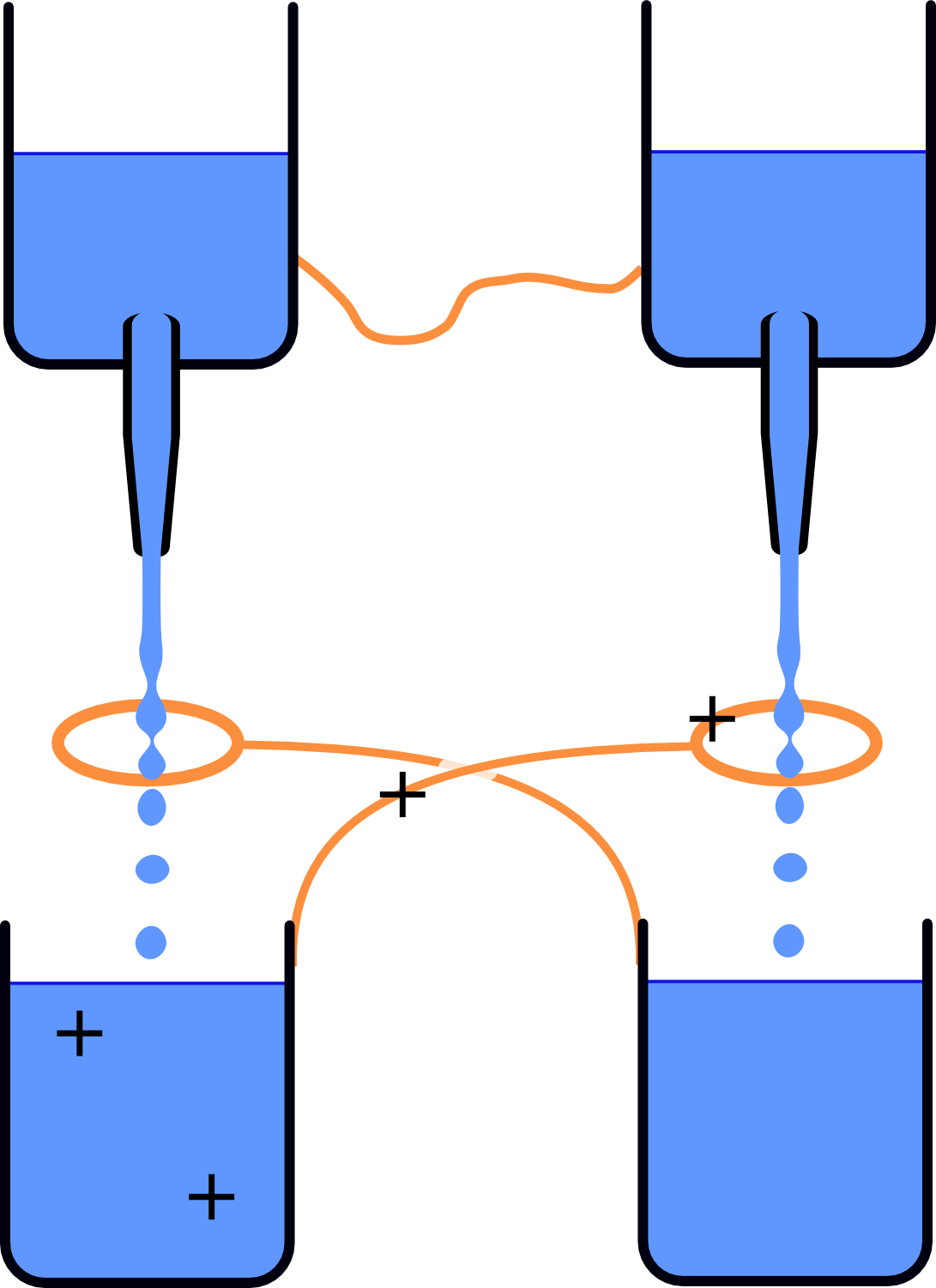
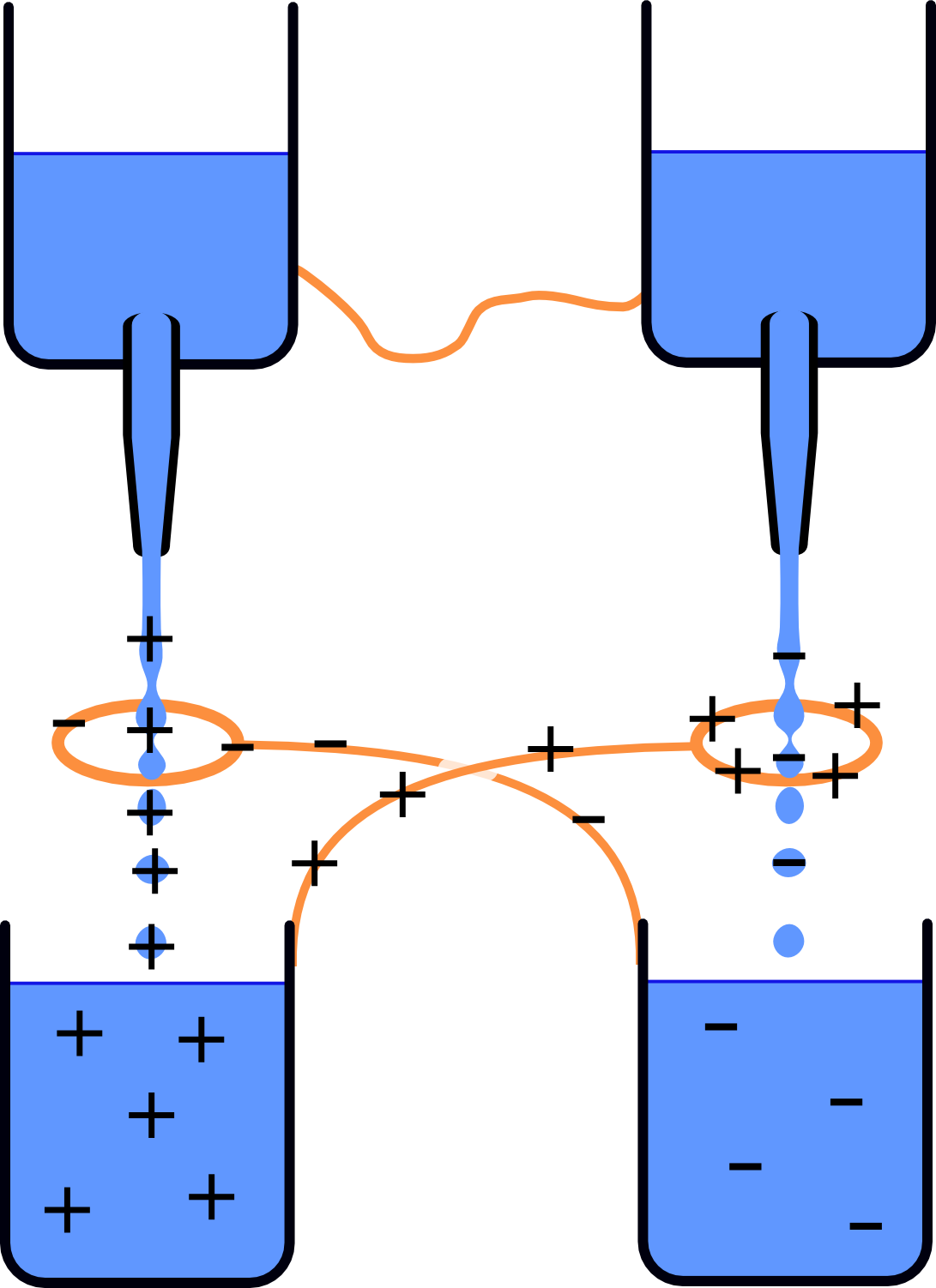
What you NeedHere we have 4 tins, the top to are connected to each other electrically, and the bottom two are insulated. There are two pipes coming from the top tins. There are two metal rings around the ends of the pipes and the right hand ring is attached to the left hand tin and vice versa. Watch what happens when the water is turned on. What is going on?As the water drips down one of the bottom tins becomes positive and the other negative with a voltage difference of probably over 1000v. This means that any small droplets are deflected by the electric fields and go on crazy paths.
Why does it charge up?This is the beautifully elegant bit. If one tin happens to randomly become slightly positive that means that the opposite ring will also become slightly positive.
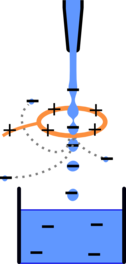
Electrons in the water are attracted by the positive ring, so the drops which are just forming in this ring become negative and then fall into the pot below.
This pot then becomes negative, and therefore the opposite ring also becomes negative. So the drops forming become positive. These fall into the left hand pot making it more positively charged.
This effect will keep getting stronger and stronger until the voltage builds up enough for charge to leak away in the air, or sparks form. The experiment will work just as well with couple of tin cans, some wire and some rubber tubing, as long as you get the electrical connections right.
What to doWhat may happenWhy does it happen?Related ContentCommentsYeah. And infact they are. Both are sitting (as far as I recall) on a sheet of aluminium which you might just be able to see looking at the set-up in the photo, forming the connection (the paint having been sanded off the bottom of the pots). You could equally use a single trough of water with two taps out of it. An extra wire ought to be drawn in... rosy, Tue, 22nd Sep 2009 You are of course right, I have now updated the diagrams daveshorts, Tue, 22nd Sep 2009 "Electrons in the water are attracted by the positive ring, so the drops which are just forming in this ring become negative and then fall into the pot below. " If the positive ring is attracting electrons from the water, shouldn't that leave the water drops with a positive charge? Or are we looking at ionization of the air within the ring (positive ions sucking electrons from the water)? Mick, Sat, 3rd Oct 2009 ...no that wouldn't work either -- dammit! Mick, Sat, 3rd Oct 2009 Scuse me, Is there a way to harness this 1000v energy? Josh, Mon, 26th Oct 2009 I want to know how we can measure the voltage in this equipment(Kelvin's water dropper) Samuel Moon, Wed, 28th Oct 2009 Shouldn't the top two containers be connected together too? Bored chemist, Thu, 5th Nov 2009 I think it is important to mention that the effect is due to Electrostatic Induction ( see http://en.wikipedia.org/wiki/Electrostatic_induction ). Calum, Thu, 3rd Dec 2009 Hello i was wondering why my Klevin Water dropper is not working. I have practically copied the model in the video except my drippers are 50ml glass burets (large pippets) and i have a wire attaching these together they then drip down through my inducers (coat hanger wire) to my collectors which are baked bean tins with an alumnium false bottom which i added due to the plastic lining on the inside of the cans also i have done the experiment in the souther hemisphere with aproxx 60% or less humidity and i dont know if its my flow rate thats the promblem or what also i checked for shorting with an am radio but there wrre none also i was aproxx getting 1.5 dropps per second thanks if any one has a solution please contact me on aj_wild@msn.com Adrian, Sun, 27th Jun 2010 |