Ingredients
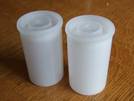 | film canister | 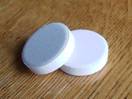 | A fizzy tablet or two |
 | a little water |
Instructions
First, if your tablets are large, snap one in half (so as not to waste too much).
Now, half-fill your canister with tap water.
Next, find an open space where it won't matter if things get wet.
Then as quickly as you can:
Drop the half-tablet into the water.
Seal the lid on tightly.
Place the cannister upside down on the floor.
Stand back! (At least 2-3m away is advisable).
Now wait (but note that it can take up to 2 minutes to go off).
BUT - DO NOT GO BACK TO THE FILM CANISTER WHEN IT IS CLOSED because the liquid can fly into your eyes, which is unpleasant.
Result
You should find that the film canister goes off with a satisfying pop and flies into the air, and even (as we often found) into your neighbour's garden!
| The film canister should launch with a satisfying mini explosion |
Explanation
The fizzy tablet contains bicarbonate of soda, mixed with a dried acid. This becomes acidic only when it dissolves in water, at which point it reacts with the bicarbonate of soda, releasing carbon dioxide (just like in the
Fire Extinguisher experiment).
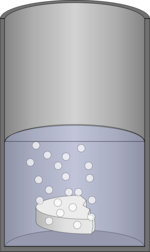 | 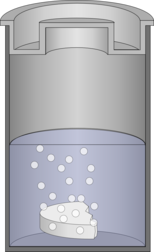 |
| The tablet reacts when it gets wet to form bubbles of carbon-dioxide. | If you put the lid on, the reaction continues, with nowhere for the gas to go. |
When this reaction takes place in an open glass of water, the carbon dioxide escapes slowly into the atmosphere, over a period of several minutes as the tablet dissolves, so there is no change in pressure.
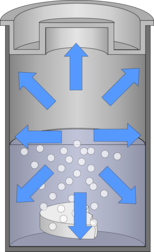 | 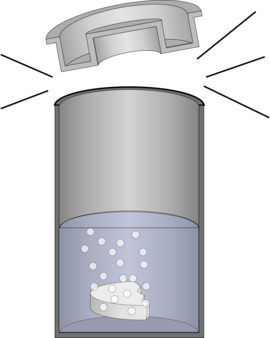 |
| As the gas builds up, so does the pressure. | Eventually something has to fail, and the lid is pushed off, releasing all the gas at once in a small pop, or explosion. |
But if the gas is prevented from leaving, by constraining it inside a container like the sealed film canister, the pressure will build up, storing energy. Eventually, the pressure becomes sufficiently high to force open the lid, and all of the gas - and the energy stored in it - is released at once with a "pop", launching the cannister into the air.
What has this got to do with real explosives?
Ordinary "low" explosives, like gunpowder and cordite (the smokeless propellant used in most guns), are just mixtures of two materials - an oxidant and a fuel - that react to produce large volumes of gas, a bit like more energetic versions of the fizzy tablet. If you set fire to them in the open, although they burn very quickly, there is no explosion.
If, on the other hand, you constrain them, they will produce gas until their container bursts, and you get a big bang. This is why, if you contain gunpowder in a card tube and set fire to it, there is a bang (a banger)
| The loose gunpowder burns fast but doesn't explode. But if it is confined, it goes off with a bang! |
This is the sort of behaviour that is desirable for the propellant in a gun: a substance which will produce lots of gas quickly, but not so quickly that it would damage the barrel. The resulting gas pushes the bullet out of the gun, and the bang you hear is the gas escaping, once the bullet leaves. This is where high explosives such as TNT or dynamite come in. They react in a different way. Unlike low explosives, where typically the oxidiser and fuel are chemically separate materials, in a high explosive they are very close together, often in the same molecule. Materials like this are designed to just burn like low explosives if you set fire to them, for safety reasons. However if you hit them hard enough, you can create a wave of compression, which moves through the material, triggering the reaction as it goes. This, in turn, produces large volumes of gas, which then makes the compression shockwave even stronger. This moves through the explosive at supersonic speeds, increasing in power as it goes. Consequently, when it leaves, it is immensely destructive. So high explosives can go bang without being confined. But what if you want to do lots of damage with an explosive?
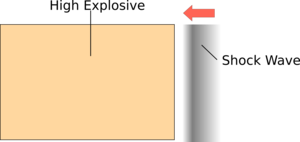
The shock wave approaches the explosive 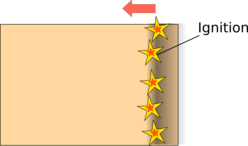
When the shock wave enters the explosive it triggers ignition of the explosive. 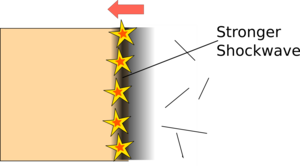
The energy from the explosive makes the shock wave stronger
- Previous Pepper's Ghost
- Next Melting Ice with Salt







Comments
Add a comment