Ingredients
3 identical jars
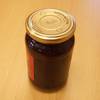 | One full of Jam |
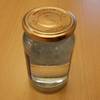 | One full of Water |
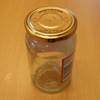 | One Empty |
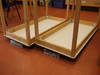 | A slope |
Instructions
Make a slope 1-2m long that drops about 2cm every metre.
Race the three jars against one another.
Be very careful to release them in a fair way, sorepeat the exeriment and swap over the jars in case you are being unfair.
In order to reduce the amount of jam on the floor, if your floor is hard you may wish to pad the bottom of the track with some jumpers or something to stop the jars gently.
Result
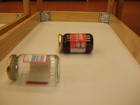 | If you race the jar full of jam and the empty jar, the full jar wins. |
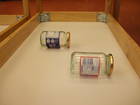 | Between the jar fill of water and the empty jar the water wins. |
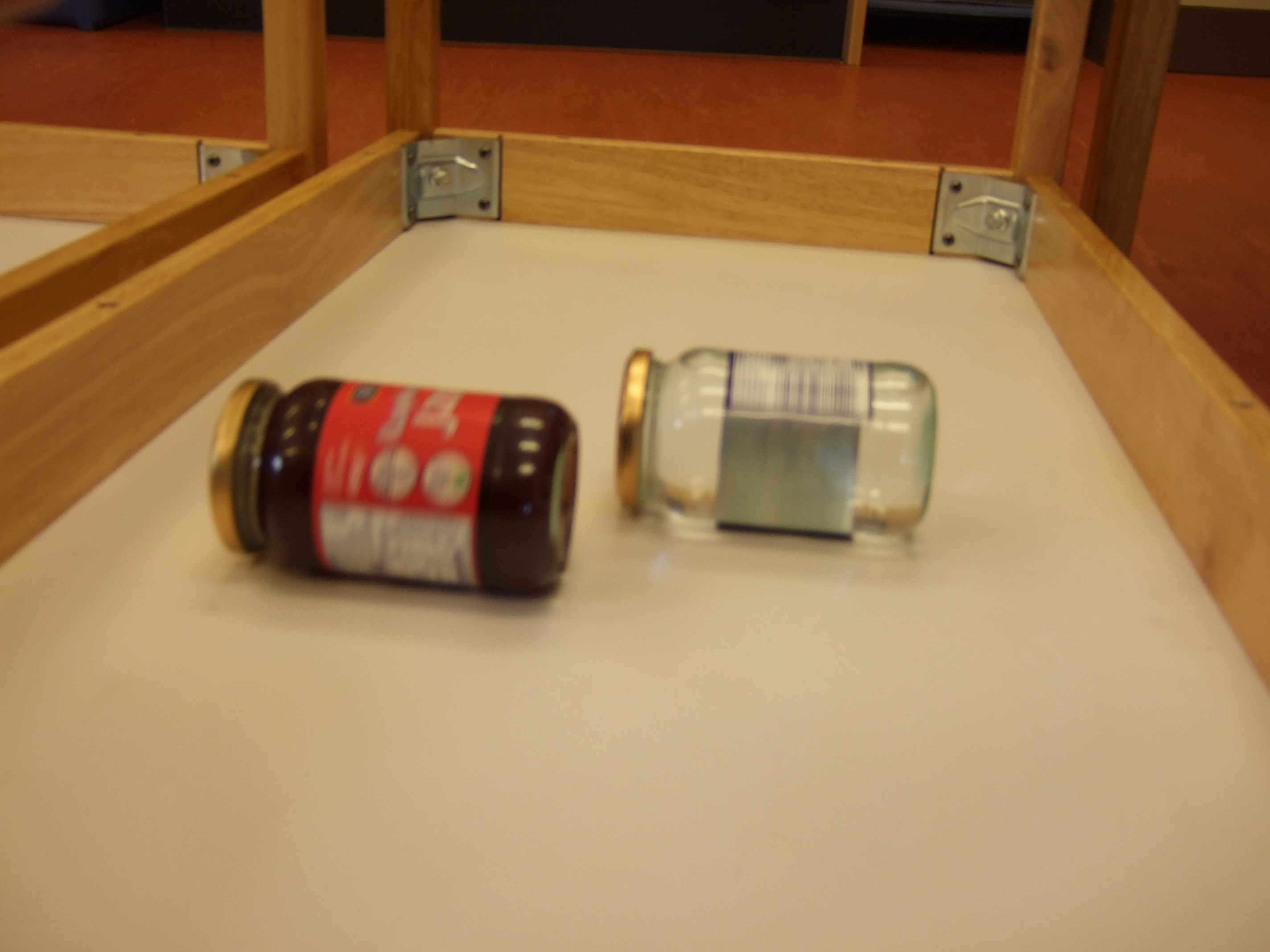 | If you race the jar full of water and the jar full of jam, you will probably find that the jar full of water is slightly faster. |
Explanation
We were all taught that things should fall under gravity at the same weight no matter how heavy they are, because the heavier something is the more force it needs to accellerate, but the more it is pulled towards the earth. So what is going on?
The jars are not just falling they are rolling and this is a different process. If you think about the centre of a jar as it rolls it goes in a straight line.
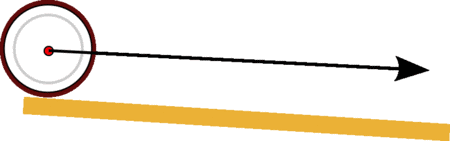
However if you draw a dot on the edge of the jar it will go on a much longer curved path.
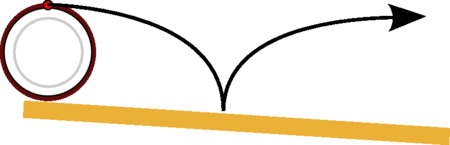
So to roll at the same speed a jar that has all its weight at the edge is moving faster than one with weight at the centre. It will take more kinetic energy for the jar with its weight at the edge to go at teh same speed as the jar with weight at the center. This kinetic energy can only come from the jar falling, so the jar has to fall further to go at the same speed, so it accelerates more slowly.
 | The empty jar has all the weight at the edge of the jar so it will accelerate very slowly. |
 | In the full jar the weight is spread out throughout the jar. So on average the weight is nearer the centre and the full jar will accellerate faster. |
 | The jar full of water is a bit different because the water is a liquid. This means that it doesn't have to rotate with the jar. So all the water isn't rotating and therefore behaving as if it is at the centre. So the water accelerates even faster. |
- Previous Water Fibre Optics
- Next Lemonade Volcano






Comments
Add a comment