Ingredients
First we got a nice log fire burning which kept on burning slowly for a couple of hours, we even got to cook some sausages on it later.
We then lit some twigs which burnt much more vigorously for just a couple of minutes. Paper burns even more quickly so that it is entirely burnt within ten seconds.
We then tried blowing some custard powder through a flame.
Do not do this at home as it is dangerous!
Result
This had even more spectacular results with all the custard powder burning in less than a second in a large fireball!
Explanation
Burning is just a chemical reaction of the fuel with oxygen. They can only react where the oxygen meets the fuel. So the more places this can happen at once the faster the fuel can burn.
&nb
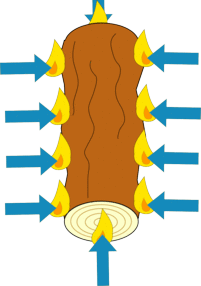 | 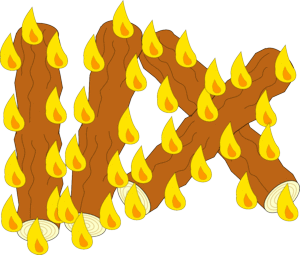 |
| The log can only burn at the surface where the oxygen in the air can get to the fuel, so it burns slowly. | The same amount of wood in smaller pieces will have a far larger area for the air to get to it, so will burn in more places at the same time so it will burn much more quickly. |
A large object like a log has a large amount of fuel inside it but quite a small amount of surface for it to react with oxygen and burn on. Every time you chop the log in half you create more surface for it to burn on so it will burn quicker, so small twigs have much more surface and will burn more vigorously. Paper has much more surface again so burns very quickly, but the custard powder has a ridiculous surface area. The particles are about a hundredth of a mm across so a gram of custard powder has a surface area of about 600 square metres. so it can burn almost everywhere at once incredibly quickly forming an impressive fireball.
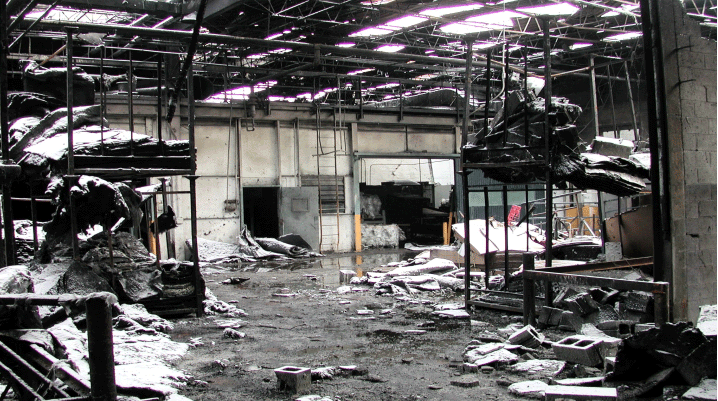 |
| The results of a dust Explosion in a factory in Kentucky © US Chemical Safety and Hazard Board |
This has caused many dangerous explosions in flour mills factories etc. when a flammable powder is mixed with air and then meets a source of ignition. Because people don't think of powders as explosive they often don't consider them as dangerous with explosive results.
- Previous Seeing the invisible
- Next Strange Glows from Sugar






Comments
Add a comment