|
||||||||||
Acoustic LevitationHere is an interesting effect I noticed a couple of years ago. I was actually attempting to smash a wineglass using sound. I was using a piece of paper to detect when the glass was nearing resonance, and accidentally discovered something altogether more fascinating, the paper started to levitate. What you needInstead of hitting a mechanical resonance in the glass with it moving back and forth, I hit a resonance in the air in the glass (a bit like when you blow across a bottle).
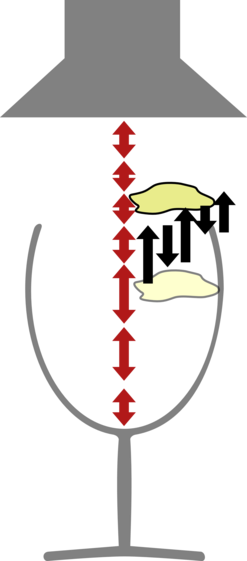
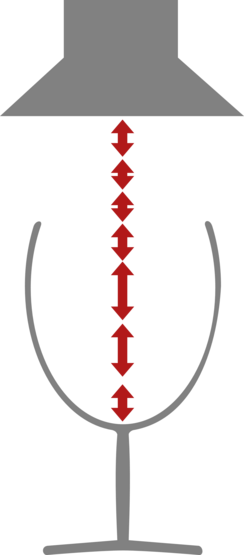
The brown tube is holding the speaker I was using. and as you can see the paper has taken to the air and has started levitating. This kept me fascinated for a good while, as I was wearing ear defenders (it is very very loud!), and I think I have worked out what is going on. The air inside the glass resonates - it moves in and pressure builds up, until the air rushes out again, overshoots and the pressure drops again causing the air to rush back in. The size of this vibration changes with position, it will be largest The levitation is due to the volume of the sound changing around the glass. It will be louder inside the glass than above it. The paper is moved with the air, so in the louder areas with more vibration it moves more than in the quieter areas. This means that if a vibration moves it from a loud area to a quiet area it is now in an area which is vibrating less so the return vibration will be smaller and at the end of the vibration cycle it will have moved. So over lots of vibrations it will have moved towards the quieter area, and if the sound is loud enough this effect is strong enough to counter gravity and will make the paper levitate.
. Written by Dave Ansell Interesting. I don't think that thinking of air rushing in and out of the glass is the answer though. The only air that will be moving in to and out of the glass will just be the air in the immediate vicinity of the mouth of the glass; I don't think there'll be any air-flow, as such, and the air movement will be more like that of A.C. current rather than D.C. current. Resonation is certainly playing some part though, whether it be the glass putting energy in to the air, and in turn, in to the piece of paper, or whether the air is resonating directly. The first thing that comes to my mind is that you're setting up standing waves in the air column within the glass that aren't perfectly tuned and so advance up the column. That's just a guess though. It would have been interesting to have had a small ball-bearing in the glass too - that would have given a good indication of the glass resonating but wouldn't react to the air resonating very much. - LeeE - 23rd Feb 09
I am not saying that there is any net air flow, just that something which is more dense than the air will feel a net force because it can move. Chaldni plates move sand around because the antinodes are moving more than the nodes, so a particle of sand will bounce a long way at an antinode but not move at a node, and so it will tend to move down the gradient of amplitude. Another explanation I have heard is that it is waves reflecting off the piece of paper, which I think may be equivalent. The glass was definitely not resonating, I managed to get glasses resonating nicely later, and that was a very different effect, and didn't make the paper float. - daveshorts - 24th Feb 09
This is just a demonstration of the fact that there is no such thing as 'suck'. It happens all the time with powerful loudspeakers. When the cone moves forwards, the air is actually pushed forwards by the cone. The air molecules are actually given momentum in a forward direction by impacts with the cone. When the cone moves backwards, air rushes in from a whole hemisphere due to the reduced pressure. This generates a net flow of air at right angles to the cone and in from the sides. You can see a candle flame 'pushed' outwards. The glass in the experiment behaves in just the same way. - lyner - 24th Feb 09
just look up Acoustic Levitation on Youtube - you'll find a lot more. this technique is already being used in silicon wafer manufacturing.
- opus - 24th Jun 09
See: http://www.youtube.com/watch?v=94KzmB2bI7s&feature=player_embedded
See the whole discussion | Make a comment- Dr. David Deak - 16th Dec 09
|
||||||||||
Information presented on this website is the opinion of the individual contributors and does not reflect the general views of the administrators, editors, moderators, sponsors, Cambridge University or the public at large. The contents of this site are © The Naked Scientists® 2000-2012. The Naked Scientists® and Naked Science® are registered trademarks.
|
||||||||||