This week on the Naked Scientists we seek solutions to your science questions.& From finding the site of the big bang to repairing the retina, mirages on the motorway to fruit fireworks in your microwave.& We also find out why staying in bed could help you keep slim, we explore the genes that let flies get drunk, and discover the source of the so-called "Oh My God! Particles", which have 100 million times more energy than in our biggest particle accelerators.& Also, we catch up with the latest in robotic cars and learn about the micro-microwave being used for analysis in the field.& Plus, in a live Kitchen Science, Dave finds out when is the best time to add milk, and still have the hottest tea.
In this episode
Eat, sleep and be skinny
Researchers have shown that, somewhat surprisingly, the key to preventing children from becoming overweight is a good nights sleep.
A growing body of evidence now links lack of sleep, increased appetite and weight gain amongst adults, but it wasn't clear whether the same applies to children as they grow up. A few studies have hinted at higher obesity rates amongst youngsters who take the least sleep, but it wasn't clear which effect came first, and whether being overweight just leads to poorer quality sleep.
 To find out Julie Lumeng and her colleagues at the University of Michigan enrolled nearly 800 nine year olds and followed them up for three years, to see whether their sleep patterns (reported by their mothers) were related to changes in weight as they grew up. The results were astonishing. The children getting less than nine hours shut-eye per night were much more likely to pile on the pounds over the next three years than their superiorly-slumbering counterparts. Even more striking was the finding that every extra hour of sleep the children took at the age of nine resulted in a 40% decrease in obesity risk by the age of twelve. And at age twelve each extra hour reduced the risk by 20%. The researchers cannot say for certain why extra sleep should keep kids in trim, but there are several explanations.
"Children who are better rested may have more energy to get more exercise," explains Lumeng. "It's also possible that when children are tired they may be more irritable or moody and use food to regulate their mood." It's likely that hormones also play a role.
Amongst adults, sleep deprivation has been linked to a reduction in levels of the appetite-suppressing hormone leptin, and increased production of the appetite-boosting hormone ghrelin. These changes translate into a stronger urge to eat, increased calorie intake and weight gain. So, paradoxically, kids might be able to justify missing the school bus in future on the grounds that they're battling the bulge...with a lie-in!

Panoramic Ultrasound Scanner
Researchers have built a panoramic ultrasound scanner to work from inside your body
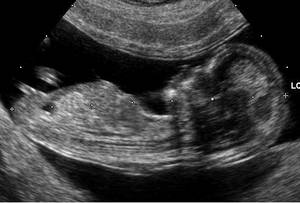 Ultrasound scanners are normally used from outside your body looking in, most famously for looking at unborn babies. They work by sending pulses of sound into you and then listening for reflections from structures in side your body. The shorter the wavelength of the ultrasound the better the resolution of the system so the better the images. But short wavelengths mean that the signal can't penetrate very far so images deeper into the body are not very detailed.
This problem has been avoided in the past by putting the sensor inside the body on a probe, sometimes down a blood vessel. The problem is that the sensors could only look in one direction so doctors got a very detailed but blinkered view.
Jing-Kuang Chen and colleagues from New Mexico University may have a solution. They have folded a tiny sensor into a 1mm across hexagonal box. So it can now look forwards and sideways in a total of 7 directions, which should give doctors a panoramic view from inside the patient.
Plants engineered to silence pests
Nobel prize-winning medical research has found an agricultural niche, as two teams of researchers have engineered crop plants to combat the troublesome pests that feed on them by switching off their genes.
 In 2006, Craig Mello and Andrew Fire won the Nobel Prize for Physiology and Medicine for their discovery of RNA interference, a process whereby specific, unwanted genes can be switched off. RNA is a template for genes. By inserting into the cell a short piece of RNA, called an interfering RNA, which is the mirror image of the section of RNA that codes for a particular gene, that section can be cancelled out or silenced. This prevents that specific gene from being made.
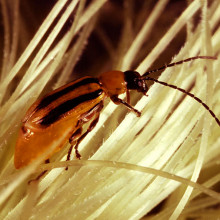
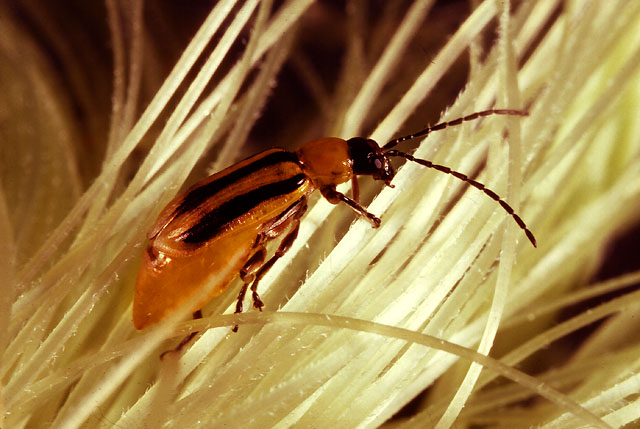
Now, researchers at Monsanto Company in Missouri, US, have turned plants against their pests using the same technology. Targeting the western corn rootworm - an insect that causes an estimated $1 billion worth of damage to corn crops every year - they inserted a short section of RNA that silenced a gene that the rootworm needs in order to grow.
A second team, based at the Shanghai Institute of Biological Sciences, China, used the same technology to target the cotton bollworm, a moth larva that causes huge damage to cotton plants. They silenced the gene that allows the bollworm to tolerate high levels of gossypol - a toxic polyphenol in cotton. Both insects have developed resistance to insecticides - this new approach allows the plants to hijack the pests' own cell biology and turn it against them.
Source of 'Oh-My-God' particles
Cosmic rays are very high energy atomic and subatomic particles that hit the earth from space. There are several which pass through you every second, but most of these are fairly low energy and come from the sun. Others come from outside the solar system and the more energy they have the rarer they are. Until about 10 years ago astronomers thought that there was a limit on the speed of these particles because they would get slowed down by hitting photons from the cosmic microwave background radiation.
Then astronomers detected what are sometimes known as "Oh-my-god!" particles in a couple of small cosmic ray experiments. One of these sub-atomic particles has a similar energy to a tennis ball travelling at 60mph despite being about 10 000 000 000 000 000 000 000 times lighter. This is about 100 million times more energy than the particles in our biggest particle accelerators.
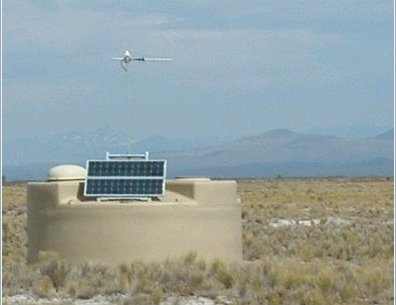 Scientists had no idea what was creating these particles until now, to find out they built the
Pierre Auger Observatory in Chilie, this is an array of detectors the size of Paris built high up in the Andies mountains. It consists of hundreds of tanks of very pure water which glows when a cosmic ray goes through it. They also look for similar ultra violet glows in the atmosphere above the detectors. A very high energy particle will hit the air and create a whole cascade of other particles which the detectors can see.
From these observations it would appear that many of these high energy particles are coming from directions with a very similar distribution to very large black holes at the centres of galaxies, but there is still very little data, so astronomers only know it is possible they are coming from the galactic nuclei let alone what is creating them.
12:12 - Drunken flies and the alcoholics’ genome
Drunken flies and the alcoholics’ genome
US Scientists have sequenced the catalogue of more than 30 genes that are influenced by exposure to alcohol.
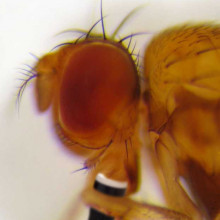
The study was carried out in drosphila, fruit flies - often used in genetic studies as their genome is very simple to model, and they share many of their genes with humans.
The researchers suggest that this could provide a starting point for genetic studies of alcohol, which could eventually identify with genetic predisposition to alcohol addiction.
To measure the effect of alcohol on the flies, the scientists, from North Carolina State University, first had to get them drunk in a piece of apparatus they termed an 'inebriometer'.
This is a tiny tube-shaped pub for flies. Along the inside of the vertical tube are small shelves that slant downwards. The flies cling to the shelves, while the tube is filled with alcohol fumes until the flies are drunk enough to fall off their perches.
This gives the researchers an organised stack of flies - lightweights at the bottom and the most hardened drinkers at the top.
The scientists then selected and bred the most booze-resilient and the most lightweight strains of flies, and compared their genomes to examine which genes were responsible for one fly's ability to drink (or at least absorb) its buddy to the bottom of the tube.
The team also found that flies could be genetically mutated to respond differently to alcohol by inserting additional copies of these genes.
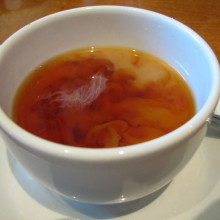
Why do biscuits go soggy quicker in milky tea?
Chris - Biscuit dunking duration was actually the subject of a proper scientific study in recent years. It was done by Len Fisher who is based at the University of Bristol. He published his findings in his book "How to dunk a biscuit"...
The reason, he says, the nation's favourite snack goes soft when you dunk it in anything is because biscuits are largely made of starch molecules (that's the flour), which are long chains of molecules. Between them are sugar crystals that stick them together along with some fat as well. When you put the biscuit in something hot like hot tea the heat melts the fat. Also the water soaks into the holes between the molecules and dissolves the sugar. This makes the whole structure become very weak and the biscuit falls apart.
Different biscuits with different physical properties and dimensions have different "dunking times" - in other words how long it takes before biscuit-meltdown occurs.
For Rich Tea the dunking time is about four seconds. Digestives last longer, they can tolerate up to ten seconds of dunk before they start to fall apart.
The only difference they found between the milky tea and non-milky tea was the flavour. They found that milky tea makes the biscuit flavour much more intense. The reason, probably, is because milk has got a lot of fat in it unless you're drinking liquid water (the white skimmed stuff). The fat intensifies the fat-soluble flavours in the biscuit, helps them to evaporate and go up your nose. You'll get more flavour and more retro-aroma, as it's called, from a biscuit dunked in milky tea than one dunked in black tea. The only possible exception I can think is that perhaps the fat in the milk is helping to liquefy the fat in the biscuit a little bit faster.
Another possibility is that it could be down to the surfactants in the milk. In order to keep the fat suspended, milk contains chemicals called surfactants. These behave a bit like washing-up liquid, which lifts fat off your washing-up by making oils dissolve. A consequence of surfactant action is that reduce the surface tension in the water so that could mean that the water can get into the biscuit quicker. If it's absorbed faster it will have more time to dissolve the sugar.
Therefore, the dunking time for a given biscuit in a cup of tea made with full-fat milk might be lower!
What is now in the position of the big bang?
Chris: That's just not possible!
Dave: As far as we know, when the Big Bang happened, everything was not only closer together but space was smaller. When we say the universe was really, really tiny - maybe less than the size of an atom - that means all the space is not just all the particles close together. Literally, all of space was smaller as well.
In some senses we are, at the moment, where the Big Bang happened, because this bit of space we're in now was at the Big Bang - space has just expanded hugely since.
Why do we have wisdom teeth?
Victoria: Yes, as far as I understand it, that's the case. Our ancestors needed wisdom teeth. They are, as many people will know through suffering, teeth that come through much later (between the ages of 18 and 25). That's why they're called wisdom teeth. You're older and wiser when you get them. Allegedly. Our ancestors, when they used to eat raw meat and grub around and eat lots of roughage would grind down their existing teeth. They had to use very powerful jaws and chew a lot more. They then had a spare set of teeth that came in later on.Chris: I've only got one and it hasn't even come through. I went to the dentists about five years ago and he said let's do an x-ray and see where your wisdom teeth are and there was one wisdom tooth. I asked him why he thought I only had one as most faces are set up symmetrically. There must be some kind of developmental thing - the cells that make that tooth didn't turn up in that bit of my jaw.
How much energy does the earth produce per peson?
Chris: The Geo4 paper came out this month and this is a big, multi-national report where scientists get together from every country in the world. They look at the raw data and work out where the Earth's going and how it's 'powering' itself. Their current calculations show that the current environmental demand, or how much land it takes to power each person on Earth, is about 22ha of land surface per person. How much can the Earth sustainably supply in the long-term? The Earth can only support humans sustainably on 15.7ha of land per person. We're already using the land space, per person, of two Earths just in terms of land space. If you look at fishing the amount of exploitation of the oceans is thought to be 250% of sustainable levels of fishing in the long-term. Victoria: That really puts into perspective how much extra land we're going to need for biofuels as well. Chris: The other point they make is that in about forty years time they think the Third World will need land space equivalent to the entire of South Africa for producing enough food just to support the extra people that the planet is sustaining by then.
Could the retina be repaired using stem cell research?
Chris: In the last twelve months we've seen evidence that perhaps it can. The stumbling block at the moment is that perhaps we don't have the stem cells necessarily, ethically, to do it. Scientists in University College London published a paper in the journal Nature about this time last year. They took mice which had been genetically programmed develop a disease like the human disease, macular degeneration, and they took stem cells from the retina of newborn mice. They implanted these stem cells into the eyes of the mice that had macular degeneration. They were able to show that the mice got back their ability to see. By following where the stem cells went in the eyes they found that they migrated to the right part of the retina and turned back into photo-receptors. These cells take the light and turn it into information that the brain can understand.
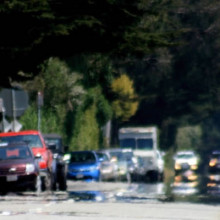
Why do roads look reflective?
Dave: This is called a mirage. On a hot day, the air above the road gets hotter than the air above. When air gets hot it expands and becomes less dense. The less dense the air is, the faster light goes through it. So light is going slower high up than it is close to the road. This means that light refracts as is comes down from the bright sky; this bends it upwards and into your eye. So you end up seeing is an image of the sky in front of you. This makes the road look reflective and appear to shimmer, almost like there is a sheet of water on the surface - but that is the blue light of the sky, not water!
Chris: When you have toast cooking in your toaster and you look at the air above it, it's also all twisty and shimmery...
Dave: It's the same phenomenon. You get hot air in swirly patterns above the toaster that bends the light which produces a distorted image behind.
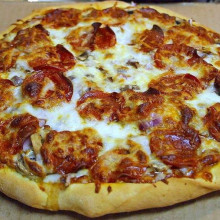
How dangerous is uncooked pizza?
Chris: You should always make sure things are fully-cooked.
The reason for doing that is that bacteria may have settled on the food when it was being prepared. They may have been there only at very low levels when the food was being prepared, but if it hasn't been stored very well, those bacteria can persist and multiply.
Bacteria can easily survive the temperatures in your freezer. Bacteria can survive being frozen down to -200 degrees.
And if you don't warm food sufficiently thoroughly to kill the bacteria, you get some bits of the food which are warm enough to sustain a much better environment for the bacteria so they grow really fast.
When they grow very fast they can either infect you, like salmonella, or they can produce toxins into the food like Staphylococcus aureus. This produces a toxin which can cause diarrhoea and vomiting. That toxin is also heat stable, so even if you thoroughly re-heat the food, unfortunately you can still get problems because the toxin is still in the food.
The moral is to make sure you cook things absolutely thoroughly!
30:55 - Robot Cars - the DARPA Urban Challenge
Robot Cars - the DARPA Urban Challenge
with Chris Vallance
Chris - Now it's time to take a look at the world of technology. This month Chris Vallance is going to introduce us to the DARPA Urban Challenge. This is a competition where people develop cars that can drive themselves around town. The Final took place on November 3rd. The competing vehicles had to compete on a sixty mile journey, obeying all the rules of the road and avoiding other drivers. This didn't happen on public roads because there were one or two accidents. They used an urban military training facility that was in California. It was a big success and the reason they're trying to do this is to develop driverless vehicles that can be used in war zones. There are likely to be some other big spin-offs for the average driver like you and me.
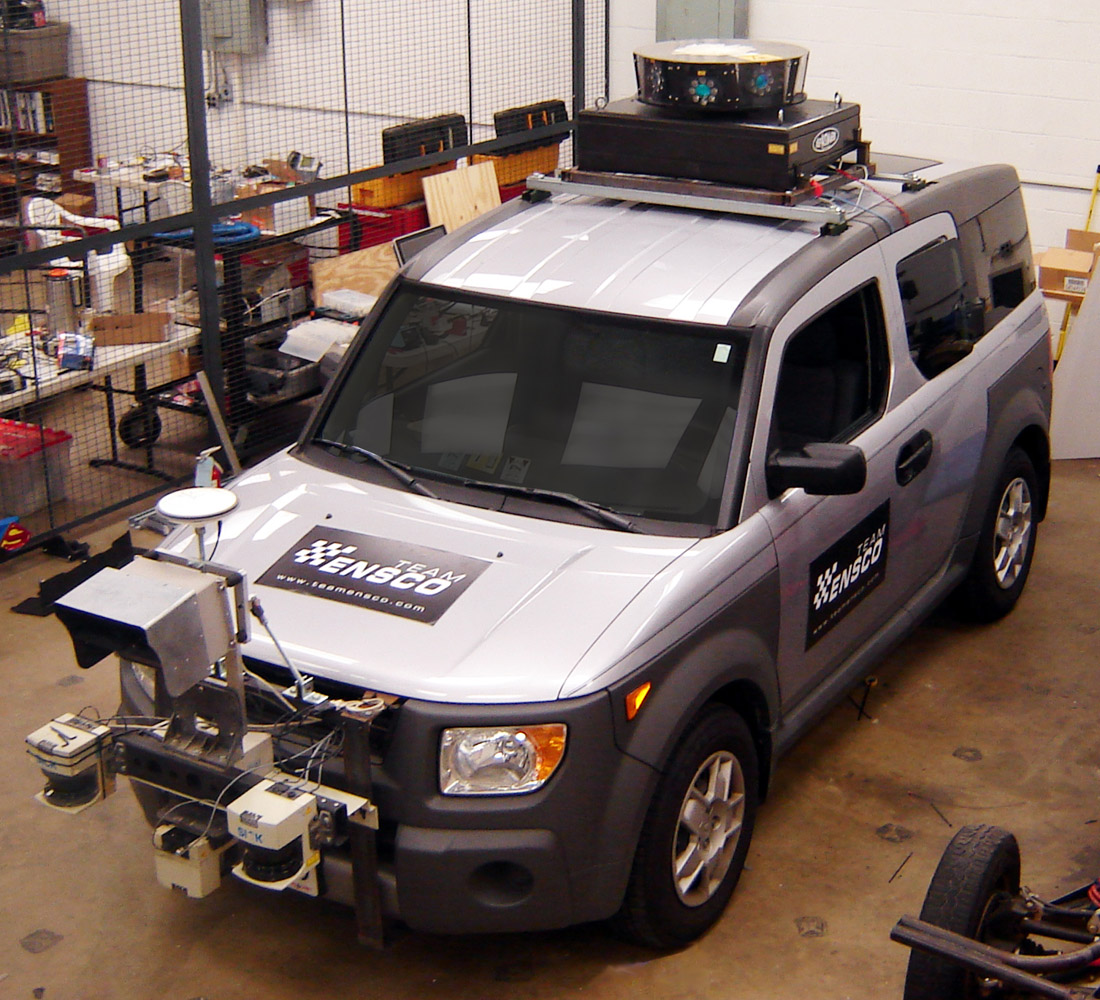 Chris Vallance - I'm obsessed with robot cars. It was the DARPA Urban Challenge. The reason I like this is that I saw the first challenge that DARPA did. DARPA is the Defence Advanced Research Project Agency. It's, if you like, the 'brains trust' of the US military. It's their geek squad. They ponied up two million dollars to see if someone could produce a robot car to drive around a simulation of an urban environment on its own. These aren't remote controlled cars. These are cars with computers on and laser scanners so they can see what is ahead of them. They intelligently drive themselves from point A to point B.
Chris - Have they had much success Chris?
Chris Vallance - Yes, it was won by a Chevvy Taho by the name of Boss produced by a team from Carnegie Mellon University in Pittsburgh. It's quite a technological feat. I remember back in 2005 they first tried this trick with what's called the DARPA Grand Challenge. That was out in the Mohave Desert. There was absolutely nothing for miles around. There were dozens of teams trying to compete and driving round the kind of desert terrain, that I think if you or I were driving, we'd come a cropper in 5-10 minutes. These cars actually drove successfully around that track.
Chris - So what are the challenges that the people who are doing these challenges are going to overcome? It doesn't sound like rocket science to make a car follow a pre-programmed route.
Chris Vallance - It's not pre-programmed. They have GPS way points. They know roughly where they've got to go but there's not a pre-programmed route. They've got to navigate obstacles for themselves. If the first DARPA challenge that was just navigating rocks and bits of rough road - not driving off cliffs or hitting bridges. In the latest challenge, the Urban Challenge, they had to navigate around other vehicles. They had to stay in the right lane in the road and deal with an urban environment.
Chris - That's a whole new ballgame. Sounds like a recipe for disaster. Were there any spectacular wipe-outs?
Chris Vallance - Well, there was a spectacular wipe-out. One of the really interesting vehicles from the Defence Agency's point of view was a vehicle called Terramax. It's a big, big truck that tried to drive into a disused shop. The cars do get a bit confused. It's not a perfect science by any means and it is quite a difficult computational and object-detection problem that these teams have to face. If you look at these vehicles they are absolutely covered in scanners. They have these things called lidars, laser detection systems and radars. They have all kinds of detections systems to help them figure out what's the road and what isn't. If you think about an environment where there are lots of drivers about that becomes really, really crucial.
Chris - How do we think that this information that goes into making these cars able to do this on their own could be translated to making my life, getting to work in Cambridge, through a horrible rush hour a lot easier?
Chris Vallance - Well, funnily enough the DARPA are primarily interested in the military implications of this stuff. If you think about the casualties in places like Iraq there are people in convoys hit by improvised explosive devices and there's actually a mandate from congress for a certain number of US military vehicles to be robotic by a certain date. In terms of the kind of cars that your or I drive, they are very keen to have this technology work its way into regular vehicles. This is Chris Earnson from the winning team of Carnegie Mellon University talking about how he sees some of this tech eventually working its way into the regular vehicles that you or I might drive.
Chris Earnson - We're hoping that you'd get to a point where the car that you're driving won't crash. You could always drive it if you want to but if there's something going wrong it might help you and prevent the collision. In the morning when you're commuting to work you wouldn't have to be behind the wheel. You could be having a nap or checking your email or on the phone and doing that safely. You'd be trusting the vehicle to get you where you're going.
Chris - He's talking about avoiding crashes, Chris. What about getting into tight parking spaces because we have a nightmare time when someone's parked and they've left a just slightly bigger space than my car. I'm not brave enough to go into those spaces sometimes. It technology able to help?
Chris Vallance - I think that's one of the things that we'll see this technology help with in parking assist. There was a Japanese motor show very recently where we had all kinds of vehicles that could park themselves. That's definitely one of the priorities, parking. Who wants a ding on your car when you're trying to get into a tight space?
Chris - Who indeed and we've heard from Paula in Lowestoft. She says, "cars using sat-nav these days often get lost. Just look at that lorry that got jammed in a country lane for three days recently. Will we end up with robot cars driving around getting lost everywhere?" Probably, is the answer to that one.
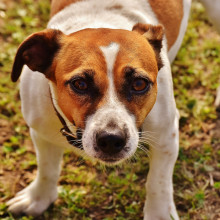
Why do dogs' eyes shine in car headlights?
Chris: If you look at the back of the eye in animals that go out at night (nocturnal animals) or animals that are likely to be hunted at night they have this structure called a tapidum lucidum which is Latin for bright carpet. If you dissect a sheep's eyeball you'll see this surface that looks like mother of pearl. The back of the eyeball is highly reflective like a mirror.
The reason for having this is that if you're under low light conditions, light comes into the eye, the retina sticks out into the jelly-like stuff in the back of the eye but any light that misses it will be soaked up by the back of the eyeball. By having the back of the eye a bit reflective then any light that missed the retina the first time can be bounced back onto the retina and you have a second chance of seeing it. The payoff is that you can see in low light. The downside is that the light gets altered in its path very slightly so the acuity, how well you can see, is lower with this structure. Dogs, cats, sheep, cows and horses all have it. If you shine a torch at a dog in the dark its eyes look like they're glowing (a bit like Tony Blair on those posters that you saw about ten years ago). It's nothing to do with the pupil being open wider or smaller, although because it's dark, the pupil will be open wider.
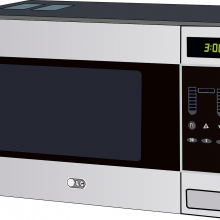
Why does it take longer to cook two things in a microwave?
Because air is a good insulator the thing that limits how fast a normal oven can heat something up is basically how fast the energy is transferred from the hot air to your food. The oven is powerful enough to keep the air hot, so adding another cake will not slow it down much. A microwave on the other hand is very efficient at transferring energy from the magnetron (the thing which produces the microwaves) to the food. So the thing that limits the amount of energy getting to your food every second is basically how much energy you are converting to microwaves. If you have twice as much food the same amount of energy will be transferred every second but it will be shared out over twice as much food, so it will heat up slower.
In terms of microwaves killing bacteria, if you don't heat food to the right extent there's a danger of getting hotspots and colds spots. That's why there's a turntable in a microwave. Without a hot enough area in the food any bugs could persist so you could end up getting food poisoning. Microwaves are just radio waves and the reason they make food cook is that it absorbs the energy of the microwave, the molecules vibrate and this raises the temperature. They're not doing anything special or zapping bugs by gamma irradiation or blasting DNA. They're just heating them up. If you don't make the food hot enough then you're not going to kill anything. It's all down to heat and nothing else.
Why do you get sparks in a microwave?
Dave: The microwaves are a form of electromagnetic wave. When they hit something they try and make an electric current flow in it. If you've got two things with a gap in between them it can produce a big current. You get a large current running across this gap or through a tiny piece of skin in between. It'll get hotter and hotter until eventually it burns out. At this point you have a big electric current trying to get between these two lumps of fruit which can jump through the air and create a spark. That will take the current and you'll get a fireworks display.
42:11 - Micro-microwaves and Mini-Fuel Cells
Micro-microwaves and Mini-Fuel Cells
with Mark Peplow, Chemistry World
Chris - Time now to catch up, as we do once a month, with Mark Peplow. He's from Chemistry World. We were talking about microwaves just now and you're talking about a microwave oven which is absolutely excruciatingly tiny?
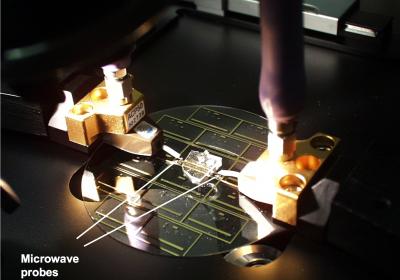 Mark - That's right, last week an American Scientist was claiming it's the world's smallest microwave oven. It's shorter than an ant and half as wide as a single human hair. It's a tiny thread of an oven. You could fit a pin head's worth of liquid in it. About a millionth of a litre.
Chris - People say ready meals are making the population too fat. Maybe we should just give them one of those microwaves because they'd get a microcalorie. What's the point of this?
Mark - Yeah, you wouldn't get much of your evening dinner in this. Essentially this is to create a device where you could heat small amounts of material very easily and very quickly. A good example is if you were doing forensic work out in the field and you wanted to analyse some DNA. One of the ways that people do that is to use a reaction called the polymerase chain reaction. That involves heating and cooling. It actually amplifies your DNA sample so that you can do a test on it. If you imagine a handheld device, it needs a very small heating facility within it. What these guys are proposing is that they can use this microwave oven, tiny as it is, to do this sort of analysis.
Chris - How does it actually work?
Mark - Essentially it's very much like the microwave oven in principle. You have a small cavity hollowed out of a polymer block where your sample goes in and small channels to deliver that liquid into the cavity. You have a very fine tracery of gold wires etched into the polymer block. It's the electrical current moving through those in a particular way that delivers the microwaves.
Chris - Sounds amazing but sticking with the very small, fuel cells are hot topic at the moment.
Mark - Yes, fuel cells are a way of turning chemical energy in a gas like hydrogen into an electrical current. Researchers in Oxford, led by Fraser Armstrong, have created a microscopic fuel cell. They've taken a graphite particle - graphite is the stuff in your pencil - and they've stuck an enzyme on it that converts hydrogen into an electrical current. They've proved that this is working by sticking another enzyme on the other end of the graphite particle which does another reaction. They're saying this is a proof of principle that you can take these sorts of fuel cells, which are already being used in cars and lighthouses, and use them to run chemical reactions in these microscopic test tubes that chemists are working on. So called, 'labs on a chip.'
Chris - Application-wise, you would think people are quite eager to have ways of powering tiny robotic things that you could put inside bodies or do very, very technical things on tiny scales. Energy sources like this must be very important for them.
Mark - That's right. Conventional batteries have proved incredibly difficult to miniaturise in that sense. Conventional battery technology just ends up making very bulky battery packs. Fuel cells are an alternative way you can really shrink things down. You can have a tiny volume of gas that serves as an energy source like hydrogen and this would be the converter to give you a constant current.
Moonlight Photosynthesis?
We put this question to Howard Griffiths, at the department of Plant Sciences, Cambridge University.
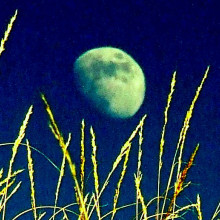
When I was first thrown this question about the role of moonlight in photosynthesis, my initial response was not a chance! Because the light intensity that we get reflected off the moon is an order of 100-1000 times too little to support photosynthesis in most terrestrial pot plants and plants we have in our garden.
However, I did a little bit of digging around and I looked at some latest analysis of photosynthesis rates in algae. Amazingly enough, it does seem that some groups of very small phytoplankton might be able to photosynthesise using the light from the moon, provided that it was in the tropics and provided that it wasn't being attenuated by a water column, which tends to absorb light exponentially.
So the answer is still "probably no" because, obviously phytoplankton grow in a water column so they're not really likely to be able to pick up the light intensity.
However, it also opens up a number of intriguing questions because plants do certainly try to avoid the light from the moon. I'm sure many of you are familiar with the folding of leaves that we see in the clover growing in your lawns and lots of plants in the garden fold up their leaves at night. Darwin was interested in this and thought that it was to do with the leaves trying to maintain their heat balance at night.
What we think is happening now is that the leaves are trying to avoid moonlight so as to prevent their circadian rhythms being disrupted by those varying light intensities, because they certainly do respond to moonlight. In fact, it's now known that lots of animals - animals as diverse as snakes and crocodiles - and a whole array of plants and different systems including humans - are highly sensitive to moonlight and the way that it can interrupt our circadian control and our sensing of day length.
What’s the correlation between cold weather and catching a cold?
Victoria: Yes it does because the ambient temperature makes it easier or less easy for your body to control the internal temperature. You have to use a certain amount of energy to keep your body at the right temperature and keep yourself healthy. It's more to do with how many bugs are around. Bug such as the cold virus and the flu virus are extremely infectious and airborne. In the cold weather you have vulnerable people whose systems can't get enough energy to maintain their core temperature and they're having to keep themselves warm. They get bugs, the bugs are transmitted and then everyone comes down with it. Dave: There's also an effect that in the Winter everyone's cramped together inside whereas in the summer they're spread out. If few of the viruses are getting from one person to the next, they're not going to spread as quickly. Chris: The other big determinant that science has shown is really important to the spread of infections is the school year. Lots of people go away on holiday and then they come back and congregate in this thing called a school which is really a viral mixing pot where everyone exchanges viruses, takes them homes to their parents and brothers and sisters who then take them to their schools. School terms are really important in determining who gets what.
Why are bubbles round?
Dave: That's because a bubble is made up of a very thin layer of water which has soap molecules on the outside and that has surface tension. It's trying to minimise its area and get as small as possible. The best shape with the smallest surface for a certain volume of air inside is a sphere, so they're round.
Why are squashed insects so hard to clean off?
Victoria: I have no idea - I should have deferred to Mark Peplow on that one!
- Previous The South Africa Space Special
- Next Human Origins and Migration





Comments
Add a comment