Join us in a peek at the secret lives of birds. We find out just how a cuckoo convinces others to care for it's young, and the tragic outcome for the cuckoo chick when the rouse is discovered. We meet the clever corvids, capable of problem solving feats that may even outfox the great apes. Also, how green tea makes strong bones,the genes involved in prostate cancer and online robotic surgeons. Plus, in Kitchen Science we find out how Dave Ansell spent his schooldays - making stationery fly!
In this episode
Green tea help bones grow
If you are a tea addict - like Helen - and you fancy a health boost in your daily cuppa, than you could do a lot worse than reach for a swig of green tea, apparently one of the world's most popular drinks.
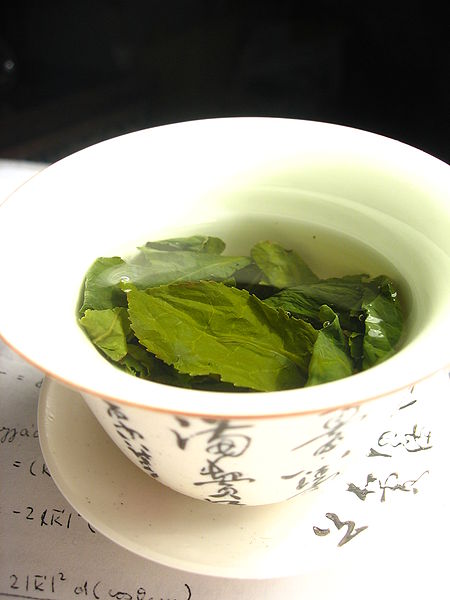 Along side all the other potential health benefits it comes with - it is allegedly good for our hearts, it has anti-cancer properties - it now seems that compounds found in green tea are good for bones too.
Ping Chung Leung and colleagues from the Chinese University of Hong Kong have been looking at the affects on bone cells of a trio of compounds called catechins that are found naturally in green tea.
By exposing cultures of bone-forming cells from rats - called osteoblasts - to these green tea compounds, the researchers found that both the rate of bone growth and bone strengthening was significantly increased within a few days.
Some of this bone boosting affect comes down to the activity of a key enzyme that promotes bone growth. One particular green tea compound called Epi- gallo-catechin (EGC), led to an increase in this enzyme's activity by 79%. It also increased levels of bone mineralization in these cells: a vital part of strengthening bones.
EGC also suppressed the activity of cells called osteoclast cells that weaken and break down old bone, part of the natural process of bone remodelling.These studies were conducted on rat bone cells, so further research is need to see if the same affect will hold true for human bone cells.
What's more, the study, appearing in the journal of Agriculture and Food Chemistry, doesn't mention how the doses of catechins used relate to the amounts found in a cup of green tea. It is also not clear whether it would have any affect on your bones when the liquid has passed through your digestive system.
Nevertheless, earlier studies have hinted at the real benefits of drinking tea, for example it's been shows that postmenopausal women who are regular tea drinkers tend to also have denser bones.
And this study certainly points towards a potential new approach to treating bone conditions like osteoporosis if the activity of those catechin compounds can be harnessed. And it just goes to show, that sipping a daily cup of green tea, is not just tasty and refreshing, but it may well be doing us some good too.
New prostate cancer genes found
Scientists at the Institute of Cancer Research and the University of Cambridge, funded by Cancer Research UK, have made another important addition to our knowledge about the genes involved in prostate cancer. They've discovered nine new gene variations that can increase the risk of the disease by around three-fold, published in two papers in the journal Nature Genetics today (Sunday 20th September). And, excitingly, some of the new genes could be potential targets for future cancer drugs.
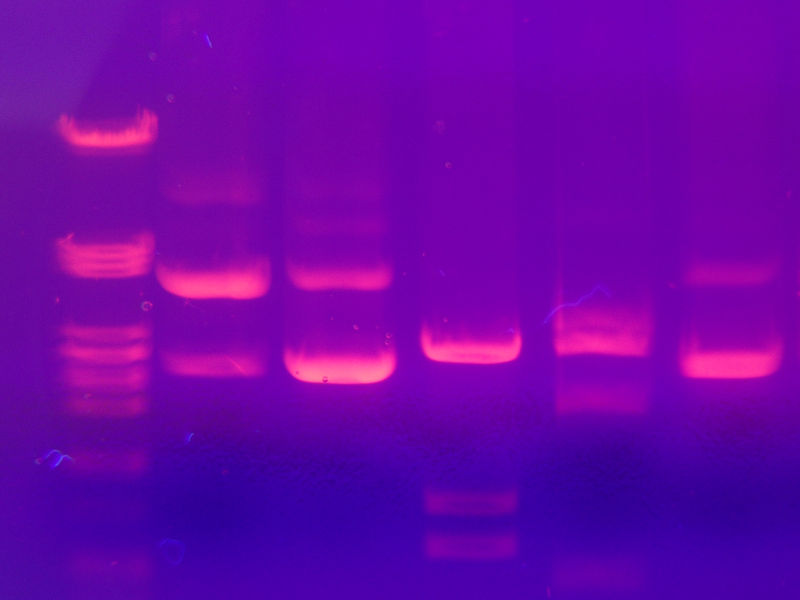 This is yet another example of a genome-wide association study involving an international team of scientists. Researchers scan through the DNA of thousands of people using the latest genomics technology. They're searching for tiny differences in the DNA sequence between people with cancer, and people without the disease. Eventually, the scientists narrow the search down to a few small regions, and can pinpoint the genetic variations that might increase the risk of the disease.
In total, in the first study, the researchers looked at DNA from almost 38,000 men, trawling through over 43,000 SNPs, or single nucleotide polymorphisms. These are tiny variations in our DNA. They discovered seven regions of DNA that are linked to prostate cancer risk - and two of them are in genes that could be promising targets for treatment.
In the second study, the scientists focused in on a region on human chromosome 8, which has previously been linked to prostate cancer risk. Their detailed investigation revealed two new variations involved in the disease. Altogether, we now know of more than 20 regions of the genomes that are linked to prostate cancer risk.
These are subtle variations in our DNA that influence risk, but don't determine that someone definitely will - or won't - get cancer. Our genes are like a hand of cards - most of us get a mix of good and bad cards (risky or non-risky gene variations) and it depends how we play our genetic "cards" through our lifestyle that affect our cancer risk.
More research needs to be done, but this new genetic information could help doctors to tell who is at most risk of prostate cancer, and offer surveillance or screening, or help to tell if a cancer is likely to be aggressive. And it provides important new clues for the development of future treatments for the disease.
Biofuels could spell bad news for the oceans
Debate ranges on over how to solve the problem of global emissions of carbon dioxide from burning fossil fuels. A new study has shown that if we're not careful, growing crops to turn into biofuels could spell disaster in the sea by worsening so-called 'marine dead zones' where wildlife is wiped out by depleted oxygen levels.
 When fertilisers are applied to agriculture land - including onto biofuel crops - much of it washes into coastal waters where it triggers blooms of algae. The algae eventually die and sink to the sea floor where bacteria break them down, using up oxygen in the process.
Because of this, every year, a huge and growing area of sea become anoxic and unable to support life. In 2008, the dead zone in the northern Gulf of Mexico was more than 27,000 km2 - that's over half the size of England.
Christine Costello and W. Michael Griffin and colleagues from Carnegie Mellon University and the University of Pittsburgh in the US, have developed a computer model of the Gulf of Mexico to predict what is likely to happen if more biofuels are planted - something that the US federal government are pushing for in at attempt to tackle climate change. The target is for 36 billion gallons of biofuels to be produced each year by 2022.
To meet this biofuel target, no matter what crops are planted - even grasses that need less fertiliser- it will lead to a massive increase in the amount of nitrates reaching the Gulf of Mexico and a worsening of the dead zone.Biofuels will no doubt remain a popular option for reducing our carbon dioxide production, but this study emphasizes the need to consider all the consequences that might have on the environment.
The authors point out various options for reducing the impacts of nutrient runoff from agricultural land, including planting strips of vegetation along riverbanks - so-called Vegetative Buffer Strips - as well as constructing areas of wetland and the very precise application of fertilisers.
If crop-based biofuels hold any hope as the sustainable green solution of the future, these are the sorts of things that need to be promoted.

The robot doctors are coming!
Robot surgery research is definitely taking off - for example, surgeons can do keyhole surgery on patients even if they're in a different country. Now new technology is improving compatibility between robot systems, allowing doctors to use the internet to operate surgical robots all over the world.
 Scientists have developed a new piece of software called the "Interoperable Telesurgical Protocol", which is designed to standardise the way that robotic surgeons are operated over the internet. To test it out, nine research teams from around the world used it to operate a robot surgeon. The scientists were in different locations in the US, Europe and Asia.
Over 24 hours, each group connected over the Internet and controlled robots at different locations, testing how different robot and controller designs can be operated through one system. This is very important, because it means that researchers who may use slightly different robots and systems can all work together.
The researchers hope that future developments in robot surgery will use the new protocol, to enhance compatibility with researchers around the world. Unfortunately, it's not much help if the internet goes down...
14:18 - Dealing with parasites
Dealing with parasites
with Rebecca Kilner, Department of Zoology, Cambridge
 Helen - It's time to turn our ears to behavioural ecology. How do animals interact with their environment to improve their lot? Well, it seems that cuckoos across the world have found ways of exploiting the nests of the other birds, but not all hosts are so easily exploited. To tell us more about which birds know best, we have Rebecca Kilner from Cambridge University with us today in the studio. Hi, Rebecca.
Rebecca - Hello.
Helen - Thanks for being with us. Well cuckoos, they are crazy creatures really, but first of all, where do they live? Where do we find cuckoos living? Where in the world?
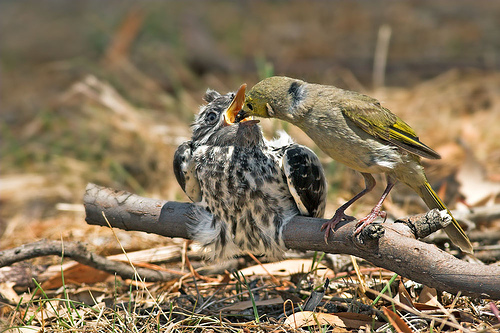
Rebecca - Well cuckoos are a member of a sort of super family of birds and there are about 140 species of them all together. But it's really only sixty of the species that are well-known and they're well-known for their habit of stealing child care from other species. So what they do is they lay their eggs in the nests belonging to another bird and they leave their poor victim with the hard job of bringing up their baby and those brood parasitic birds, as we call them, are scattered throughout the world, so we can find individuals representing this family on every continent.
Helen - And they exploit the nests of all sorts of other birds as well. I take it there are lots of poor birds out there who are having to look after things that really are nothing to do with them at all, not their babies at all.
Rebecca - That's, right. Yes, so individuals from all of the songbird family really, can be found being exploited by cuckoos all over the world.
Helen - It is a crazy thing to see. We sort of get pictures and footage on the television of a tiny songbird rearing this enormous cuckoo. Sometimes the size difference is almost comical, isn't it? It looks ridiculous. How did cuckoos go about being able to get away with this? How do they do this?
Rebecca - Well obviously, the story starts when the cuckoo adds her egg to the host nest and she does this very, very secretively. We know best probably about the European cuckoo or the common Cuckoo which exploits song birds in Britain and what we know is that she's incredibly secretive. It's very, very hard for even bird watchers to see cuckoos. It's certainly very hard for the host birds, the potential victims of the cuckoo to see this malevolent stealer of child care. So, what they do is they lurk around potential host victim nests and then when the timing is right, once the host has started laying her eggs, they very quickly glide down to the host nest in the afternoon. And they will add a single egg of their own to the clutch, having first removed one of the host's own eggs and they do all this in 10 seconds. They quickly fly away again. So there's very little chance that the host bird will spot them at the nest.
Helen - They only take one of the other eggs out. They leave the other ones there and sort of hide their one egg between all the other ones that were there.
Rebecca - Yes, that's right. So, they might possibly take two eggs but they never take every other egg from the nest and the reason they don't take all the other eggs is because it's been shown by experiment that if you reduce the clutch to a single egg then the host will simply give up on the nest because it's not longer profitable. So it's in the cuckoo's interest to leave as many host eggs in the nest as possible but she takes out one presumably because it's more - the incubation of the clutch is more efficient if there aren't too many eggs in the nest. So by taking one out and adding her own, she keeps the clutch size, the number of eggs in the nest is constant.
Helen - Okay and so, the c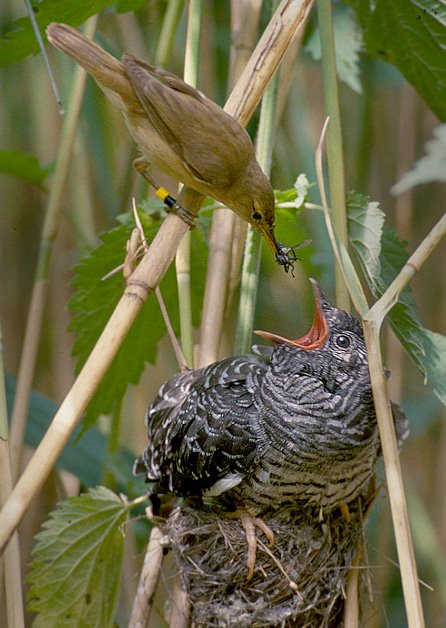 uckoo's got her egg into this other nest. What happens next? So presumably if it works then the host mother doesn't realise and father don't realise that they've got an impostor and what happens next?
Rebecca - Well, you hit on a very important point there. So it's possible that the host will realize they have an impostor egg in the nest.
Helen - Right.
Rebecca - So, for example, in the reed warblers which nest at Wicken Fen near Cambridge, roughly 20% of cuckoo eggs that are laid in the host nest are spotted by the host owner, the nest owner, as foreign and they throw them out. So more for than not, the cuckoo gets away with it.
Helen - And then presumably, they eventually will hatch, what happens then?
Rebecca - Yes, so the cuckoo egg is incubated along with all the other eggs in the host nest. But the cuckoo egg will hatch, possibly one or two days earlier than the host's own young and then at this point, the cuckoo egg sets about - the cuckoo chick rather, sets about instinctively killing off all the members of the host clutch.
Helen - I've seen that on TV in a documentary and that's extraordinary that it knows as well to, as soon as it hatches, get rid of all the other eggs around me.
Rebecca - Yeah, that's right.
Helen - It's amazing.
Rebecca - It's an extraordinary behaviour and it's an instinctive behaviour. So, it will - basically, in response to any sort of pressure on the small of its back, the cuckoo chick will walk backwards up beside to the nest and try tip that whatever is pushing on its back over the edge to destroy it.
Helen - So you've just got a nest with a single cuckoo left in it.
Rebecca - That's right. So, the common cuckoo within say, 48 hours of hatching, the cuckoo chick has destroyed the host's own offspring and it is by itself in the nest.
Helen - And then the - by that stage, the mother and father of, what they thought was their own child - their offspring, do they then just keep on feeding it as if it was their were own offspring? Do they actually have any way of figuring out, "Hang on, this isn't what I expected to see coming out."
Rebecca - Well, it's quite remarkable with the reed warblers at Wicken Fen will carry on feeding the cuckoo chick and they feed the cuckoo chick at roughly the same rate as they would provision a brood of their own chicks.
Helen - And that is extraordinary. But are there other species that have figured out ways or evolved ways really, isn't it, of defending themselves against cuckoos? Presumably, there must be quite a strong pressure to not allow a cuckoo to come in to your nest because by that - because you've really lost a whole breeding opportunity.
Rebecca - Yes.
Helen - So how have they evolved ways of getting around that?
Rebecca - Well, so there are several different lines of defence the host can mount to defeat the cuckoo who's trying to steal the child care. The first line of defence is that the host can mob the adult cuckoo as she lurks near the nest, preparing to lay her egg.
Helen - So she just screams and sort of tries to get them to...
Rebecca - Yeah, in much the same way as birds would mob a predator, for example, potential predator, they mob a cuckoo.
Helen - But they have to have seen them in the first place to be able to do that so they can be able to do that.
Rebecca - That's right, yes. So that's the first line of defence. Now obviously, cuckoos, we know that they can breach that line of defence because we know that cuckoos get their eggs into the nest. So the second line of defence that hosts can mount is to spot the foreign looking egg in their nest and so this in turn has driven the evolution of cuckoos that can lay mimetic eggs because they're much more likely to escape that line of defence...
Helen - So it means they look very similar to the eggs of the host.
Rebecca - That's right. They very closely resemble the host's own eggs. It's almost impossible to tell them apart. It's extraordinarily masked.
Helen - So it is one species of cuckoo only go and parasitise one of the species of bird or can they do different eggs? Do they have different tricks?
Rebecca - Well, the single species of the common cuckoo has split into genetically distinct host races and each host race can specialize on a different host species and they're recognizable by the fact that they lay different eggs appropriate to each host species.
Helen - That's amazing. That really is. So they can recognize. Some species can recognize the eggs and presumably, some can recognize; "This isn't my chick. This is not what I was expecting to see." Can they?
Rebecca - Well extraordinarily, it seems that the hosts of the common cuckoo can't do that. So, we think this might be because their first two lines of defence are relatively robust. They are especially good at recognizing foreign chicks, foreign eggs added to the nest. And so, because they've got this very secure initial lines of defence, they seemingly have no lines of defence at the chick stage. So if the cuckoo makes it to that point then it's home and dry, the cuckoo chick will be fed.
Helen - So they almost say, you know, we should be good at being able to figure this out early on and we're not going to worry about, by the time eggs have hatched then we expect it to be our own birds. That's always the case.
Rebecca - Yes, there's another constraint on the reed warblers as well which is that their breeding season is very short and so, even if they were to give up at that point, it's very unlikely that they would be able to get another brood produced that season.
Helen - It really is just fantastic stuff. One final question just for now. Do birds that get parasitized, that get tricked, duped by these cuckoos, do they do it over and over again or do they learn a lesson and next time, you know they were even more careful to not let the cuckoos come in near their nest or do you see reed warblers that every season, every attempt at breeding, a cuckoo comes along and takes away all of their efforts to continue their own species?
Rebecca - Well I can't speak for reed warblers but I've studied a host species in Australia and I've seen one poor victim bird, be struck three times in a row by a cuckoo.
Helen - Bad luck, isn't it?
Rebecca - Very bad luck indeed, yes.
Later in the show, we put some more questions to our guest:
Helen - Is it just cuckoos that do this?
Rebecca - No, you're quite right. It's not just confined to the birds and that's because universally across the animal kingdom providing child care is costly. So, that means it's a tremendous incentive for individuals to steal childcare from other individuals and we know that that happens in fish, for example. There's a cat fish that steals parental care from fish that brood their eggs and fry in their mouth. So, it takes care to get its host to swallow its fertilized egg and then the cat fish develops within the mouth of the host fish and eats all the other eggs and fry in there and grows spikes so that the host doesn't swallow it and then finally, it is spat out when it's completed development.
Helen - Great! That's amazing!
Rebecca - There are also some equally horrible insects that steal parental care from ant colony. Say for example, the cuckoo butterfly, so named because it induces ants to pick up its caterpillar and carry it back to their colony where they treat it like a giant member of their own colony and they carefully nurture it between 11 months and 2 years until it's grown large enough to pupate and then it becomes the adult butterfly. So yes, it's widespread in the animal kingdom.
Helen - And just a really quick one, we were talking earlier about the various strategies that animals have to recognize when they're being parasitised by a cuckoo. But what happens when a bird kind of looks at their chick and goes "Hang on a sec, you're not mine." When birds do actually recognize that they've got a cuckoo, what happens?
Rebecca - Yes, there are some - we didn't talk about this early but there are some host species that are confined to Australia, as far as we know at the moment, who can recognize the cuckoo chick in the nest. And what happens here is that, recognition typically takes place four days after hatching and the bird simply stop feeding the chick in the nest, even though it's alive and well and healthy and begging for food. Something happens that makes them realize it's not their own and they give up on the chick and they take the nest apart even thought the chick is still sitting in there and still alive and they build a fresh nest next door and eventually, the cuckoo chick starves to death and the meat ants move in and dismember the corps and carry it back to their own nest.
Helen - Absolutely brutal! And it - just rounding up this whole idea of cuckoos and what they do, it does seem quite extraordinary and that you go to such an effort to have babies and you think looking after them is very important and to trust that to another animal seems really quite bizarre, doesn't really make so much sense. You're obviously putting a lot of trust in the host animal to look after your babies well, aren't you?
Rebecca - Yes, that's right. You're leaving them with the responsibility of bringing them up but at the same time you're avoiding all the costs that they incur in rearing children. So, it makes sense that these parasites have evolved.
Helen - Excellent, well thanks so much Rebecca
23:31 - The Darwin Centre
The Darwin Centre
with Paul Bowers & Gavin Broad, Natural History Museum; Anna-Maria Indrio from CF Møller Architects
Kat - It's time to join Meera Senthilingam at the new Darwin Centre which opened at the Natural History Museum in London this week. It's an 8-storey cocoon that costs 78 million pounds to build and will not only house the museum's insect and plant collections but also aims to give visitors insight into the working life of a scientist. So Meera went along to find out just how the centre plans on getting us excited about science...
Meera - This week, I'm at the newly opened Darwin Centre at the Natural History Museum in London. Now, its structure is quite incredible because it's a giant white cocoon sitting inside a large glass box next to the museum's famous Waterhouse building. I'm inside this cocoon now and with me is Paul Bowers, the Public Offer Project Director here at the Natural History Museum. So Paul, tell me what the Darwin Centre is all about...
Paul - T he Darwin Centre Phase 2 is the culmination of our, sort of, 10 to 15-year project of bringing science out into the public domain. The new building creates world-class storage facilities for our collections - that's 17 million insects and 3 million flowering plants. It creates research facilities for the 200 or so scientists that work on those in the Darwin Centre and for me, the most exciting part is to throw the doors open and make that all of that accessible to our public. We have a journey around our spectacular cocoon where visitors will be able to see through windows, interact with interactive exhibits and talk to some of our scientists who are preparing specimens. And then on the ground floor, we have the Attenborough Studio where we will be running a daily program of nature live events where the public and scientists can meet together and engage in dialogue about cutting edge research.
Meera - Now you mentioned that it's all housed in a big cocoon and we're inside this cocoon now and it really is, you are just completely immersed with the science taking place here.
Paul - Well the cocoon is a quite remarkable structure. I mean it is symbolic for us of the scale and importance of our collections, but it's fulfilling a really functional job as well. The collections need to be held in a dark controlled environment and the cocoon does that. The cocoon is thermally insulating the collection spaces. The other aspect that we can do in a cocoon is create all of these windows over laboratories, over microscopy areas and our specimen storage areas. So the cocoon enables us to give people that sort of level of insight into the work that we do here.
Meera - How is this benefiting scientists to be able to do their work with people looking at them? Because there's someone behind us now, through that window, and I could just see them there working with samples.
Paul - For us scientists, what's really great is the research facilities. Having those research facilities created in such a way that they can discuss things with the public as they go through, is just a really exciting part.
Meera - And what about members of the public? How does that help them, to have these windows in to the life of a scientist?
Paul - It's very unexpected. Most people don't realize that we have this many scientists working at the Natural History Museum. The other side of it is, science is a massive part of our lives. So many issues of current importance in terms of climate change or biodiversity loss are really important issues facing all humans and we need to know more and understand more so that we can make good decisions about our future as individuals and through any political process. So, it's really important for the museum to be able to show off how it's done and give people an insight to that scientific process.
Meera - So you mentioned that visitors can just speak to the scientist as they're working with their specimens. How does that actually happen?
Paul - Part of the challenge for us is balancing up the different priorities of the building. We have to keep the specimens behind glass because they are at risk from being eaten by museum beetles, but we want to make sure that these conversations can take place. So what we've done is we've created an area, a little bit like a post office counter where there are microphones and speakers and there are our curators, working, preparing specimens that's working with big Victorian plant presses, pinning insects and preparing microscope slides. The public can simply use the microphone and ask the scientists what they're up to, why are they are doing it, why it's important and so on.
Meera - So one of the features of the Darwin Centre is to be able to talk to the scientists as they're doing their work. So, I'm just looking through on the windows now and I can see Gavin Broad. Now Gavin, what do you do here at the museum?
Gavin - I'm a curator in the entomology department. So I look after part of the collection of insects, particularly the parasitic wasps.
Meera - And now, I'm actually disturbing you a bit at work now because you've got your microscope and various specimens in front of you. What are do you doing here?
Gavin - I'm looking at some South-American in wasps that have been collected recently in particularly Ecuador, Peru, and I'm labelling them up and trying to identify them as best as I can. 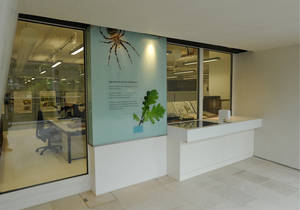
Meera - Now the glass here is actually quite big and so, does it disturb you at all to know that visitors are looking at you or to be seen doing your work?
Gavin - Well, it's not actually as distracting as I thought it would be because it's quite a dark view outside. People just sort of walk past and you don't really notice them. But it's a really positive thing, I think, to be able to explain what we do and our department has about 20 million specimens in it, specimens of pinned insects, and we can sort of show what goes into each of these specimens and we want people to appreciate that we're not just about dinosaurs and that we do a lot of research into the natural world.
Meera - I must admit. That was fun spying on scientist Gavin Broad doing his work and then also, being able to satisfy my curiosity about just what he was actually doing. Now, what else is going on around here?
...
Now, having fully wandered around this cocoon and gone deeper and deeper into the depths, I have to admit I'm in awe. So to find out more about what went into the design of what is now the tallest curved structure in Europe, I'm here with Anna Maria Indrio, one of the architects of CF Møller, the architects behind this design. Now Anna Maria, looking around, this design seems like it would've been quite a challenge.
Anna Maria - Well, it was a big challenge because in the competition, we were expecting to do an extension to a museum, a kind of exhibition building, but we discovered that the extension was made essentially of three elements: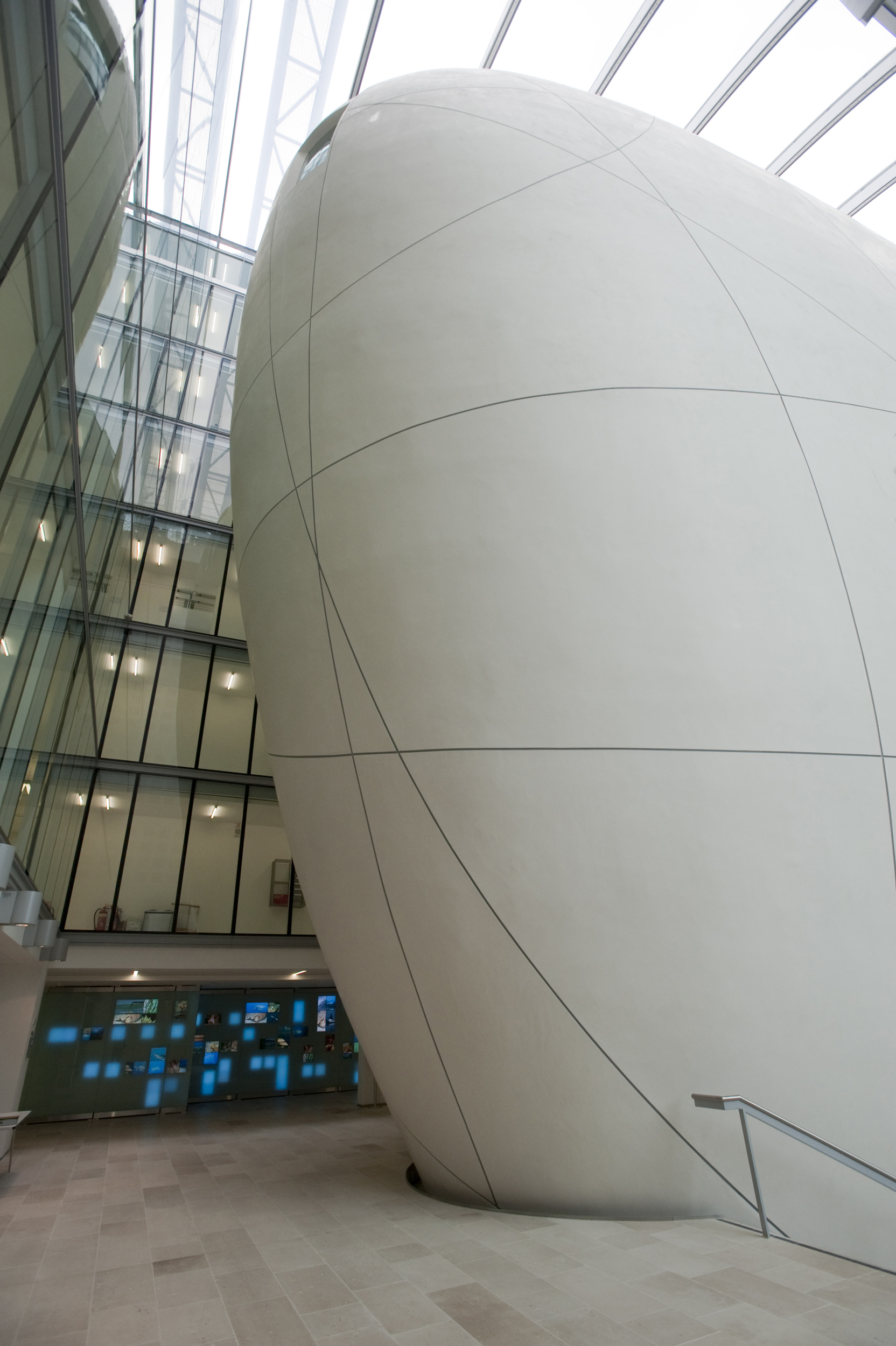 an archive which was enormous big, a scientist's working space and the public offer.
Meera - How did you go about facing those challenges and coming up with this design?
Anna Maria - Well, we discovered that the items we were going to exhibit was very small. They were plants and insects. So, how to communicate to the people the huge size and the importance of this collection? So the idea of the cocoon like a treasure containing this precious collection was coming out of this.
Meera - What do you think the main feature and best part of the design of this building is?
Anna Maria - The transformation of history, because this is an old historic building which is very much introvert and built as an introvert building to a modern new extrovert building connecting outside, inside and history and space, that for me is so nice for people.
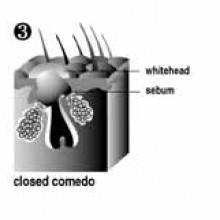
How does skin scrub help against spots?
Now, there are some people I know who'd argue that it doesn't really and you're best of actually not cleaning your skin too much because it sort of messes up the balance of it. But I should think that skin scrub helps to get rid of dead skin and the surface grease and yuck and the things that block your pores that cause spots. But then some people might argue that it actually dries your skin out too fast and takes all the natural oils off it. So, it's meant to help that way but whether it really does is for discussion.
Does black tea affect bone remodelling?
The fundamental difference between green and black tea is that black tea is actually fermented. So, it's probably got some different chemicals in there almost certainly, different things going on. So, that remains a bit of a question mark, but maybe that's something they might look at in the future and I think there are good things about drinking black tea as well.
Why does lemon make green tea go colourless?
There are probably two reasons for this: The first is that lemon juice is acidic; so it will lower the pH of your tea and, in turn, add hydrogen to some of the coloured chemicals that are in your tea; this makes them change colour because it can alter the way the electrons are distributed around the coloured molecules and, in turn, altering the way they interact with light. This is how indicator paper works when it changes colour in the presence of different acids or bases.
Secondly, in many places we have a lot of limestone dissolved in water as calcium bicarbonate; this can form insoluble precipitates (particles) when mixed with tea, and this can make your tea cloudy. But, if you put in an acid, it will react with the calcium bicarbonate, so it remains clear.
32:52 - Clever Corvids
Clever Corvids
with Chris Bird, Department of Zoology, Cambridge
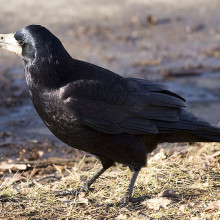
Chris Bird - We've been looking into the tool use of rooks. Now, rooks are a member of the corvid family, the crow family, and the crow family has been known to be really intelligent, and probably the most intelligent of the birds. They have a really large brain-to-body size ratio. They are capable of doing some quite remarkable things with objects, using them as tools to solve particular problems.
Meera - So knowing about this intelligence to do with rooks, you've been doing some interesting experiments with them to find out just how smart they are?
Chris Bird - Yeah, precisely. We've basically been giving them tool use experiments 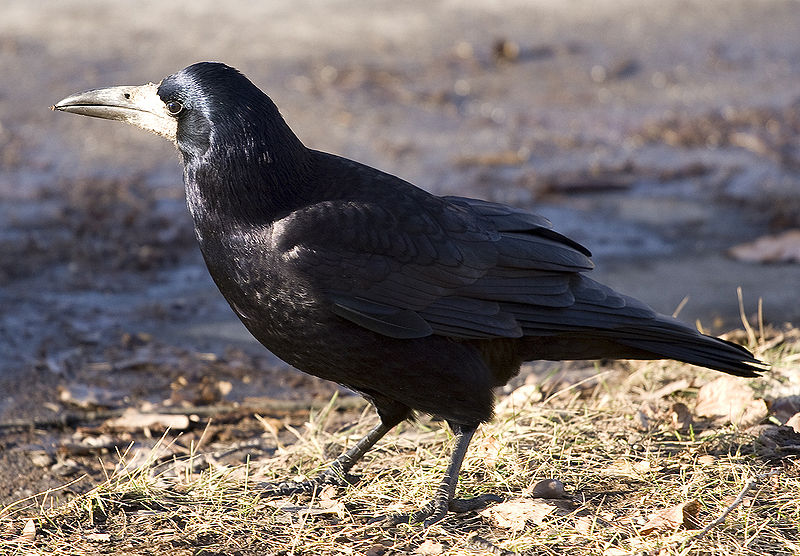 where they have to solve a problem that they've never seen before. When we're giving them these problems, we're looking at whether they're able to solve them using an understanding of how the problem works and an understanding of how the tool works. When we're looking at their solutions, we're looking at what they do on the very first trial. So not whether they're solving it through trial and error but whether they're solving it through insight into the problem. Basically, what we've found is that they're capable of showing these insightful solutions to novel problems using tools.
Meera - How have you actually gone about experimenting this?
Chris Bird - We've basically given them a variety of tests. In the first set of tests, we gave them an apparatus which had a platform on which a wax worm, their favourite food was suspended and the birds couldn't reach that. But they could collapse a platform by dropping a stone down the tube and they would select the right size and shape of stone depending on the diameter of the tube. So they were really conscious of the properties of the tool they were using. They also were able to solve that problem by using sticks. So they would use a stick to collapse a platform, they'd also modify the stick to make it able to fit into the tube and they were also capable of meta-tool use which is sequential tool use, using one tool to get another tool. We gave them a second set of experiments where they had a clear Perspex tube about 15 cm tall with a small cardboard bucket in the bottom. In that bucket was a couple of their favourite worms again and we wanted to see whether they were capable of using a hook-like tool to extract the bucket and get at the worms. That's something which New Caledonian crows have been shown to do in the wild. They've been shown to use hook tools and even to manufacture hook tools in order to pull out grubs from holes in the trees. So we gave the rooks these experiments and found that they were just as capable of using a hook tool to extract the bucket. Not only that, but when you gave them a straight piece of wire, they would put the wire into a tube and make their own hook then flip that hook around and use the hook to pull the bucket out of the tube which is really quite remarkable.
Meera - Now, you've shown me videos of them doing this and it is actually quite impressive because you can almost see them have this moment's thought to just think, "Okay, which is the right choice?" And get their worm. Now as well as all of these, you've also been doing some experiments to see if one of Aesop's fables is true.
Chris Bird - Yeah. That's right. Aesop had his fable called "The Crow and the Pitcher" which is basically about a thirsty crow that couldn't find anything to drink apart from the small bit of water in the bottom of the pitcher jug and the bird couldn't reach that water. So, it went off and got some stones and put those into the jug to raise the water level up until it could reach it. Now, we wanted to see whether that was something which was within the possibilities of what the rooks could achieve. There was a report in the early 1980s about rooks in an aviary, using a plug to form a pool of water and they would put in the plug during dry periods so a pool of water formed and they could drink and bathe in it. So, putting that together with the fact that they are capable of using tools, we thought, "Well maybe they're capable of solving Aesop's task." So we gave them a problem that was analogous to Aesop's fable. We gave them again a clear Perspex tube with a little bit of water in the bottom and a worm floating on the surface of the water, which they couldn't reach directly. And we gave them a bunch of stones next to the tube and we found that straight away, they would put the stones into the tube and raise the water level up until they could reach the worm.
Meera - Now what I found particularly interesting about this story though was not only did they put the stone in the water to raise the level, but they actually also knew just how many stones they should put in.
Chris Bird - That's, right. So they would add a number of stones before trying to reach the worm which did suggest that they understood that they needed to raise the water level by a particular amount and they didn't just try and reach the worm after adding each stone. So, that really showed that they understood how the problem worked and the solution that they were trying to achieve.
Meera - And so, what has it actually taught you overall about their level of intelligence?
Chris Bird - It really emphasizes to us that these birds are remarkably intelligent. They have really high levels of physical intelligence and that their intelligence is really quite general. What I mean by that is that they haven't just evolved a specific ability for a specific ecological problem. So they haven't evolved tool use specifically for problems in their environment but their intelligence is general enough and flexible enough for them to be able to transfer what they have learned in other contexts to new contexts like using tools.
Meera - So how does this translate to rooks in the wild?
Chris Bird - So we used captive hand-reared birds because we need to know exactly what their previous experience is. When we're giving them these problems, we know it's the first time they've seen these problems and when they're solving them, we know that they're solving them through insight rather than trial and error learning. When you see corvids using tools in the wild, the New Caledonian crows are the most habitual tool users, they're using tools because they need to. In New Caledonia, they don't have access to many types of food, apart from the grubs in holes and trees. So that makes up a lot of their diet. Rooks on the other hand have access to all sorts of other food supplies. They eat lots of seed from agriculture. They eat roadkill, they're carrion birds like lots of the other corvids and they forage on human rubbish. All of those foods are sort of the easy access foods for them and they don't actually need to use tools to get to them. So, rooks don't use tools in the wild not because they can't, but rather because they don't need to. And that really emphasizes Aesop's moral to the thirsty crow which was that necessity is the mother of invention and rooks only really solve the problems using tools when they actually need to.
Meera - Now, one thing this has all being compared to is the intelligence of great apes. So, how are you looking into corvid intelligence alongside ape intelligence?
Chris Bird - Well basically, lots of the experiments that we've done with the corvids, researchers have also tried with the great apes, we're finding that the corvids actually perform much better than the great apes like the chimpanzees. So they're showing intelligence that rivals those great apes which is remarkable, considering they have such a smaller brain. The size of the brain of the corvid is about the size of a walnut and they don't have an area of the brain which is typically thought to be the intelligent part of the primate brain called the neocortex. So people for a long time thought, "Well, how can they be doing such intelligent things?" Birds actually have a different part of the brain called the nidopallium which probably evolved from the same area as the neocortex evolved from and the birds are using that area to do a similar thing as the primates use the neocortex for. Now, the two areas have a really different structure. So, it's interesting to see that convergently, they've evolved intelligence using a radically different brain structure.
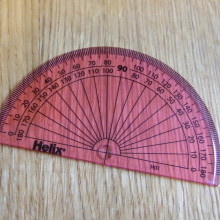
Flying Protractors - the power of ground effect
Make stationery glide serenely across a tabletop and find out how it relates to some of the largest aircraft ever built.
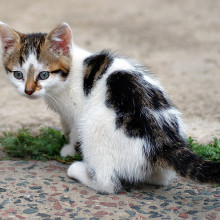
How do cats purr?
Now, there isn't really a special purring organ in a cat. It's simply a very fast movement of their voice box. So it's fast twitching of the muscles in their larynx which rapidly kind of flap up and down something called the glottis. That's some little flaps inside your throat, and it causes air vibrations when you inhale and exhale. And interestingly, a fact for you is that tigers, lions, jaguars, and leopards can only purr when they're breathing out!
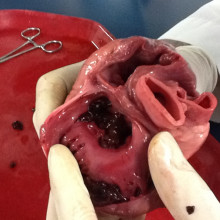
What powers a heartbeat?
Now, this is a really good one because basically it's the same energy that we use for all our metabolism. That's the energy created by eating fuel, metabolizing the food that we eat, turning into energy in the form of ATP within ourselves, it generates energy. But actually, the stuff that makes the heart beat is electrical impulses from our nerves and then the electrical impulses in the muscles and interestingly, you can take muscle cells out of the heart. You can grow them in the lab and they'll still beat within the lab because basically, you have this kind of feedback loop that just keeps on beating, but they get all out of rhythm and you need the nervous energy, the nerve impulses to get them all beating together.
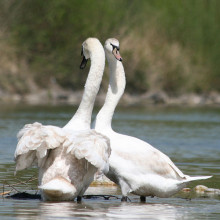
Why do some birds mate for life?
We put this to Rebecca Kilner, Department of Zoology, University of Cambridge...I don't think there's a consensus in the scientific literature on this, but there are a couple of good ideas and the general theme is that if it takes two to rear babies effectively then you stick together with the one that you already know. So, that might be the case for example if nest sites are in short supply and it takes two of you to defend the site, then it's better to stick with the team-mate that you've got than to change for the next season. Similarly, if you're feeding your chicks on complex food that's hard to forage for, it's better to stick with an experienced bird than to try your luck with a potentially naive individual.
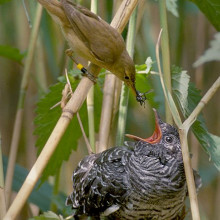
Do other species cuckold like cuckoos?
We posed this question to Rebecca Kilner from the University of Cambridge...It's not just confined to the birds and that's because universally across the animal kingdom providing child care is costly. So, that means there's a tremendous incentive for individuals to steal childcare from other individuals. We know that that happens in fish - for example, there's a cat fish that steals parental care from fish that brood their eggs and fry in their mouth. So, it takes care to get its host to swallow its fertilized egg and then the cat fish develops within the mouth of the host fish and it eats all the other eggs and fry in there and grows spikes so that the host doesn't swallow it and then, finally, is spat out when it's completed development.There are also some equally horrible insects that steal parental care from ant colonies. Say for example, the cuckoo butterfly, is so named because it induces ants to pick up its caterpillar and carry it back to their colony where they treat it like a giant member of their own colony and they carefully nurture it for between 11 months and 2 years until it's grown large enough to pupate and then it becomes the adult butterfly. So yes, it's widespread in the animal kingdom.
What happens when a cuckoo chick is spotted?
We posed this question to Rebecca Kilner from the University of Cambridge...
There are some host species that are confined to Australia, as far as we know at the moment, who can recognise the cuckoo chick in the nest. And what happens here is that, recognition typically takes place four days after hatching, and the birds simply stop feeding the chick in the nest, even though it's alive and well and healthy and begging for food.
Something happens that makes them realise it's not their own, and they give up on the chick and they take the nest apart, even though the chick is still sitting in there and still alive, and they build a fresh nest next door and, eventually, the cuckoo chick starves to death and the meat ants move in and dismember the corpse and carry it back to their own nest...
Can cuckoos trust the surrogates?
We put this to Rebecca Kilner, Department of Zoology, CambridgeYes, that's right. You're leaving them with the responsibility of bringing them up but at the same time you're avoiding all the costs that they incur in rearing children. So, it makes sense that these parasites have evolved.
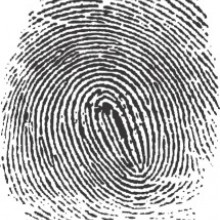
52:36 - Why do we have fingerprints?
Why do we have fingerprints?
We put this question to Dr Roland Ennos from the University of Manchester...Well, the answer, I'm afraid, is that no one truly knows. The most obvious idea is that they roughen our fingers to increase the friction. But we've done some test here in Manchester and we found that in fact the fingers actually behave rather like car tyres and because the fingerprints reduce our contact areas with a surface, they will actually reduce friction, just like the grooves in car tyres in a wet weather tyre and reduces the grip of the formula one car. Another possibility which I must say I favour, is that the ridging could actually help to prevent blister formation because the pattern will allow our skin to have much greater compliance and so that can help to reduce the sheer stresses around the edge of our contact zone. And the reason I believe is that if you ever do DIY tasks, what you tend to find is that the only bits where you get blisters is the bits, not on your fingerprints or wherever the big pattern of your palms, but in areas where there aren't any prints. Well, of course there is no doubt that one of the roles the fingerprint must be to improve tactile discrimination because rubbing you finger over a surface, when it hits the rough projections they seem to help to detect vibrations and so, it is likely that one of the roles of finger prints is to improve touch discrimination. But that can't be the main function because the soles of our feet, the palms of our hands also have finger prints. So, that must be just the secondary function.







Comments
Add a comment