Ingredients
| A tin lid or something fireproof | Something insulating you don't care much for | ||
| A 9V PP3 battery | Some wire wool |
Instructions
First this experiment involves burning iron, which is very very hot, don't touch it, and it and the object it is sitting on will get hot, so don't touch them until they have cooled down.
Find something fireproof and then sit it on something you are not too fond of. A tin lid sitting on an old plate would be ideal.
Make sure there isn't anything flammable near by.
Make a small ball of wire wool, and sit it on the tin lid.
Just quickly touch the 9V battery to the wire wool then gently pull it away
- Sometimes it welds itself to the battery, so having a stick ready to detach them might be a good ideal.
Watch the display!
If you have one try doing the same experiment on some accurate (<0.1g) scales and see what happens to the weight of the wire wool. I found that I had to put something insulating like a piece of wood between the wire wool and the scales to avoid overheating them.
Result
You should find that the wire wool starts to glow brightly and little bright patches move around following strange patterns through the ball.
If you weight the wool while this is happening you should find that it gets slightly heavier.
Explanation
The resistance of the very thin steel wires that make up the wire wool is low enough to allow a very large current to flow when you touch the battery to them, this huge current heats up the wires to over 700 celcius, just like the current flowing in a cooker ring or a light bulb.
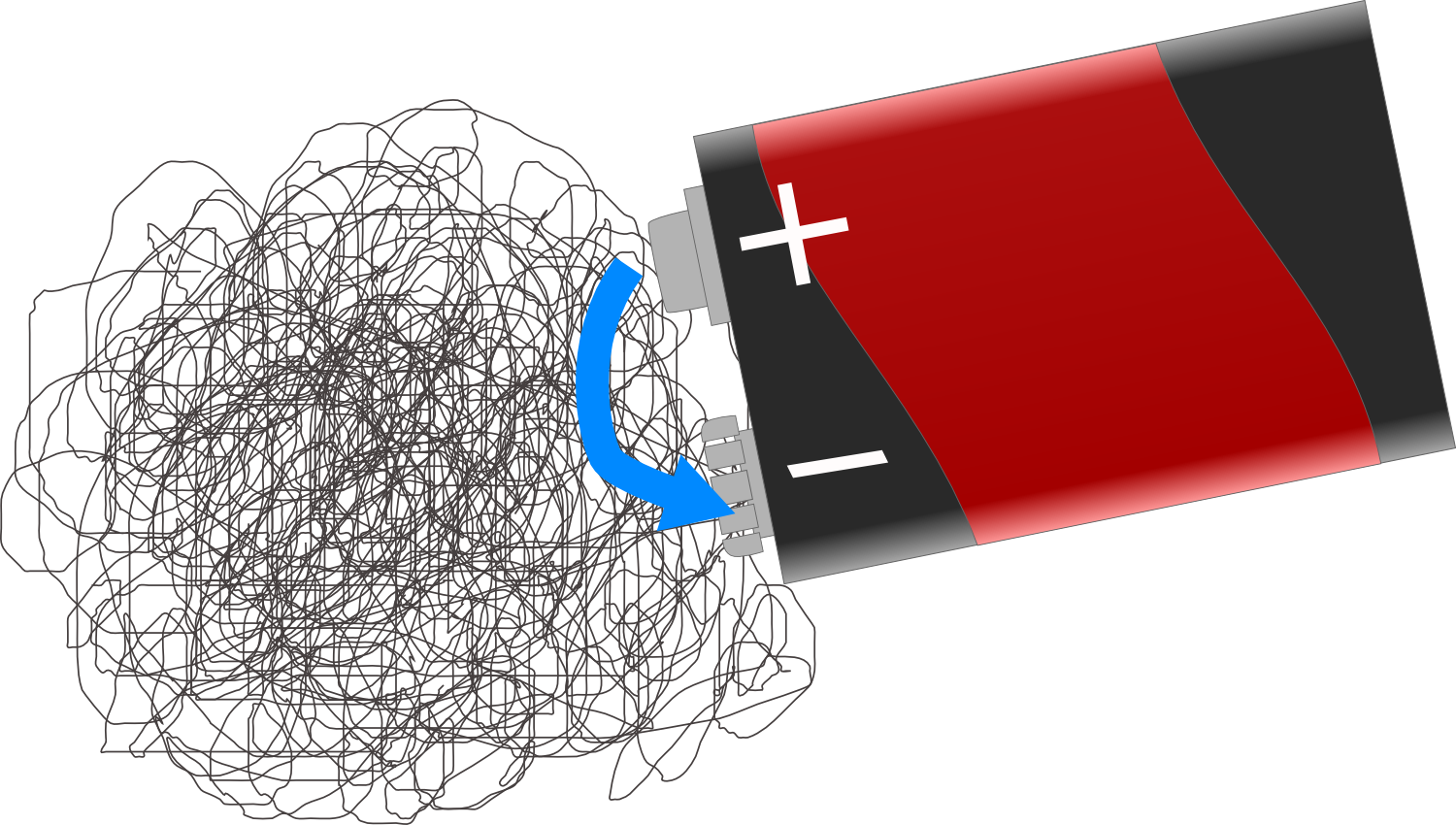 | 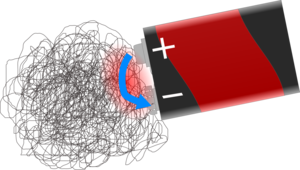 |
| When you touch the battery to the wire wool a large current flows through the thin wires. | This current heats the wire up to very high temperatures. |
Iron at this temperature will react with oxygen from the air pretty quickly in a chemical reaction to form iron oxide*.
Iron + Oxygen -> Iron Oxide
This releases lots of heat, heating up the next bit of iron which can then react, essentially the iron is burning in the same way that carbon in charcoal does in a barbeque.
The only real difference is that charcoal burns to produce carbon-dioxide which is a gas so it floats away, where as iron oxide is a solid so it sticks around and because it has gained oxygen it is heavier than the original iron, so the wire wool gets heavier as it burns.
* The orange rust you are used to seeing is another form of iron oxide with the formula Fe2O3 this reaction seems to produce blueish iron oxide which is probably Fe3O4 but there will be a mixture of different oxides depending on how much oxygen can get to that bit of iron
- Previous Cool coin launcher
- Next Microscopic Laser Shadow Imaging







Comments
Add a comment