Ingredients
2 funnels |
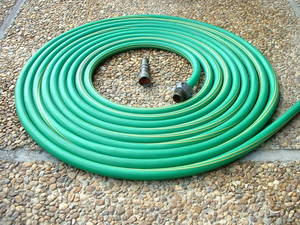
About 1m of hose pipe - garden hose is fine | ||
An unsuspecting volunteer |


Instructions
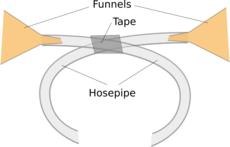 Cut the hose into two pieces, each the same length (about 50cm long).
Stick a funnel into each piece of hose, or tape it to the end if it doesn't fit inside the hose.
Tape the two pieces of pipe together so that the two funnels are pointing in opposite directions, as in the diagram to the right.
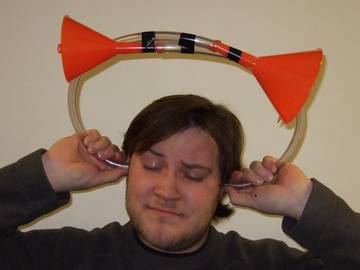
Get your volunteer to put the free end of the pieces of pipe into each ear.
Ask your victim-volunteer to shut his/her eyes. Once you're happy that he's not cheating, walk in a circle around him, making plenty of noise. See if he can point to where you are.
Result
You should have managed to entirely confuse him, and he will fail to point you out, wherever you're standing. When you are to his left he will think you are to his right, and vice versa. If you are listening with stereo speakers or with headphones you can listen to the effect here
Explanation
Your brain has various ways of detecting where a sound is coming from, but the main one uses the fact that you have two ears (known as binaural hearing). Sound travels at about 330m/s which means that if there is something noisy to your left, the sound will get to your left ear about a 2000th of a second before it arrives at your right ear. This means that the signal will get to your brain this much sooner, and so your brain can calculate that the source of the sound is to your left.
Similarly, if the object is to the right, the sound will get to your right ear first.
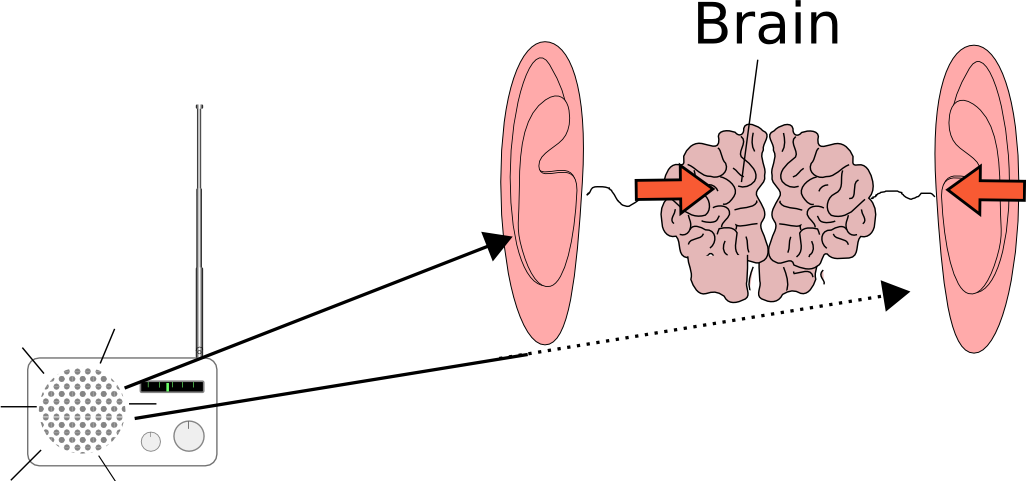 | 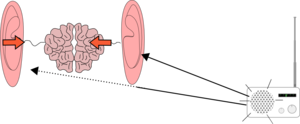 |
| The sound reaches your left ear first, so the signal from that ear gets to your brain first, and your brain knows the sound is coming from the left. | Now the sound reaches your right ear first, so your brain knows the sound is coming from the right. |
The funnels are good at collecting sound and 'funneling' it into the tubes - so most of the sound that gets to your ears has come through the tubes.
If a noise is on the left hand side, the sound reaches the left hand funnel before the right. It then travels through the tubes and gets to your right ear before your left, so your brain interprets this as sound coming from the right - as a result, you get very confused!
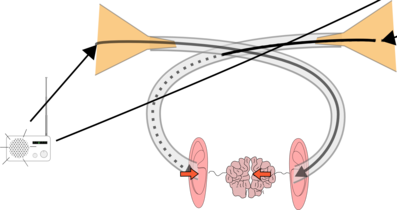 |
| The sound reaches the left hand funnel first, and is then directed along the tube to your right ear, so your right ear hears the sound first, and you think the sound is coming from the right. |
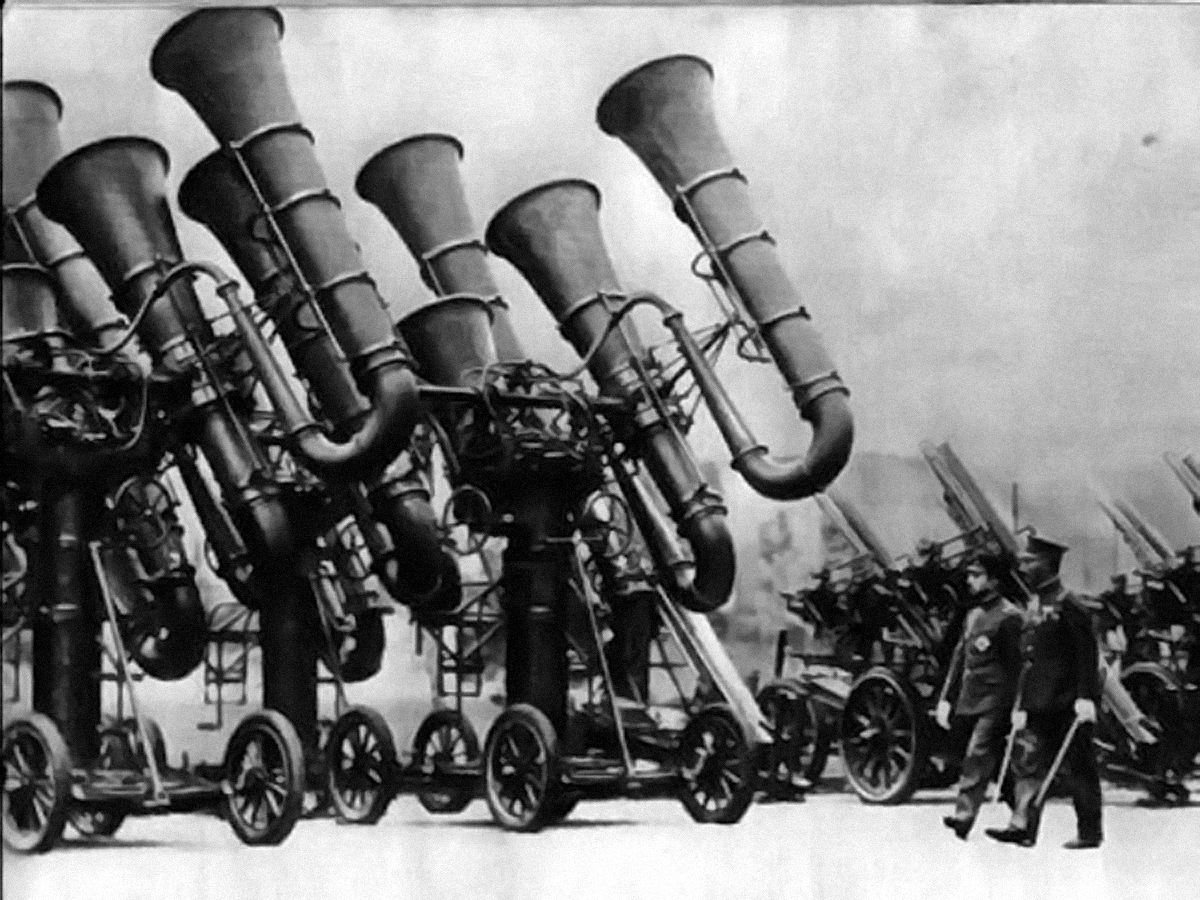 |
| Japanese War tuba - actually an acoustic horn to find the direction of incoming planes. |
The Japanese War Tuba
Before the invention of radar, the direction-finding-abilities of human ears were used to act as an early warning system for detecting planes. They used multiple large horns (like the funnels in this experiment) which were attached with tubes into an operator's ears. The operator then moved the horns until they sounded like they were pointing at the aircraft, and because they were so far apart, the direction was much more accurate than ears alone.
Unfortunately as planes got faster, the direction of the sound was indicating where the planes used to be, not where they were at that moment. This technology was rapidly replaced by radar.
- Previous Melting Ice with Salt
- Next How fast is a sneeze?









Comments
Add a comment