Rubens' Tube - waves of fire
Ingredients
Rubens' tube was invented by Henrich Rubens in 1904, it consists of a large diameter (normally metal tube) with a series of holes drilled in the top. A loudspeaker is attached to one end, and a flammable gas supply to the other, and the gas coming out of the holes is lit.
I saw this demonstrated by Bryson Gore (of Christmas Lecture fame) and loved it, so I had to build one. It involved drilling 360 1mm holes in an aluminium pipe, and arranging to attach a speaker to one end and a propane supply to the other. So I now am the proud owner of a Rubens' Tube.
| |
| Big Rubens' tube, the speaker is just off the shot to the right and the gas comes in to the left. |
As you can see waves of flame seem to be created and their wavelength changes with the frequency (pitch) of the sound being fed in. The basis for this effect is resonances in the gas in the tube.
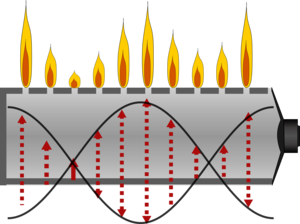
When the loudspeaker vibrates it sends a series of waves of air down the tube at the speed of sound, these then reflect off the far end of the tube, so there are two sets of waves moving through the tube in opposite directions.
For most wavelengths this does not produce a very interesting effect, but when the length of the tube is a multiple of half the wavelength the two waves add together to form what is known as a standing wave. In some places the two waves add together forming extra large changes in pressure (antinodes) and in other areas they cancel each other out so the pressure is constant (nodes).
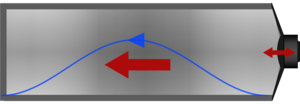 | The loudspeaker vibrates creating compressions in the air which move down the tube (sound waves) |
|---|---|
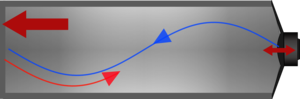 | When they hit the end they reflect back, and travel back again. So you have two waves moving in opposite directions inside the tube. |
The lines are a graph of the pressure changes in the tube | If the wavelength is right the two waves will add together to form a stationary pattern called a standing wave. This contains areas where the pressure is varying by a large amount (antinodes) and others where it is constant (nodes) |
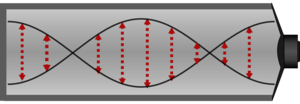
(It is actually slightly more complex in the Rubens' tube as the holes act as damping, broadening the resonances and allowing it to form patterns even when the wavelength is not quite right.)
How does this standing wave affect the flames?
That is in fact a very good question, the average pressure at all points of the tube is the same, so the answer is not that some parts of the wave are at a higher pressure than others. This means the answer must lie with how the flames react to the changes in pressure.
Just to make things more complex Rubens actually discovered that his tube could behave in two completely opposite ways. When the sound is relatively quiet the flames get shorter at the antinodes but when the sound is very loud they get longer.
| |
| At the start of this the flames near (but not quite at) the ends are being shortened by the sound, but as the sound gets louder the flames get longer |
These two completely different behaviors seem to have different causes.
Relatively quiet
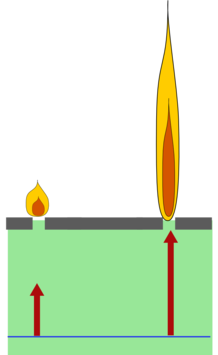
When the sound is relatively quiet the changes in pressure due to the sound are less than the gas pressure. For relatively small pressure differences the flow of gas through a hole is proportional to the square root of the pressure difference (pressure difference is energy per unit volume of gas, and the change in kinetic energy of the gas is proportional to its velocity squared, so the velocity and so the flow rate is proportional to the square root of the pressure difference).
This relationship means that the increase in flow when the pressure increases is less than the decrease in flow when the pressure decreases so on average the flow, and therefore the flame length, is less where the pressure is varying a lot, at the antinodes.
| Part of the tube: the flame on the left has a constant pressure, the pressure for the flame on the right is changing | |
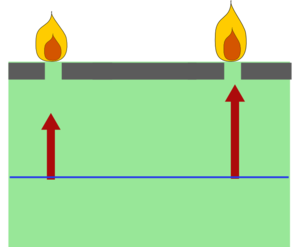 | 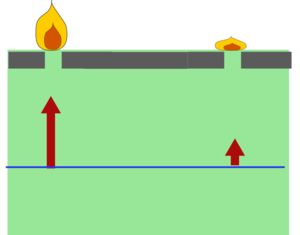 |
| When the pressure increases the flow of gas increases a bit and the flame gets slightly longer. | When the pressure decreases the flow reduces a lot and the flame gets a lot smaller. |
This means that the flames are shorter at the antinodes (loud parts of the tube) and the same length at the nodes.
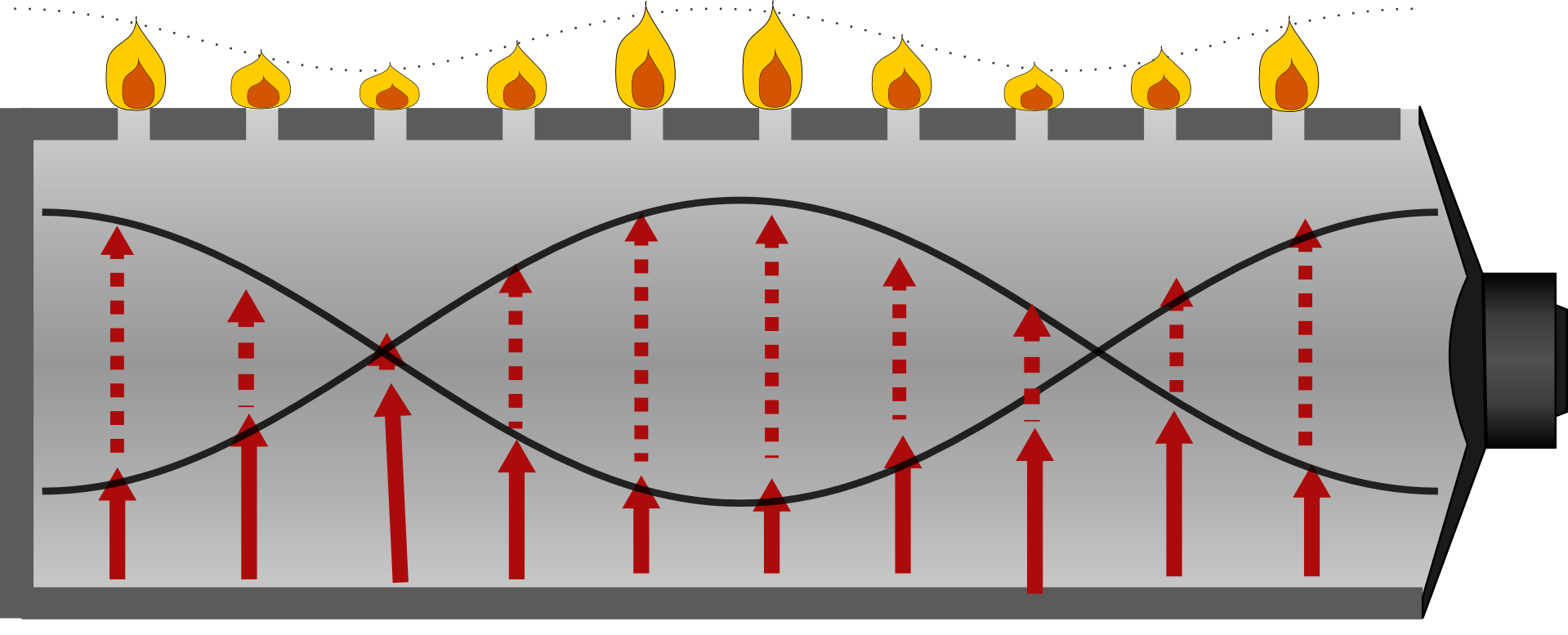 |
| In this case the areas with the largest changes in pressure produce shorter flames and those where it is quiet will produce longer ones. |
When the sound is very loud
I have not found any discussion of this case, Rubens seemed to think that it was so obvious that he didn't bother writing it down. It isn't obvious to me, but this is what I can work out:
When the speaker is set to loud the changes in pressure due to the sound are much larger than the gas pressure, and the behavior is very different. Now the gas is squirted out of the holes and forms a jet traveling away from the tube.
The pressure then becomes lower in the tube than outside so gasses from outside are sucked in. However these gasses are not just the propane that was squirted out; suction doesn't have a direction, so gases are sucked in from all around the holes, most of which are air.
| Part of the tube: the flame on the left has a constant pressure, the pressure for the flame on the right is changing | ||
| 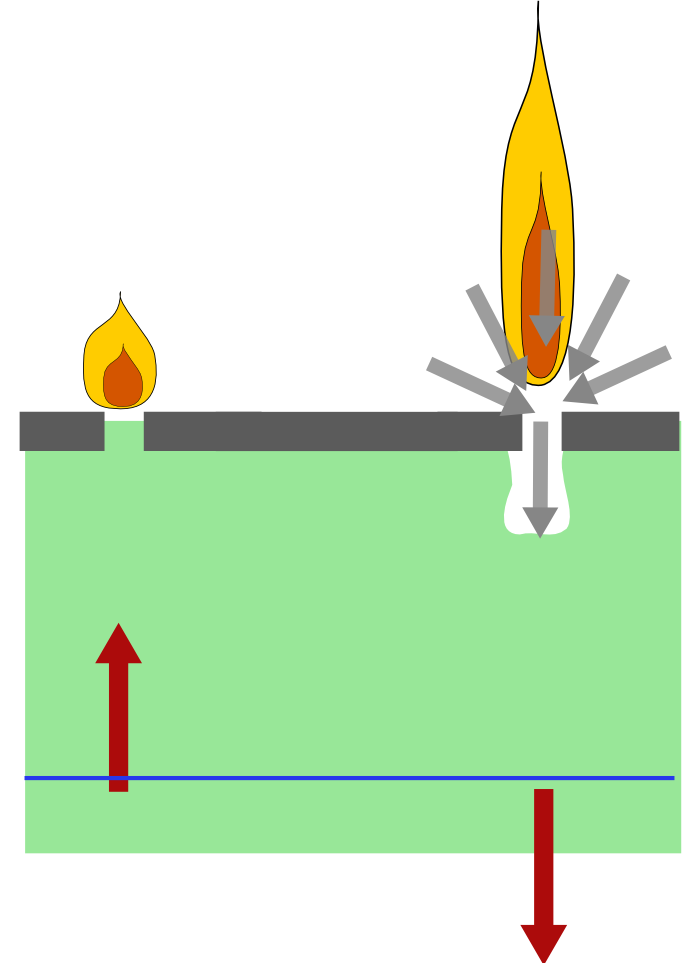 | |
| The pressure difference is very large so gas is squirted out forming a fast moving jet | The pressure change is so large that air is actually sucked in. Because suction happens in all directions, most of what gets sucked in is air. So to start with lots of gas is squirted out and air is sucked back in. | |
 |  | |
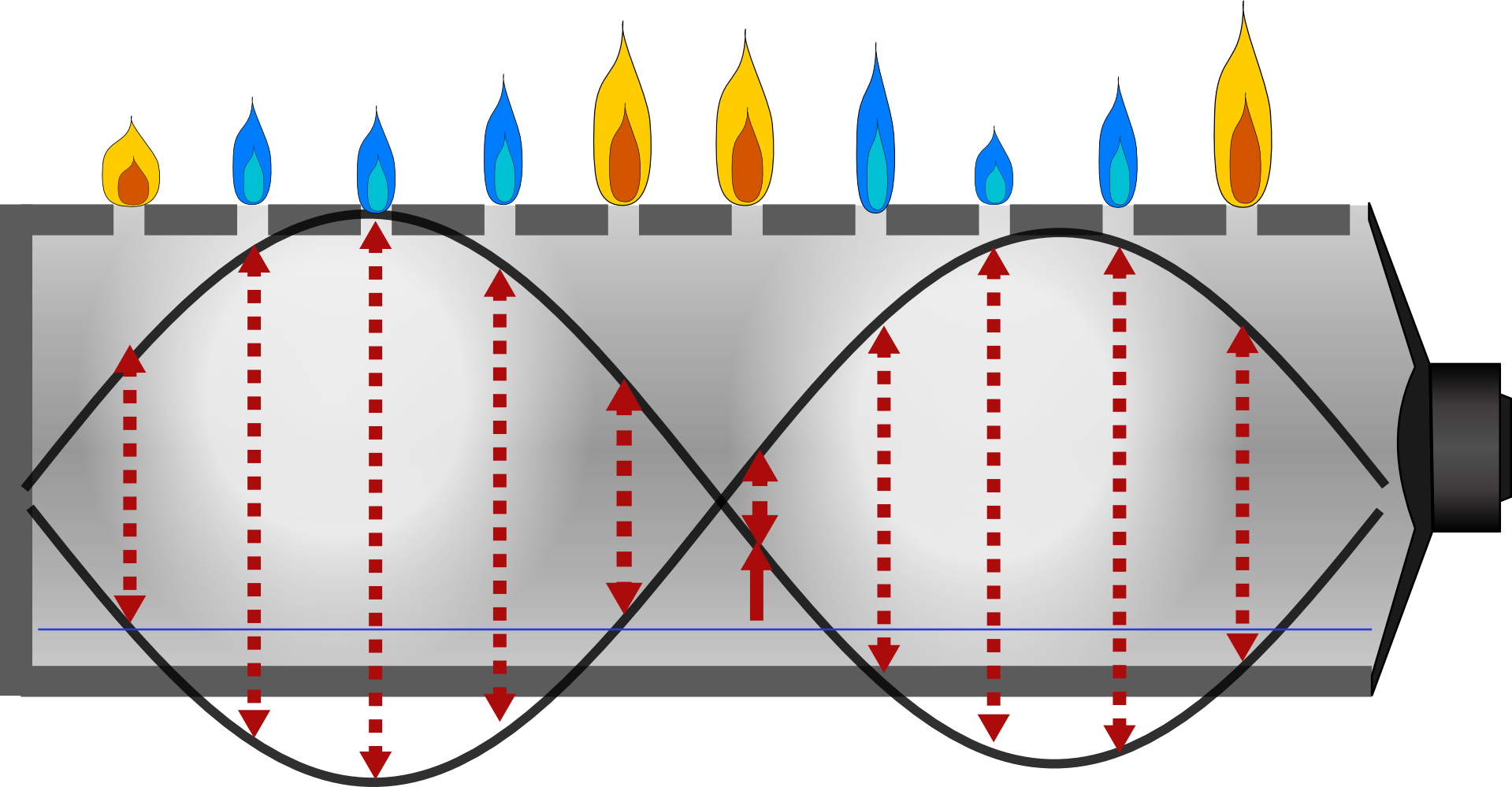
| The areas with the loudest sound have the longest flames | |
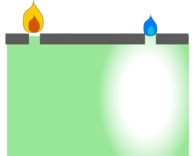
So gas is squirted out and air is sucked in allowing more gas to be squirted out in the next cycle. This hugely increases the flow of gas out of the tube, for a while... the mixture of gases in the tube is slowly made up of more and more air. This makes the burning cleaner and cleaner, forming a bluer flame, until eventually there isn't enough gas to sustain combustion and it can put itself out.
| |
| Over time air is sucked in making the gas mixture weaker and weaker. Leaving the antinodes with very little gas to squirt out. |
 |




Comments
What is the practical use of
What is the practical use of rubens tube?
If it is only demonstrating sound waves as pressure waves, a simple slinky can be used for that.
It doesn't truly have a
It doesn't truly have a separate purpose than to demonstrate sound waves as pressure waves, however it is a very interesting and visual representation that is likely more engaging the a slinky would be.
Add a comment