In this show Prof. Roger Pedersen, from Cambridge University, joins us to discuss what are stem cells, what is their role in the developing embryo, and how can they be used to repair or replace damaged tissues, and Dr Huseyin Mehmet, from Imperial College London, discusses how he is developing therapies for cerebral palsy based on stem cell repair. Also joining us is Soren Muller Bested, from Singapore's umbilical cord blood stem cell bank, CordLife, to discuss how discarded umbilical cords of new born babies are a rich source of stem cells.
In this episode
Clean Air For The Olympics in Beijing Thanks To Rooftop Grass
In a bid to clean up its act in time for the 2008 Olympics, China's choking capital city, which has seen traffic on its roads rising by 15% per year, has taken to planting grass on roofs to help filter the air. Most major capital cities rely on oases of green open spaces planted with trees and vegetation to preserve air quality. But Beijing is too crowded for any more green belts so officials are turning to rooftops instead. Last year they planted 10,000 square metres of evergreen grass on rooftop lawns and this year the target is 100,000. They're also intending to shift 200 of the worst polluting factories. During 2004 officials claimed to have reached their goal of 227 days with clean air, although many are sceptical about the standards used to make the claim.
How Venus Flytraps Snap Shut
Charles Darwin called the Venus flytrap one of the most wonderful things in the world yet, over 150 years later, researchers are still struggling to explain how the plant closes its traps so quickly. But now we think we know the answer. Previously scientists had suggested that the rapid closure of the traps occurs when special 'motor cells' deflate, rather like a balloon popping, which brings the two halves of the leaf together. But even this wouldn't account for the speed with which the process takes place. To solve the problem a team of researchers in France, the US, and the UK used high-speed photography, capable of capturing 400 frames a second, to track what happens during the tenth of a second the trap takes to close. The photos have revealed that the flytrap 'snaps' from a convex shape to a concave shape very quickly, just like a broken tennis ball turned inside out that can rapidly be 'popped' from one stable shape to another. This is achieved by the arrangement of cells and fibres within the wall of the leaf, although precisely how the arrival of a potential meal inside the trap triggers the shape change, the scientists haven't yet worked out.
Alien Ant Invasion in Hong Kong
Scientists in Hong Kong are considering introducing ant eaters to control a recent outbreak in alien ants. The ants, called red fire ants, are thought to have arrived from South America in imported pot plants. Ant hills were first spotted in fields and are now popping up all over the city, including Disney Land Hong Kong. Although red ant bites are not usually fatal, they can be very painful. Some people are allergic to ant bites, and a nasty nip can trigger a dangerous allergic reaction. As these ants have only just been introduced, this may be the perfect time to stamp on the invasion and stop the ants spreading any further. One of the solutions suggested by the Hong Kong government is an army of anteaters. This natural predator would wander the streets and hoover up the ants. Whether this strategy will work is yet to be seen. Other examples of biological control, such as the cane toad in Australia, have ended in disaster.
- Umbilical Cord Blood Stem Cell Technology
Umbilical Cord Blood Stem Cell Technology
with Soren Müller Bested, CordLife, Singapore
Chris - What's the motivation behind banking umbilical cord stem cells?
Soren - We learnt a few decades back that developing babies do not have any bone marrow, and that all of the stem cells that are responsible for producing bone marrow later in life are found circulating in the blood. So the blood of a new born baby has about ten times the concentration of stem cells that you find in the bone marrow. The idea is that if we can collect umbilical cord blood (after the baby is born), we can harvest the stem cells in the blood and use them as a replacement for bone marrow in a transplant situation. The blood is collected after the baby is born from an umbilical cord that would otherwise be thrown away. We cryogenically preserve the cells at minus 196 degrees Celsius under liquid nitrogen. Evidence suggests that if stored in this way, the stem cells should last indefinitely, although this is hard to prove. Researchers have shown, however, that, when stored in this way, the cells are just as viable after 15-20 years as the day they were first collected.
Chris - Say I have a condition that stem cells can treat. How would you treat me with your stored stem cells?
Soren - We would treat you in a similar way to how we treat a patient with bone marrow stem cells. You would undergo a course of chemotherapy to get rid of the diseased bone marrow in your body. We would then take out the umbilical cord cells that were stored earlier in life and infuse the cells into a vein. The cells circulate in the bloodstream for a short while before they home in on the bone marrow cavity, settle, and begin to produce a new bone marrow. This is exactly the same as in a new born baby. It also means that if you had cells from a female umbilical cord, you would have a female bone marrow for the rest of your life.
Huseyin - People are making huge claims about umbilical cord stem cells. It sounds like Cord Life is a big business and is sincere in what it is doing. What's your current thinking that we could take umbilical cord stem cells and make any tissue you like in the body?
Soren - I think it has a higher potential than we ascribe to it today. However, I don't think cord blood cells will make everything. We restrict ourselves to heart disease and bone marrow disease at the moment.
Chris - One of the constraints is that you only get a small number of stem cells from each umbilical cord. It's not enough to cure an adult. What technology do you have to help solve that problem?
Soren - We realise that this is a problem. We are currently about to start clinical trials on trying to grow umbilical cord stem cells. We are using what is known as the Cytomatrix technology. This technology was originally developed by NASA and is a material with a very large surface area to volume ratio. It was being used in space shuttle catalytic converters. When we looked at the material, we realised that the matrix looked very much like human bone marrow. The thinking was that if we could put the cells in an environment like they are used to, we might be able to expand the cells. We found that it worked. Laboratory and animal tests have been done and we are now at the point where we about to enter human clinical trials. We hope the clinical trails will finish in the next two years, so it will probably be about three to five years before this will become a standard therapy.
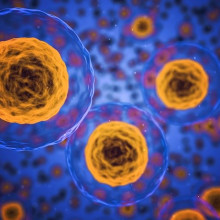
- Embryonic Stem Cells And Stem Cell Technology
Embryonic Stem Cells And Stem Cell Technology
with Prof. Roger Pedersen, Cambridge University
Roger Pedersen, from the University of Cambridge...
Roger - I would like to talk about the subject of human embryonic stem cells. This type of stem cell, the mother of all stem cells, has the potential to turn into every tissue in the body. It therefore is very exciting and has lots of potential for the clinic. I want to talk about why we should be interested in these cells not only as a product but also what they can tell us about ourselves and how we came into existence. It is interesting to think about what we have learnt about these cells and how they are contributing to very fundamental knowledge.
Chris - Stem cells have had lots of media coverage, but what is a stem cell?
Roger - It is a cell that can undergo specialisation to form a specialised cell, but at the same time, retain the ability to specialise. When stem cells divide, one becomes a specialised cell, while the other remains a stem cell. Specialised cells are all the different cells in our body that perform a function. They are all the cells we see on us and in us, such as lung cells, skin cells, hair cells, and kidney cells.
Chris - One egg meets one sperm and you get a single cell. Is that therefore a stem cell?
Roger - That would be a special use of the word stem cell because that is the first cell of human development. This cell has the potential to make all the cells in not only the foetus but the placenta too. What we are interested in are the cells that have made that first decision to be the embryo rather than the placenta. These are the source of stem cells, which has caused so much excitement for their clinical use.
Chris - They are controversial too because if we want to get stem cells, we need to get an embryo. To get an embryo for ourselves would require cloning ourselves.
Roger - I will split this into two parts: the embryo and cloning. The embryo that is the source of embryonic stem cells comes from the surplus embryos from in vitro fertilisation. They were donated by patients who had finished their families and want those embryos to be used for scientific research. The source is a very tiny hollow ball of cells the size of the point of a pin.
Huseyin - I'd like to add that legally, if these eggs are not donated, they must be destroyed once the people have conceived. Many people who have been helped by IVF technology say that as they are spare embryos that they can not use themselves, they want to donate them to help research. The embryos can only be saved if they are donated.
Chris - The embryonic stem cells that we want to use are in the very early stages of development. They are the cells that are going to go on to form a developing foetus.
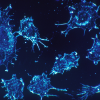
Roger - Yes, and once they are growing in the petri dish, they maintain this very early unspecialised state. The cells themselves look very innocent. They look like very non-descript flat cells that don't appear to have this enormous capacity to grow into any cell in the body.
Chris - How can they be used?
Roger - That is the challenge of our research. We know that they can specialise but the challenge is to find out how to do it in the petri dish. For that reason, we need to find out what they are and what it is to be a stem cell at the very early stages in development. How does it know what to turn into and how does it make that decision?
Chris - Do we know any of the signals that makes a stem cell know to turn into, say, a heart cell? What are the triggers?
Roger - There's quite a lot known now from studying animal models such as frogs, fish, sea urchins and mice. We know quite a lot about what goes on in them but we don't know much about humans.
Chris - I have heard that if you inject stem cells into damaged areas, the cell knows where to go and travels to the site needing repair.
Roger - There are some early studies that suggest this. However, what is not so clear is that the damage is repaired by stem cells. They might be helping the native cells to repair themselves. When we have an injury, blood goes straight to the damaged area. This might be the reason why damaged skin goes green if Green Fluorescent Protein-labelled stem cells are injected into bone marrow.
- Stem Cell Therapy For Cerebral Palsy
Stem Cell Therapy For Cerebral Palsy
with Dr Huseyin Mehmet, Imperial College London
Huseyin - My background is in brain development and especially trying to understand brain damage in premature babies. As doctors are becoming better at saving premature babies, our work is becoming more important. The more babies that survive, the bigger the pool of patients we need to treat. Once babies are born, there are a large number of cells in the brain which are already dead. We can't do much to help after the damage has been done. Our team became interested in replacing those damaged cells before they die, which is how we got into stem cells. We are very interested in using stem cells to help replace the cells lost in things like cerebral palsy. There's a lot of confusion in this field. I want to talk about exactly what the situation really is and take away some of the media hype. I also want to talk about where we might be going with stem cells and what the real prospects are for the future.
Chris - It may be possible to use these cells clinically. What are you doing to try and help people with cerebral palsy?
Huseyin - I'm a firm believer that there should be a good basis of scientific knowledge before clinical testing. There are many patients who are willing to take the risk of trying out treatments, but I think it's important to understand what's happening at the mechanistic level first. At the moment, we are trying to bring stem cells to the stage when we can differentiate them into tissues. If we understand this, then maybe we can persuade the patients' cells to do it. If we can make our own stem cells change into the tissues we want, there won't be any moral or ethical problems.
Chris - What is the difference between adult and embryonic stem cells?
Huseyin - The classic examples of non-embryonic stem cells are those isolated from bone marrow and neural cells from the brain. Some of these non - embryonic stem cells are already being used successfully today. Some blood stem cells are isolated from the bone marrow and put back into leukaemia patients after they've undergone their chemotherapy and radiotherapy. This repopulates the blood of the patient. This shows that there are clinical uses for them. However, the debate at the moment is whether they really have the same plasticity as embryonic stem cells. By that, I mean whether they have the breadth of potential to turn into all the other tissues. If we take stem cells from the bone marrow, they might only be able to produce cells that would normally arise in the bone marrow. Similarly, stem cells from the brain might only be able to turn into nerve cells. Some people have claimed to take brain stem cells and make them into muscle cells, but in my opinion this is very early days and highly controversial. However, if it is true, it will be very exciting.
- What's the possibility of getting some repair in the case of damage caused by glaucoma ?
What's the possibility of getting some repair in the case of damage caused by glaucoma ?
Glaucoma is a condition that arises when there's too much pressure in eye. Long term pressure damages the optic nerve and consequently impairs sight. The condition is inherited so it is important to get it checked. Glaucoma is very easy to spot and treat by controlling pressure in the eye. Many people compensate and don't even realise they have it. - Huseyin - This is one of the problems, in an ideal world, that stem cells would be able to rectify. Scientists have used animal models of retinal damage and injected stem cells into the eye of mice with retinal damage. By labelling it with Green Fluorescent Protein, we can find out where they've gone. In many cases cells have been found in the retina, but we don't know if the animals can really see better. All we know is that electrical transmission in the nerves is better. One method used to test whether mice have improved sight is to test one of their natural responses. If mice have a light shone on them, they freeze and stay very still. However, we want to know if the treatment is better than being able to respond to light or dark, although any improvement would be better. Again, it is important to stress that it's very early days for stem cell treatment. The possibility is there, but we have to be realistic. There are already experiments with Parkinson's disease using foetal tissue which have been very successful. China is a big country for stem cell research and they are reporting some success. However, it is still too early to put vast NHS resources into this technology. I would rather invest in the basic building blocks of knowledge and then move up to experimental models. Only after that can we try experiments in humans. We need to be able to reproduce it on a basic level first. I refuse to put a date on it, but I suppose 15 to 20 years might be realistic. - Roger - The idea is like creating a retinal implant. We think that's many years away. We are trying to apply the knowledge people have of the development of retinal cells in animals and make it work in the petri dish.
- Do we have stem cells when we're adults? How long do they last Can't specialised cells divide ?
Do we have stem cells when we're adults? How long do they last Can't specialised cells divide ?
- Roger - I dare say we have stem cells in our bodies throughout our lives. We need stem cells on parts of our body that get worn out quickly and thus need replacing all the time. The skin is an example of this. We need to work out how to make these stem cells work better. By and large, specialised cells stop dividing once thy have finished their specialisation. - Huseyin - The problem with the brain is that even though we know the stem cells are there and that they are kicked into action when there is damage, there aren't enough of them. If there were, people would be able to get better if they have a brain disease or brain trauma. Specialised brain cells just don't have the capacity to divide again.
Can stem cells be used to cure vitiligo?
Vitiligo is a de-pigmented patch on the skin. It occurs where the immune system has destroyed a patch of melanocytes which are the cells that produce the dark pigement melanin, which mops up UV light from the sun. Michael Jackson claims he has this disease. It's possible, though unlikely at the moment that stem cells could be used to repopulate skin that has lost its melanocytes.
- I'm a diabetic. What do you think is the realistic timescale to cure diabetes ?
I'm a diabetic. What do you think is the realistic timescale to cure diabetes ?
- Roger - This is one of our key objectives. One of the biggest frustrations is that we can't say when we will have a cure. Hopefully we will have clinical trials in five to ten years, but it could be two to three times that. - Chris - You might be aware of some grafts of pancreatic cells in Canada. They have grafted cells from people who have died, isolated the important cells and put them back into people with diabetes. This has had some good success. Eyelet cell transplants like this do not come from stem cells but from people who donate their pancreas after they die. There are side effects to the grafts because the immune system will attack it as foreign material. To stop this rejection, you need to turn off immune system. This can be bad, and so these grafts are only given to people who have very bad diabetes and might die otherwise. - Huseyin - I would just like to give you some bullet points. Firstly, it is quite clear that we can make insulin secreting cells in the dish. It has been done with both types of stem cells. It has not been fully accepted that we have pancreatic stem cells, but embryonic stem cells can give rise to insulin cells. Secondly, the issue of transplantation is a very important one. Of the very small amounts of stem cells injected into animals and human, few actually survive. The surprising fact is that those cells cure in many cases, so you don't seem to need too many stem cells to survive to have an effect. Thirdly, the immune system might still attack the stem cells. If you have an immune disease that attacks the pancreas, it is just as likely that it will still attack the pancreas even after treatment. There's a lot more work to be done, but I think the study in Canada is very encouraging. Patients should take heart from that.
What are the plant cell walls made from ?
Plant cell walls are made from cellulose, the woody stuff in trees. So when you saw down a tree, you are sawing down cellulose and lignin. If you look down a microscope, what you see is brick-shaped cells. The outermost part of each cell is the cell wall, and inside that is the cell membrane. Sometimes the outside can be lignified, which makes the cell stiff so plants can stand up straight. It's also how you make paper. All the cellulose and woody bits from the plant cell wall are the fibres you see in paper.
- What is is success rate for stem cell therapy after heart attacks ?
What is is success rate for stem cell therapy after heart attacks ?
There is evidence in animals that you can get improved cardiac output afterwards. The stem cells might give rise to new heart muscle cells, or promote the growth of new blood vessels which improve blood supply to the heart muscle, helping it to work more efficiently.







Comments
Add a comment