This week, we look at the latest science news and tackle more of your questions. We uncover the source of the asteroid that finished off the dinosaurs, find out how moray eels eat like aliens, and although we know that breast is best, could nicotine in smokers' breast milk be affecting childrens' behaviour? Also, is the future of formula one eco-friendly? Meera investigates race cars running on biofuels and built from hemp and cashew nuts! We discuss award winning beards, eerie glowing fish and what makes for a long life. Plus, we find out what to expect at this year's BA Festival of Science in York, and in Kitchen Science Dave demonstrates how a pair of paperbacks can be stronger than a quarterback.
In this episode
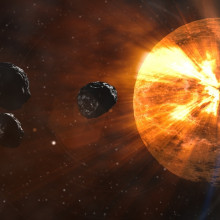
02:01 - Origin of Armageddon Asteroid Uncovered
Origin of Armageddon Asteroid Uncovered
Scientists in the US and the Czech Republic have discovered the origins of the meteorite that helped to bring about the demise of the dinosaurs.
Bill Bottke, from the Southwest Research Institute in Boulder Colorado, together with David Vokrouhlicky and David Nesvorny from Charles University in Prague, used numerical simulations to wind back the cosmic clock over 160 million years to piece back together the puzzle of what plunged the planet into the equivalent of a nuclear winter and wiped out the dinosaurs.
The team used computer simulations to track the orbits of these fragments back to the time when they first formed. Their calculations show that a large 170km diameter asteroid, known as the Baptistina parent body, collided with a smaller 70km object between Mars and Jupiter about 160 million years ago.
The result was the creation of more than a thousand smaller asteroid pieces each measuring 1 kilometre or more in diameter. This occurred in a part of the solar system where the combined gravitational effects of Mars and Jupiter create what Bill Bottke terms a "celestial escape hatch".
Here, warming by the sun's rays triggers a process called the YORP effect, which can alter the path of small objects and nudge them into Earth-crossing orbits. The result was a 100 million year long meteor shower, which, say the researchers, included the 10km diameter "Chicxulub" impactor that struck Mexico's Yucatan Peninsula about 65 million years ago.
A recently-discovered meteorite fragment recovered from the Pacific in sediments dating back to the same era is a chemical match for the Baptistina fragments still in orbit out beyond Mars.
"So we can say with more than 90% probability that this breakup event 160 million years ago looks like the origin of the impactor that produced the mass extinction event 65 million years ago," says Bottke.
Implosion Fusion - A New Approach to Nuclear Power
A New approach to fusion has been given the go-ahead near Oxford in the UK.
Nuclear fusion is the power source for the Sun and involves smashing nuclei of light elements, like hydrogen, together so they fuse, releasing lots of energy. This is different from conventional nuclear power which involves splitting large atoms to release energy.
The problem with fusion is that keeping the nuclei close together when you give them the energy needed to react. One way is to confine them using magnetic fields, this has been given funding recently in a project called ITER, but it's extremely difficult and expensive.
Professor Mike Dunne, of the Rutherford Appleton Laboratory, has a slightly different plan. He has just been given the go-ahead to build a machine to compress and heat pellets of hydrogen with large lasers until they are hot enough to fuse. When you hit a pellet of hydrogen with a laser, the outermost layer of the pellet heats up quickly and explodes, and this explosion forces the remains of the pellet together, compressing it down. The technique of blasting hydrogen with lasers to cause fusion has been tried before but Professor Dunne's plan is to use one large laser to partially compress the pellet with a pulse of a few billionths of a second long, and then blast the pellet with a a very short laser pulse only a few trillionths of a second long. This second pulse will trigger fusion.
If it works, this would be a non-polluting source of energy which could be virtually unlimited.
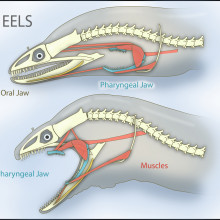
08:10 - Jaws II - The Moray Returns
Jaws II - The Moray Returns
Scientists have discovered how Moray eels manage to swallow things nearly as large as themselves - they have a second set of teeth in their throat, called pharyngeal jaws, that jump forwards and grab whatever's in the mouth and drag it down the animal's oesophagus...
Rita Mehta, from UC Davis, made the dicovery by capturing fast camera footage of morays as they dined, and then confirmed the findings with fluoroscopy, the eel-equivalent of a barium swallow.
"These creatures have evolved this intriguing adaptation because their large body size makes them dependent on eating other large creatures like fish and cephalopods" explains Mehta.
"Most fish use suction to pull prey into their mouths and down their throats; but larger prey can more easily escape, and since morays live in crevices and holes, they would not be able to expand their heads to create the suction they needed to capture things."
Other long thin creatures, like snakes, use alternative methods to swallow large prey, such as dislocating their jaw and racheting it left to right to squeeze things in. But this is the first time that an alternative to hydraulic has been seen in fish.
P-Ink - Billboards inspired by Butterflies
Researchers in Toronto have developed a new form of display inspired by butterflies, they call it P-ink.
Most displays today, whether that are conventional TV's, LCDs or big LED billboards work by emitting light. This is great at night but during the day they tend to look dull and washed out because the daylight is so strong. Glowing also requires a lot of energy.
Dr Andre Arsenault and colleagues at Opalux in Toronto have come up with a neat solution. Many iridescent butterflies and beetles produce really bright colours without using pigments at all. They rely on a phenomenon called structural colour - they have tiny repeated structures, about the wavelength of light in size, which produce colour in a similar way to reflections in a CD, a layer of oil on water or in an opal.
Opalux are using a similar effect by putting lots of tiny silica beads in a polymer. This makes colours in the same way as the beetle, but the clever bit is that by changing the distance between the beads by using a voltage, they can changes the colour that the beads reflect - and so change the colour that you see. By building up a grid of pixels like this and using a computer to calculate the distances, you can make a display. So far, the refresh rate isn't good enough to use for video, but it works well enough for billboards or e-books.
13:08 - Breastmilk and Nicotine
Breastmilk and Nicotine
with Dr Julie Mennella, Monell Chemical Senses Centre
Chris - Tell us about this study that you've done on mothers that are breastfeeding but smoking as well.Julie - Well, there really hasn't been a lot of research on the consequences of smoking while you're breastfeeding, and there have been changes in policy here and one of the questions that we had was, what are the short term effects? What we found is that if a mother smokes 1-2 cigarettes and breastfeeds the baby, even within a few hours after breastfeeding we find drastic differences in the baby's sleeping patterns. The baby is sleepless, they wake up from their nap sooner, and the greater the disruption in sleep correlated with how much nicotine the baby ingested.Chris - When you say the baby slept less, how much less? Was it a significant amount?Julie - Yes. What we did was we looked at the baby on two days, one day the mothers refrained from smoking and one day the mothers smoked, though not in the presence of the baby. We found that the amount of time the baby slept was reduced by almost a half hour, in just that three and a half hour period.Chris - So that's a reduction of a good 40% isn't it?Julie - Sure.Chris - So if the babies are sleeping 40% less, are they catching up some other time in the day?Julie - That's great question that we don't have the answer to. One of the interesting things is in mothers who breastfeed and smoke there's been a number of studies that show that [their babies are] more colicy and more active, and maybe this is one of the consequences of the nicotine exposure. We don't have the answers for cigarettes but what we do know if that we also get sleep disruption when alcohol is also transmitted to human milk. What we can learn from those studies is that if the mother doesn't continue to drink the babies do compensate for it later on in the night, but the key is that the baby can't be exposed to nicotine again.Chris - Now, I think there have been some studies that have shown that if you are exposed to nicotine as a young baby, there's an association with having learning difficulties or behavioural problems later on in life. Is that correct?Julie - Yeah, and most of those studies were looking at the relationship between nicotine exposure during pregnancy and then learning disabilities during childhood. There's been very few studies that have factored in the exposure during breastfeeding. One of the things is that mothers can reduce the amount of nicotine that babies are exposed to by timing it, so unlike that which occurs during pregnancy, babies would sleep less. Getting back to your question though about learning disabilities, one of the functions of sleep is for memory consolidation and the forming of new memories, and so disruptions in sleep may be the mechanisms underlying that.Chris - It's quite a significant difference in the amount of sleep they're getting though, do you actually think if you did this on large numbers of people you would see this effect maintained? You looked at fifteen mothers, so do you think that's a big enough number to draw conclusions from?Julie - Well, this study is what one calls a 'within subject', so you look at each baby on the day that their mothers don't smoke and compare it to when they did, so that's quite a powerful design. We know that there are colic problems in infants, we know that nicotine is a known stimulant that has effects on sleep in adults and so this is really consistent with a large body of research. But as now, if you think of the infant you would expect a greater result because the liver is not as mature and they're not able to break down the nicotine as well. So I would say that it's consistent with a large body of literature and also literature in other animals which shows that nicotine is a stimulant and disrupts sleep.Dave - If the mothers are addicted to nicotine, would they be behaving differently when they haven't had a cigarette, and would that effect the babies at all?Julie - Good question, there hasn't been a lot of research on that at all. So I dont have the answer to that one for you.Chris - And do you think that as these babies are being exposed to nicotine, as you've shown it in large amount in breast milk, are they more likely to go on and smoke when they get older?Julie - I'd like to think of it the opposite way too, just like with alcohol, with nicotine not every child of a mother who smokes or drinks is going to become a smoker or a drinker. What is it about the role of early experience that puts one child on one trajectory and another on another? We don't have the answers to that. But I would add that unlike that which occurs during pregnancy, a lactating mother can minimise the amount of nicotine that gets to her baby if she does smoke, so that's part of the goal too in talking to researchers to get that type of information out there.Chris - If a lady wants to breastfeed, because we don't want to put people off from breastfeeding because we know that has the best outcome for babies, it's the best thing to do; so what should a woman do if she wants to be able to smoke and breastfeed her baby with the minimum risk?Julie - I couldn't agree with you more and I want to state that over and over; Breastfeeding is the ideal way to not only feed, but to nurture infants. What's interesting is that women tend to cut down or actually stop smoking when they're pregnant only to start creeping up back again later. The number one thing is try not to stop smoking again, having a husband who smokes contributes to the relapse, so I think fathers have got to take some responsibility here and there really has been very little research ion what's the most effective intervention to meet the needs of mothers for smoking cessation. The second thing is minimise the babies' exposure, don't smoke in the baby's presence, in confined area like the car or home where the windows are closed, and also, what I want to tell them is what the time course is; When you smoke a cigarette the nicotine levels in your milk are going to peak about a half hour to an hour after you smoke and then by three hours they're really going to be at low levels. So you want to time your breast feeds to minimise the baby's exposure, so wait a couple of hours after you smoke, you can imagine just breastfeeding the baby and then having a cigarette if the baby feeds every 3-4 hours.
Why can fish glow green?
It's quite unlikely that the glowing was due to radiation, if it was radioactive enough to glow like that you would probably get serious radiation poisoning just from being near it, and the fish would have been unlikely to live for long enough to get to catchworthy size. It's more likely that there were algae in the fish which phosphoresce, or there are other microorganisms which can glow in the same way, by taking energy in as one form and emitting it as light.
How small will electronic components get?
There definitely is a limit, because if you get too small then electrons can 'tunnel' between two wires which are too close together. That limit is somewhere around 10-50 atoms wide. There's a thing called 'redwall', where the semiconductor industry are making smaller and smaller microchips, with increasing numbers of transistors on them, but they predict that around 2012 they will no longer be able to make chips any smaller. However, new technologies may yet find ways to shrink things even further.
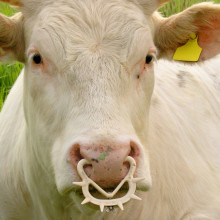
Does red really make bulls angry?
Bulls eyes are dichromatic - they have two colour-detecting pigments in their retinae. That means they can see red, but they can also see many other colours too. But, because they are dichromats they would see colours in a similar way to a colour blind person. In other words, there's nothing special about red; it's more likely to be that the bull is excited by someone wearing silly, bright clothes, dancing about and flapping something in the bull's direction. The bull is generally hot, bothered and fed up, making it more likely to attack. But there's no evidence that there's anything special about the colour red for a bull...
34:24 - F1 goes Green!
F1 goes Green!
with Ben Woods, University of Warwick
We're all being asked to lower our carbon footprint and one area where you'd think this would be nearly impossible is the world of Formula one racing. But scientists are now working on a way to reduce the damage that results from this sport. Meera went along to the Science Museum to find out how.
Meera - Everything you hear about these days has a 'green' or 'eco-friendly' statement attached to it and cars are bang in the middle of it all. I'm sure you've probably heard of biofuels, but how exactly do these benefit the environment?
Biofuels , like bioethanol and biodiesel, are a whole new type of fuel that run cleaner and save those precious fossil fuels. When we burn fossil fuels we release carbon dioxide and increase its concentration in the atmosphere. Biofuels are made from plant sources and as plants absorb CO2 from the atmosphere to photosynthesise, the CO2 released from burning plants in the form of biofuels doesn't produce a net gain in atmospheric carbon dioxide in the same way that fossil fuels do. Fossil fuels release carbon which was previously locked away safely underground.
Basically it's all about reducing emissions. But the image of eco-friendly doesn't really put them in the same league as a Ferrari or a Porsche...does it?
Well, not anymore! because a group of scientists at the University of Warwick have set out to do just that. They plan to get eco-cars not only into this league, but make them better than those flash, mid-life crisis, bank-breaking beasts and get them into the world of Formula 1.
The team recently displayed their results at the science museum in London, so I went along to meet the teams and had a chat with Ben Woods, research engineer on the Warwick team.
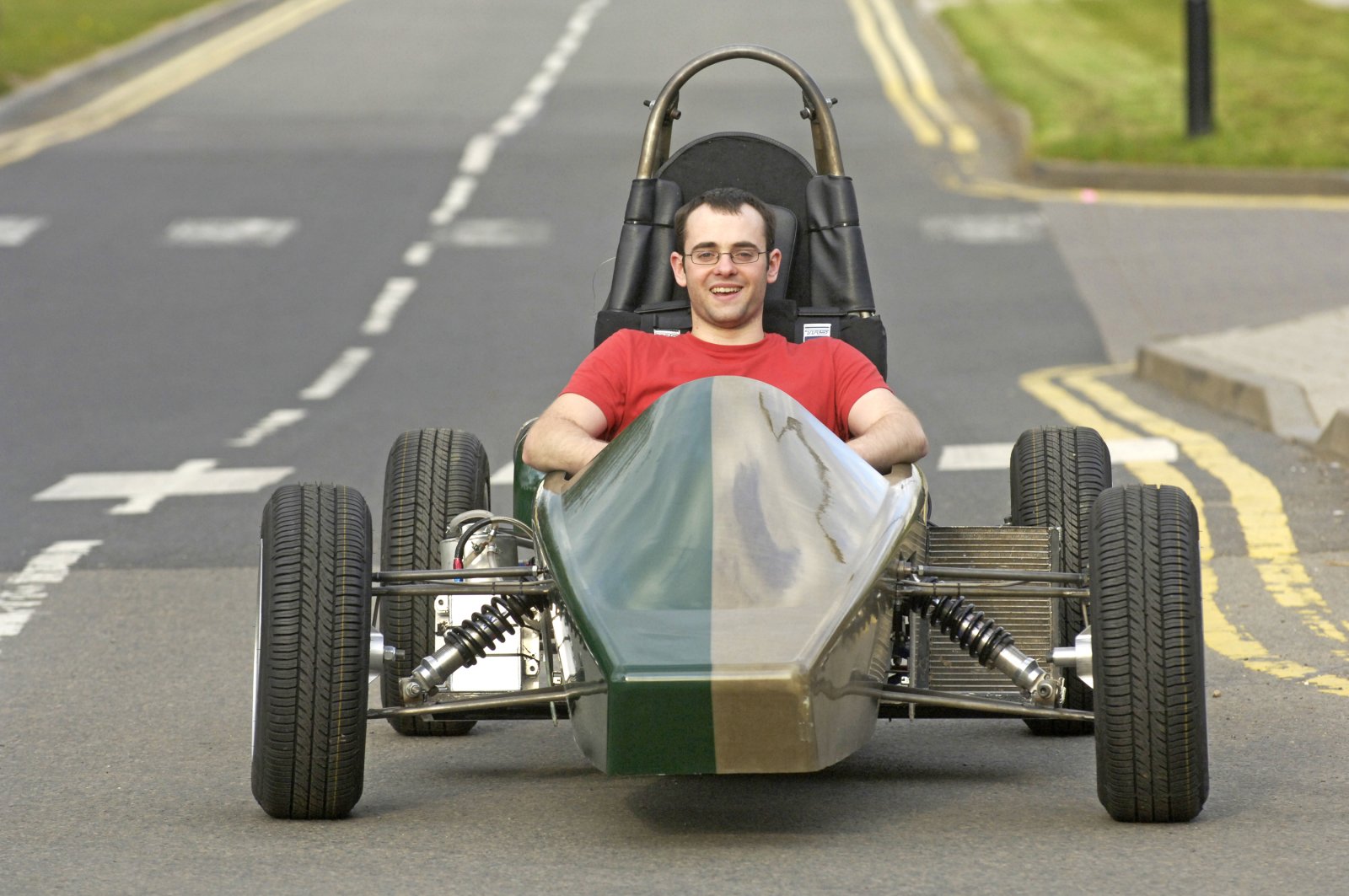 Ben - The bodywork is made from hemp, or marijuana, as some people know the plant as and its held together with a resin made from plant oils. The tyres are made from about 1.5% potato starch which replaces some of the fossil fuels and nasty bits and pieces that go into a normal tyre compound. We've got cashew nut brake pads believe it or not made from cashew nut shells and various other bits and pieces then we have bioethanol fuel made from wheat and oil made from plant oils again, it's completely biodegradable.
Meera - So is this total car biodegradable?
Ben - We think between 90 and 95% is either biodegradable or recyclable. Some of the metal components are recyclable but we can't replace those for safety reasons with environmentally friendly materials. We basically wanted to show that race cars can have a conscience. You can have an environmentally-friendly car that is good to drive and is nice and fun, because quite often the misconception is that they have to be slow and boring, so we've got a car here that has a better power: weight ratio than a Ferrari Enzo.
Meera - Are you going to be racing this? What are you going to be racing this in?
Ben - We're a bit of a victim of our own success in that this is the only car of its type in the world, so its very difficult for us to race anything. We've got Eco² in the pipeline which is the slightly twee name for the second generation of this car. That's going to be a Formula 2000 chassy and basically we'll be hoping to race that using a biodiesel powered engine.
Meera - So could I just ask, how fast does this vehicle actually go?
Ben - Well Eco1 will hit 60mph from a standing start in about 3 seconds, has a top speed of between 140mph and 150mph.
Meera - That's impressive. Are you looking to expand that for your 'squared' version?
Ben - Well that car will have downfalls. It'll have bug wings like a Formula one car so we're hoping it'll be a bit more stable around the fast corners. I've only taken this car up to about 120mph at the moment through fear!
Meera - What do you think the future for more everyday cars is?
Ben - Well we like to think that a lot of the technology and the materials we've used can be carried over to the mainstream automotive industries. Such as the tyres, the oil, the fuels and the brake pads. The body panels can be carried over into other forms of motor sport, and it's excellent doing an event like this because it means we can enlighten people about the material and technologies that are available to them.
Meera - So you're out to prove that eco-friendly cars don't have to be slow and boring?
Ben - Absolutely right, yeah.
So there you have it, the must-have vehicle of the moment is not a gas-guzzling Chelsea tractor but an emission-reducing eco-friendly car. Soon Louis Hamilton could be racing around the track in potatoes and hemp! Just wait and see....
48:51 - The BA Festival of Science
The BA Festival of Science
with Sue Hordijenko, The British Association for the Advancement of science
Every year, the British Association for the Advancement of science hold a festival. They go to a different university each year and the idea is to make science fun and interesting for the masses. Sue Hordijenko is one of the people responsible for making it all happen...Chris - Now what are you going to have on offer for everybody in York?Sue - Well there's about 350 different events, exhibitions, talks, discussions and debates going on across the university of York campus and also in various different locations across the city, starting today [9th September 2007] and going on until next weekend.Chris - And what sort of level of education do people need to have to come to this thing? They don't need a PhD presumably?Sue - No, not at all. It's an extremely varied programme of activities, so it spans across all of the sciences. We like to find scientists who have extremely good communication skills so it's very much aimed at a lay audience.Chris - And what are the highlights? What sorts of things would you say is definitely going to be on your wish list to drop in and see?Sue - Well, when I've finished talking to you, Chris, I'm off to see a talk by Robert Winston, talking at the theatre royal in York. So he's going to be in conversation with broadcaster Sue Nelson, he's going to be giving us an insight into what it's been like working in the area of fertility all of those years, and really what it's like to be a scientist working very much in the media spotlight. So I'm off to see him later and I think that should be very good. Being a bit of a chocolate fan myself, we've got an event on Tuesday taking place on the university campus which looks at some of the scientific issues raised in our passion for chocolate, including the notion of whether or not chocolate addiction does exist.Chris - I think it certainly does, if you ask my wife.Sue - And if you ask me as well... It's also going to be looking at some of the conflicts that have arisen over the years where cocoa is concerned. We've got some events on natural disasters, like earthquakes, that are taking place on Wednesday, should be quite interesting. Also on Wednesday we've got an event that looks at the truth about hypnosis, and an event which looks at rock guitar in 11 dimensions, so I'm sure you're safe from that Chris, there really is quite a diversity of events taking place. Chris - And if people want to come, are they going to have to dosh up loads of money or is this going to be something that they can get good value for money from?Sue - The tickets that are priced are extremely reasonable, and there's also quite a lot of free activities taking place that people can drop into as well.
The BA Festival in York ran from the 9th - 16th September 2007, and the Naked Scientists were there all week! Look out for a special edition series of podcasts soon!
Can unusual fish live in power station outlets?
The water coming out of a nuclear power station should be identical to that coming out of a normal power station, but it would be nice warm water. Chris used to sail near the outlet of a power station and found the water so warm it was like a bath! Because this water is so warm, they've found fish around UK power stations that you would normally find in the Mediterranean, which wouldn't survive a winter otherwise. Also, the warm water encourages other marine species that the fish can feed on.
- Previous The Best of the BA Festival
- Next Naked Science Q&A





Comments
Add a comment