Before Chris and Co get back for the start of the new series, Ben and Diana dive deep into the science of the sea. We find out why cold water corals can act as a climate calendar, how fish feminised by human female hormones have a surprising effect on the ecosystem and discover the marine micro-organisms that keep the climate in check. Also, why the humble garden pond can guard against global warming, and how penguins can be identified by their feathery fingerprint. Plus, in Kitchen Science, Ben and Dave have a unique tea party to find out if the saying 'as useless as a chocolate teapot' really holds (hot) water!
In this episode

01:31 - Studying Corals
Studying Corals
with Murray Roberts, Scottish Association for Marine Science, & Brendan Roark, Texas A&M University
Murray - These are so-called cold water corals or deep sea corals. So these are a different animal to those you would find in tropical shallow water areas. They're not reliant on sunlight, not directly anyway. They're found in deep, cold, dark waters. There are huge developments of these coral reefs off Norway, Scandinavia and their distribution extends down off Britain and Ireland, right across the Atlantic with patches on the Mid-Atlantic Ridge to the American side of the Atlantic off Florida, the Carolinas and round into the Gulf of Mexico.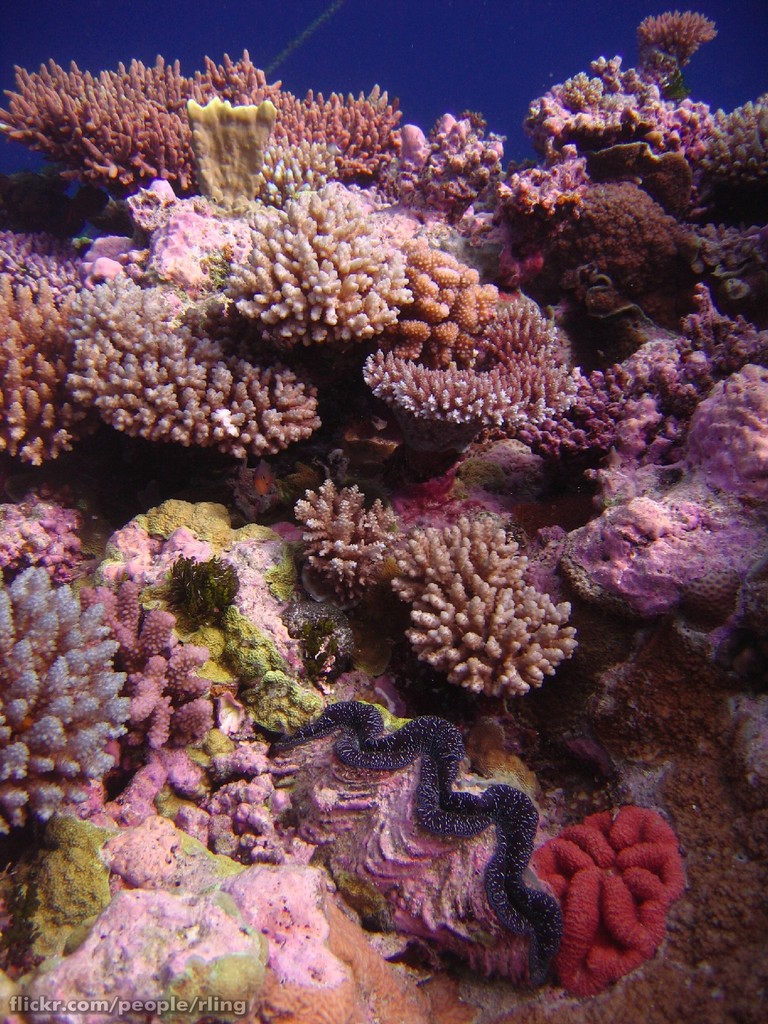
Chris - If they live down there they're not photosynthetic. How do they survive?
Murray - They're surviving on the food that's produced at the surface layers of the ocean, plant plankton. That plant plankton captures energy from the sunlight just as plants do anywhere. Animal plankton will consume that. Some of the corals seem well-adapted to take that animal plankton and eat it - they're predatory. Others seem quite well-adapted to taking remains of the plants that are brought down from the surface. There has to be a critical link between a productive layer in the ocean and a physical mechanism in the sea that gets that and transports it down with fast water currents to the sea bed where the corals live.
Chris - So they're doing a pretty important job of actually translating material which is up at the top of the ocean into biomass, material which is fixed at the bottom of the ocean.
Murray - Yeah they are. What they do in that process is lay down a skeleton. The coral forms a skeleton and that makes a reef, a framework. That forms a reef and that's effectively an underwater city, if you like with high-rise developments where many other species can find a niche. They can find a place to live. When we look at the numbers of species that live in these areas they're amazingly high. Even in areas of the Atlantic that we've studied for the last 150 years we go out to sample these areas and find many species that have never been described before.
Chris - How deep are they down there?
Murray - It depends where you are. They're distribution tracks certain types of seawater, certain characteristics of the sea water. They can be anything from 200m down to 1000m typically.
Chris - How big are the individual coral structures?
Murray - The structures they form can grow very large. Off Scandinavia they may grow to extend up to 13km in length. They grow off the sea floor several metres in height. In other places, in deeper waters we have evidence that coral structures have grown right back through time. They'll grow, form a reef structure that traps sands and muds. In glacial times the corals will die back and other kinds of sediments come in. Then corals start growing again and this process repeats and repeats and repeats all the way back over 1.5-2 million years. Those structures can be hundreds of metres in height.
Chris - Brendan Roark, you've been working on these corals. How far back in time do they go if we've got it right?
Brendan - The carbonate structures that Murray was talking about can go back 2 million years. Individual species or individual specimens we've shown with some of the proteinacious corals from the Pacific have life spans upwards of 2000-4000 years. Chris - Given it's that long-lived, what else can it tell us about the environment it's growing in?
Brendan - As Murray was talking about, the linkages from the surface ocean to the deep ocean are recorded in some of the different types of skeletons on the deep sea floors. You have two different kinds of skeletons made by deep sea corals. One is a proteinacious horn-like material and those are the long-lived organisms typically. That skeleton can record what's going on in the surface ocean. In other words it's deriving all of its carbon from particular matter from the surface ocean. You contrast that with typical carbonate skeleton that corals deposit: those are recording the ambient conditions of where the coral is living.
Chris - It's a bit like tree rings then, isn't it?
Brendan - It's exactly like tree rings. Most of the corals have growth rings.
Chris - So you've got this really powerful, high resolution coral clock which is tracking back what's going on chemically in the ocean for 1000s of years. How far could you take that back, though? A big problem with climate change and ocean temperature models is that we're stuck in the near-term since we've been recording things, aren't we?
Brendan - By collecting dead specimens as well, we have with the gold corals continuous records overlapping the same way you would with tree rings going back 5000 years. We have a few specimens that are as old as ten thousand years.
Chris - What about on the longer time scale though? You said these corals live thousands of years and they may even be millions of years in terms of the time they've been growing where they are. Can you go back literally millions of years?
Brendan - Yes, you can go back millions of years with the drilling in the carbonate mounds.
Chris - Murray, how are you setting about to try and study and improve our understanding of these corals?
Murray - What we're trying to do is set up a transatlantic coral ecosystem study. The idea here is to firstly unify the research right across the Atlantic so that we take advantage of the very exciting place we are right now after ten or fifteen years of work: understanding where the habitats are and mapping them. We're able to go to places within the Atlantic ocean and find carbonate mounds, cold water coral reefs, the kinds of species that Brendan has been talking about, and sample them and bring them into a large study to look at that climate history right across the Atlantic. Also we want to tackle other questions as well. We know they're diverse ecosystems. A thousand species just in the North Atlantic. A number that keeps going up with more and more studies. We've not yet tried to compare that diversity across the Atlantic to understand where these species are found. We haven't tried to compare right across the Atlantic how they're connected genetically. Do we have one area that is the source of the larvae that then disperse across the Atlantic or are they growing in certain areas in isolation from one-another? These are the kinds of questions you can only approach on a big scale. Also to take the most advantage of the expensive resources that are needed for this work we want to share that internationally. If, for the sake of argument, a German ship goes to sea then we're able to take American and Canadian scientists along so they can get the samples that they need. Equally when an American ship goes to sea we want to see European scientists working alongside so we get the most benefit from the investment that we're making here.
Chris - When do you think we're going to see a return on the investment?
Murray - The project starts now. We have our first sea-going planned in October. We want to keep this going for four to five years. We think that within about three-to-four years we'll have our initial results. Of course, as with any project like this the writing period and the analysis period will begin. We'll see the big results coming out in about five years from now we hope.
14:52 - Mapping Our Oceanic Impact
Mapping Our Oceanic Impact
with Kimberly Selkoe, University of Hawaii
Kimberly - We tried to gather as many global scale, high-resolution datasets that covered any type of human activity that influences the marine ecosystem. We tried to put it all together in a single format that we could compare them all and lay them on top of each other and see what the global impact is on the oceans.
Meera - How many impacts did you look at?
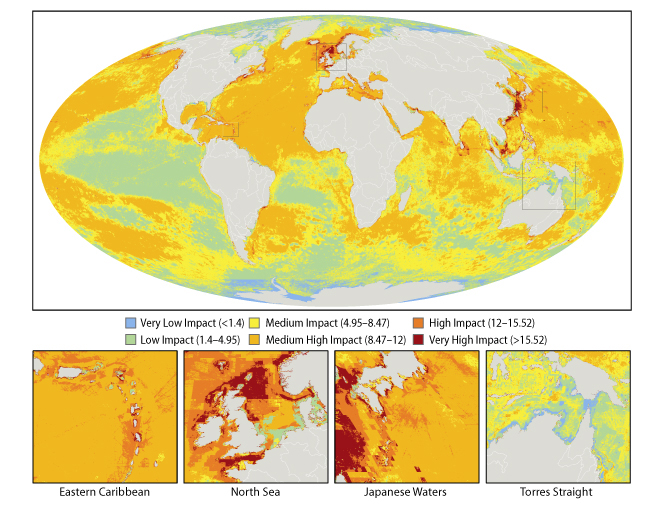 Kimberly - In total we found 17 datasets. We had an original list of 34 different stressors that result from human activities and half of these did not have any global scale data on them. We don't know where these things are going on. For seventeen we did find suitable data.
Meera - Of those 17 did you find out which ones had the most impact?
Kimberly - Yes, we always have to come up with a way to rank. The way that we used had to do with their impact. In that case sea temperature rise was having the largest impact in the most areas of the ocean. That means there are areas that have greater impacts locally.
Meera - How about fishing because that's usually quite a big cause?
Kimberly - It is a big cause. We divided fishing into five different commercial categories and also artisinal fishing. We didn't look at the six categories as a sum, we only looked at them individually. Individually they did not have such a large effect compared to the climate change effects.
Meera - So you've put all this stuff together but what did that show on the map? What areas were the most effective?
Kimberly - There was a large area off of the East China Sea and the South China Sea. Also the northern part of the North Sea stretching into the north Atlantic.
Meera - What are the main impacts, do you think, affecting those areas?
Kimberly - The sea temperature rise was very great in, for instance, the North Sea area. Also there were many types of fishing and very heavy shipping. Shipping had a major impact that we were surprised by in our model. Even compared to fishing.
Meera - Now you've got this map and you've got this information what do you want to do with it? What are the aims of the map?
Kimberly - There are a lot of different things that could be done. It's really a tool to be used by scientists to answer new questions about the spatial patterns that we have generated by human activities in the oceans. It can be used by educators to spread the word about how badly impacted the oceans are. We also see specific uses for policy makers in order to figure out who needs to coordinate to solve some of these problems of multiple uses that are having large impacts.
Meera - What kinds of effects are these impacts having on the marine ecosystem? What's happening to the life there?
Kimberly - The general impact is that it's affecting biodiversity. It's affecting how nutrients are cycled. In the worst-case scenario when there are too many activities for too long an ecosystem can entirely collapse. That means it just shifts into a different state altogether where the species change, the diversity is low. The nutrients cycle in a new way. Often in a way that's not as useful for a human society.
Meera - If this map helps people realise the different impacts having these effects would it be possible to reverse?
Kimberly - Yeah, I think one of the hopeful things about our project is that it provides for the first time a map of where different activities are happening and with that information we can make smarter decisions about how to manage our oceans. We can continue using the oceans and hopefully in a way that will maximise the benefit while minimising the impact.
26:31 - Female Hormones Feminising Fish
Female Hormones Feminising Fish
with Karen Kidd
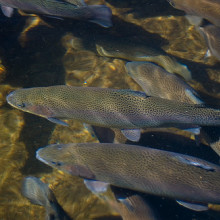
Karen - What we did was a whole lake experiment at the Experimental Lake Area in North Western Ontario. We took the oestrogen that's used in birth control pills and added it to the lake for several summers. The reason that we did this is because there was quite a bit of evidence coming out of the UK in the 1990s showing that male fish living downstream of municipal waste water outflows were becoming feminised. What I mean when I say feminised is that males were starting to produce egg proteins and in the more severe cases they were developing eggs. Several follow-up studies had actually started to link this feminisation in wild males to the presence of oestrogens that women excrete naturally or the synthetic oestrogen that women excrete when they're taking the birth control pill.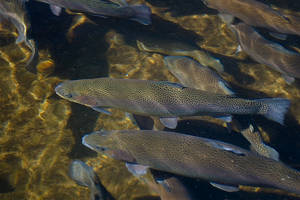
Chris - If you were already aware of that data what were you hoping to learn by doing it in a sealed lake?
Karen - Well, the big question that we want to answer with our study was 'so what does it mean for the fish populations to have feminised males?' Can these males still successfully reproduce or are we going to see them decline in their numbers?
Chris - When you did this what was the outcome of putting the oestrogen in the water?
Karen - Right away the males started to respond as we expected they would so we started to produce egg proteins and in one species of fish the male started to develop eggs after the first summer. These kinds of feminisation responses weren't surprising to us. In the second summer conditions we had quite a surprising response in that the fathead minnow, this is a very common and short-lived species in North America, had stopped reproducing. That led to a collapse in the fish population.
Chris - These fish don't live very long which is why if they stop reproducing their numbers are going to fall dramatically quite quick. What about if you look at fish that live much longer?
Karen - We looked at another longer-lived minnow species, the pearl dace. Their numbers did decline but they didn't decline quite as rapidly or as dramatically as the fathead minnows. That was telling us that yes, the characteristic of the fish, the life histories of the fish really affect how sensitive it is to these oestrogens. The ones that only reproduce once and then die off seem to be much more sensitive to oestrogens than the ones are longer-lived and reproduce several times over their life cycle. What we also saw in our study that was quite a surprise was the impact that the oestrogen had on the longest-lived fish: the lakeshrimp. It seems that the lakeshrimp weren't affected by the oestrogens directly but their numbers dropped in the third year of our study because they lost their food supply. When the fathead minnow population collapsed the lakeshrimp lost some of its prey and that, in turn, led to a drop in their numbers. This was pretty sobering to us because it showed that oestrogens can affect fish populations directly and indirectly through the food chain.
Chris - In other words by having a previously unrealised impact, by knocking down the populations and taking away the food supply your oestrogen is also affecting the fish in another way.
Karen - That's right. It's an indirect effect of this input of oestrogens into our environment that we didn't expect to see in our whole lake experiment.
 Chris - I guess the key question is, we know we're contamination water downstream of sewers and things but if we were to clean up our act tomorrow how long would the repercussions last for?
Karen - I think in our case we saw the fathead minnow population recover in three summers. It does suggest that they can recover quite quickly and certainly that's at the population level but when you look at things like the egg protein production or the development of eggs those kinds of responses in males would go away very rapidly after you removed the oestrogen from the system.
Chris - The other possibility is we just tell women they're not allowed to take the pill any more...
Karen - That's right. I've had that question before so does this mean we should ban the use of the birth control pill? The answer to that is no. We know 100 million women world-wide rely on the birth control pill and the answer really is in better ways of water treatment: making sure the waste water is treated at least with secondary treatment.
32:07 - Marine Microorganisms and Climate change
Marine Microorganisms and Climate change
with David Karl
David - Microorganisms are responsible for the planetary stability and the planetary habitability. Marine microbes are responsible producing most of the oxygen in our atmosphere. They also are the food source for most of the marine food webs that lead up to fisheries and up to humans. They not only capture solar energy and convert that into food that we have some great interest in but they also are very important for the nutrient balance and keep nutrients cycling in the ocean. Nutrients like phosphorous and nitrogen in particular.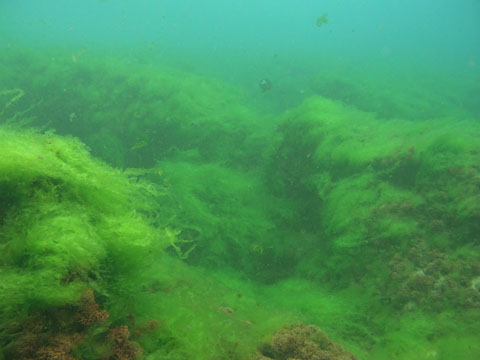
Meera - What aspects of climate change are you looking into that are affecting microbial activity?
David - The climate change that we're mostly interested in is the effect of climate on ocean conditions. This is everything from the temperature of the surface ocean to the ocean currents to the interaction of the ocean with the atmosphere. All of these features set the condition for the environment: the habitat we call it. It's the habitat conditions that decide whether or not a particular group of microorganisms is selected for or against. The ocean habitat is the parameters that define its existence. That's everything from the chemistry of the habitat to the physics of the habitat to the microbes that live there. As the habitat changes so does the population of microorganisms. For example, some microorganisms prefer to live in acid conditions and some microorganisms prefer to live in warm water conditions and so on.
Meera - What are the effects of climate change on the sea temperature and things like that? What's happening to the microbial community?
David - We know based on first principles that as you change the ocean temperature you will deselect for certain groups of microorganisms. It will increase the rates of metabolism. You may change the balance between the production of oxygen and the consumption of oxygen. These are different metabolic properties that have different kinetic constants and different organisms responsible for them. If you change the environment basically what you run the risk of doing is decoupling otherwise coupled cycles of nutrients and energy and dissolved gasses in such a way that we change the conditions of our own planet in part because the atmosphere which we rely on has a very short turnover time. Therefore it has a very rapid response time. All you need is a slight perturbation in gross fluxes of dissolved gases, for example, to have an impact on the atmosphere.
Meera - If these changes were to happen that you've suggested, what are the larger-scale repercussions of that?
David - A lot of that repercussion would be to change the habitability of the planet by changing the oxygen budget of the atmosphere and therefore precluding forms of life that we're used to thinking about like humankind. At some point in time there will be a threshold level of oxygen below which we can't survive and certainly other organisms can't survive either, or a threshold of carbon dioxide that will build up very rapidly. These gases tend to be opposite in sign so oxygen is decreasing in the atmosphere while CO2 is increasing for the same reason that we're burning fossil fuels. Burning fossil fuels consumes oxygen and produces CO2. These are not good effects for humans. High CO2 is not good, low oxygen is not good but high CO2 and low oxygen is even worse. The ultimate repercussion would be that higher forms of life like humans and other vertebrates would somehow have a very difficult time surviving.
Meera - How exactly are you monitoring this? Where are your stations and how are you actually looking into it?
David - In terms of the atmosphere there were probably a million monitoring sites around the globe. In terms of the ocean there are two. Two comprehensive measurement sites: one at Bermuda and one near the island of Hawaii. These are called ocean time series sites and they're only two of a hopefully larger network that will be developed over the next couple of decades. To do the same thing that we're trying to do with climate modelling of the atmosphere - people are all familiar with weather forecasts. If you think about a weather forecast it is derived from more than a million measurements that are being made simultaneously around the globe. We would eventually like to have ocean forecasts that would be not unlike the weather forecast. Maybe more predictable but it would take a million sites around the globe to do such a thing. Probably even more than that because the ocean is much larger than the terrestrial environment that our weather forecasts are focussed. We have a lot of work ahead but it's something that's tractable to start building more observation sites around the globe or at least in sensitive regions of the planet.
Meera - How much time do we have in order to try and sort this out to stop it becoming a very big problem?
David - Well I think we're already behind the timeline here. The climate has been changing radically since we've been able to start measuring it back in the early 50s when we had the CO2 measurement programme. We have now CO2 measuring programmes at maybe 20 sites around the globe. We really have to get going on this because time is of the essence. One thing that might provide a little bit more time might be to find material engineering solutions on the planet that would somehow either slow down the rate of CO2 increase or stop it altogether and people have been thinking about different ways to do this. Any one of these geo-engineering that we develop would have presumably have intended as well as unintended consequences that we need to look at carefully before we adopt these wholesale.
38:14 - Garden Ponds Combat Climate Change
Garden Ponds Combat Climate Change
with Professor John Downing, Iowa State University & Jeremy Biggs, Pond Conservation
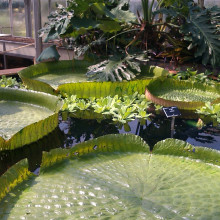
Kat - We all know that trees can take up carbon from the atmosphere, helping to combat climate change. But there's another important place where carbon is taken up that you won't find on most diagrams of the carbon cycle. That's ponds. I caught up with John Downing, professor of ecology at Iowa State University who has just published results suggesting that ponds could play a vital role in damping down the greenhouse effect. I started by asking him what his results show.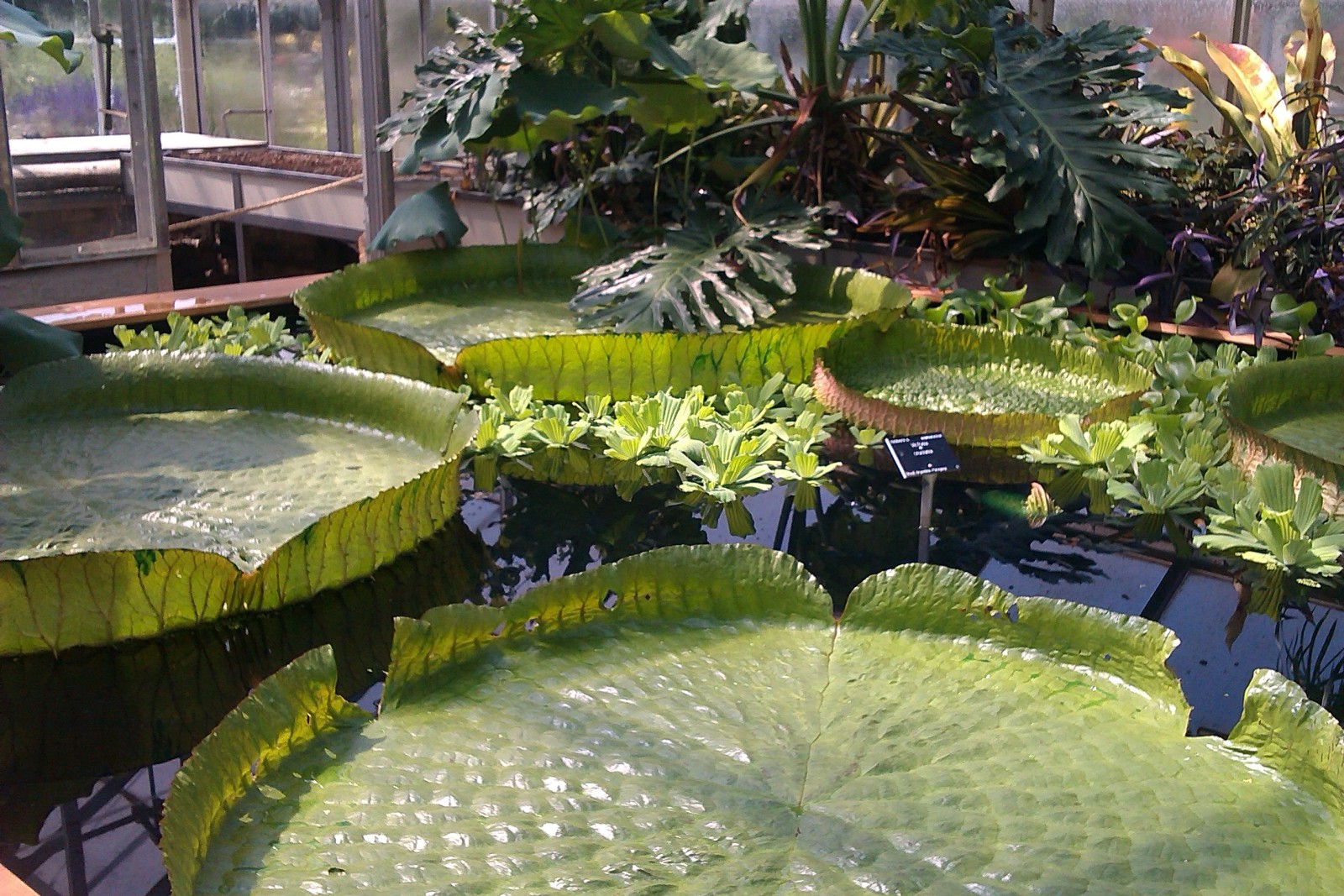
John - Actually it's one of the smallest aquatic systems and the most carbon-active in the biosphere and are probably absorbing as much carbon as the global oceans.
Kat - How did you find this out, that they capture so much carbon?
John - We measured the deposits of carbon and how thick they were and various sediments. We also measured their rate of deposition in little constructed system across the central part of the United States.
Kat - What sort of ponds are these?
John - Farm ponds. Yeah, there are 76,000 square kilometres of farm ponds in the world and they're burying carbon at about 2kg per square metre per year which is a tremendous amount of carbon because they're so active even though they're small. They're disproportionately important to the global carbon cycle.
Kat - So what does this mean, for example here in the UK? Should we all be going out digging ponds?
John - It's not a bad idea really! They are also very nice for recreation, marvellous for biodiversity. We are encouraging people in the United States to build more ponds. They trap a tremendous amount of carbon and in some areas of the world we've taken away a lot of these ponds. We've filled them in, we've destroyed them, we've drained them on purpose, put them back. We're going to actually be able to have a positive effect on the amount of greenhouse gas that goes into the atmosphere.
Kat - So we should be digging ponds rather than planting trees?
John - I didn't say rather than, I said build ponds and then plant trees around them. They're both good things to do.
Kat - Professor Downing's research only relates to ponds in the US. What about the situation in the UK? I spoke to Jeremy Biggs from the charity Pond Conservation to find out what the situation might be like over here, across the pond.
Jeremy - Well, we've just done some preliminary research looking at the effects of ponds in trapping carbon. What we found so far is that they seem to be as good as John is suggesting over here as well. We've done some very preliminary survey so far in the last couple of months or so. We're capturing carbon at just about the same rate as he is in America. That's a pretty exciting result for us because it suggests that they might work as a carbon capture technique over here as well.
Kat - What does this mean for conservation policy and for climate change policy?
Jeremy - Well, it suggests that there's another way of mitigating the impacts of climate change by capturing carbon, taking it up in ponds (if we make ponds of the right size and shape and put them in the right places) then we should have another method for trapping carbon just as we do with trees at the moment. If we do both these things we will actually trap more carbon from the atmosphere and hope to mitigate some of the effects of climate change.
41:30 - Tracking Penguins from Afar
Tracking Penguins from Afar
with Tilo Burghardt, University of Bristol
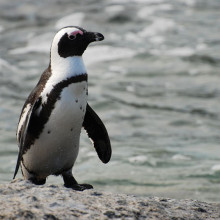
Tilo - What we do is we identify individual animals, in particular African penguins, by their coat pattern. Instead of banding or otherwise tagging animals we use their natural coat better. In the case of African penguins their plumage in order to identify them. African penguins carry a spot pattern on their chest and like humans have unique fingerprints. African penguins have unique chest prints. We've built a computer system that could identify first of all an African penguin in video frame and then extract the chest print and compare it in a database population so we can tell which penguin is where, when.
Meera - You have me wearing this apron onto which a spot pattern has been printed. What do I now do?
Tilo - What you do is walk towards the camera. You'd better waddle actually and then the camera will pick up. It's a simplified system, rather than the real world that will pick up on this spot pattern and will extract it and will assign a name to it. It can identify you as an individual penguin.
Meera - I'm walking up now and it's saying that I'm Pandora.
Tilo - Yes, you're basically one of the penguins. Actually in real life we don't give names to them it's rather numbers that identify them because you couldn't have thousands of names remembered. We then assign the unique identifier like humans have names they get numbers.
Meera - So you're able to spot these penguins, but what's the benefit of being able to do this?
Tilo - The main problem we try to solve here is finding out about the species. The reason for that is the species is in decline. In the last few years about 50% loss in the population count has been found. Just to give you some numbers: about 100 years ago there were more than 1.5 million African penguins while last year's centres gave only 35,000 breeding pairs which is a really sharp decline. We need to find out why. With this technology we can basically play Big Brother over the colony without being invasive so you don't need to catch the animals or tag the animals any more, which is basically interfering with their life. With this technology you then get out information about it which mainly is where, when. We can talk about foraging duration, how long are they out of the colony to get the fish. We can talk about which penguins walk together in groups. Do they have friendships? You can start asking entire new questions that haven't been asked before in the first place.
Meera - How does the actual technology work to recognise the patterns?
Tilo - It is a computer vision system which does the following: the images are transmitted from the camera to the computer and the first thing the computer has then to decide is where in the frame/where in the image are African penguins in near-frontal poses? So basically penguins that show their chest pattern. Once the computer has figured out where they are in the image then the computer has to extract the chest area and the spot pattern within. Once the chest pattern is then available there's a final step to do and that is the matching. Matching of this chest pattern which is, as I said, very similar to human fingerprints to a database of individuals that have already been identified. Basically re-sighting the animal.
Meera - If it doesn't come up in the database it's obviously a new penguin and you would just assign it a new number.
Tilo - Exactly.
Meera - Where are you going to take this next? Are you going to expand it to other animals?
Tilo - Absolutely, I mean so far we are monitoring a colony on Robben Island but first of all there are three other species of penguin you can apply it to. Then on top of that the technology has also been trialled on zebras. Basically anything stripy and spotty, or technically carrying Turing light patterns, can be identified with the technology. For example with the zebra you have a stripe pattern. What you do is you can turn this stripe pattern into spot pattern by simply taking the bifurcation points and ending points of lines. Then you have a spot pattern again and you do what you do with penguins. If you have a look at different images of different animals, different zebras you will find that although they look very similar the details of the stripe pattern are vastly different. They again can be used to identify them as individuals without tagging them.

Why do I overheat after drinking alcohol?
Sarah - Well, he did say normally I get quite cold when I go to sleep and that's quite normal because your body temperature actually drops during the night and it's usually at its coldest about two hours before you get up.
But, when you've been drinking, your liver is madly metabolising all the alcohol, breaking it down to get it out of your blood stream. This is a really exothermic process which means it produces a lot of heat.
Your liver is actually the main heat-producing organ in your body anyway. When it's working extra hard you're producing a lot more heat than usual. Added to that alcohol stops you from being able to thermo-regulate. When you're too hot, you sweat to cool down - the alcohol stops your body from being able to do that. This combined with much more heat being produced by your liver really makes you heat up in the night.
Ben - So it's a double whammy then. The actual breaking-down of the alcohol produces more heat anyway and the fact that there's alcohol there means your body can't cope with that excess heat?
Sarah - Yeah, exactly. Although you can actually see the opposite thing in people coming out of clubs late at night. I'm sure everyone's seen it or done it themselves: the sort of 'beer jacket' effect where you come out in a just a small T-shirt and you're not cold. It's because the alcohol makes you less able to feel the cold.
Ben - This is for when you've gone out and tried to avoid spending the extra pound to put your coat in the cloakroom so you just leave your coat at home. Actually at 3am, you don't notice at all that you're losing lots of heat?
Sarah - Exactly. Usually it's fine but it can be quite dangerous for people who live on the street and if they drink they might not notice it's really cold so it can be quite dangerous for them.
Does your body burn energy keeping cool?
Sarah - This is linked to what I was saying before about thermo-regulating. Your body works best at a certain temperature around 37 degrees centigrade so when your temperature goes below or above that your body will try and reset it to its level at homeostasis. When you're too hot you do things like you sweat and when you're cold you shiver to warm you up. The simple answer is that it takes a lot more energy to warm yourself up because to do that with shivering it's kind of like going to the gym. It's the really fast contracting of your muscles that causes you to shiver. It's like going for a run or doing other sorts of exercise. Obviously that's going to take up a lot of energy whereas cooling yourself down through sweating is a much more passive process. It doesn't take that much energy from your body to pump the sweat out onto your skin so the air is sort of doing the work for us to cool us down. Ben - So as your sweat evaporates off your skin that takes the heat away from you, you're not having to actively remove the heat. Sarah - Exactly.
Ben - But Steve is in Dubai. Surely the processes that people go through in Dubai can't be the same as over here in the UK where, let's face it, it's not very warm.
Sarah - No. I think also not just the heat but the level of humidity in the air is quite important. If it's really humid so there's lots of water already in the air it's obviously going to be a lot harder for the moisture in your skin to evaporate so you will always feel hotter when it's humid than when it's dry. Ben - The same amount of sweating will actually lead to less cooling. Sarah - Yes, because the air is already too full of water for it to take much more from your skin.
Is the Rhesus positive blood group dominant?
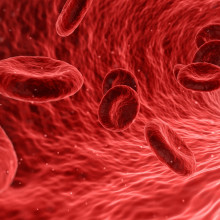
Sarah - The rhesus blood typing system is very similar to the A, B, O system, but it's much more complicated. There's not just three types, it's actually a lot. When people talk about Rhesus positive or Rhesus negative they're talking about the Rhesus D gene. That means that you either have or do not have these particular structures on the outside of your red blood cells. Rhesus positive means that you do have them and Rhesus negative means that you don't have them. He's exactly right that Rhesus positive is dominant. The allele for that is dominant over the Rhesus negative allele. Actually about 84% of the UK population is Rhesus positive.
Ben - So that again (as with the A, B, O system) means that if you have two parents that are Rhesus negative then you're certainly going to be Rhesus negative, but if your parents are Rhesus positive then actually you could turn out to be either. Sarah - Yes. Both of my parents are Rhesus positive but I'm Rhesus negative. Ben - That means we can work out that each of your parents has one copy of the gene saying Rhesus positive and one saying Rhesus negative in order to have passed on the negative ones to you.
Sarah - Yep!






Comments
Add a comment