We go nuclear this week to investigate the future of atomic energy, the issues surrounding nuclear waste management and how a proposed new breed of hybrid fission-fusion reactors might help to boost nuclear fuel efficiency and minimise radioactive waste. Also, following the 65th anniversary of the first nuclear bomb test, we hear how the accidental wilderness created where "the Gadget" was detonated is now a flourishing example of biodiversity. In Kitchen Science we build a home-made radiation-detector and we get to the bottom of why humans kiss. Plus, news of malaria-proof mosquitoes, turning hostile bacteria into safe vaccines and scientific scrutiny of high-heel-induced foot discomfort!
In this episode
01:49 - Making Malaria-proof Mosquitoes
Making Malaria-proof Mosquitoes
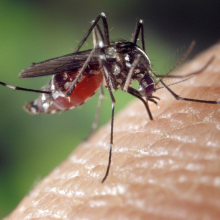
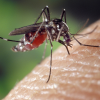
There's been a study published this week in the journal PLoS Pathogens where scientists attempted and succeeded in creating a malaria-proof mosquito. And this is really exciting, because malaria kills around a million people every year, many of them children. It's caused by a parasite called Plasmodium, that infects and replicates inside female Anopheles mosquitoes, before being passed on to the next person. The incubation period in the mosquito is about 10 to 14 days.
So the group from the University of Arizona, led by Michael Riehle, genetically engineered Anopheles mosquitoes to increase the expression of a particular gene in the gut for a protein called AKT. This protein is what is known as 'highly conserved', meaning it is found in many animal groups - both vertebrates and invertebrates - to do the same thing - in this case involved in immune response and lifespan.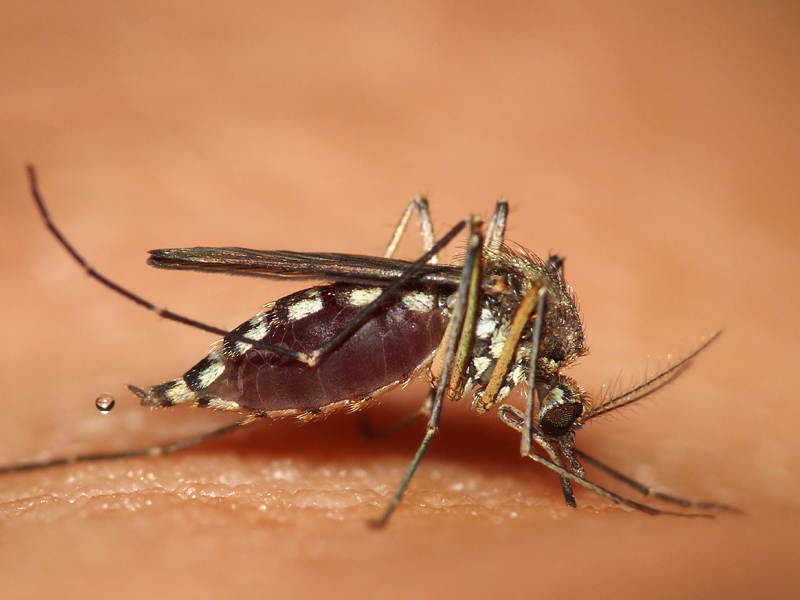
The researchers compared mosquito siblings with and without the engineered gene by feeding both groups an artificial blood meal containing Plasmodium. Ten days later, the team checked the guts of the mosquitoes to see if any of the Plasmodium had successfully formed oocysts, the next stage in their development.
Up to 99% of mosquitoes that were heterozygous for the engineered gene (so with one copy) were found to be parasite-free, and all of the homozygous mosquitoes (with two copies of the gene) were parasite free. There was also a 20% reduction in lifespan. This is an important point, because it takes time for the Plasmodium to develop in the mosquito to become infectious, so shortening the lifespan of the vector is an efficient way of preventing infection.
So what does this mean for the global fight against malaria? Well, Riehle's eventual aim is that engineered mosquitoes would be released, and breed with wild populations, introducing the engineered gene to reduce Plasmodium infection and shorten mosquito lifespan. This is obviously still quite a way off, but it's a really encouraging first step.
04:43 - Killer bugs tamed with a dose of the Arctic
Killer bugs tamed with a dose of the Arctic
Scientists have found a way to tame hostile bacteria and turn them into docile vaccines, by replacing key genes with those from the bugs Arctic counterparts!
Writing in PNAS, University of Victoria, Canada, researcher Barry Duplantis and his colleagues reasoned that some of the essential genes carried by bacteria that have evolved over billions of years to live in very cold climes will most likely be optimised to those temperatures. So exchanging some of these genes for their equivalents carried by warmth-favouring pathogenic bacteria could produce a temperature-intolerant, disabled bug that could function as an ideal vaccine.
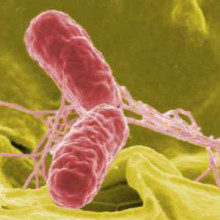
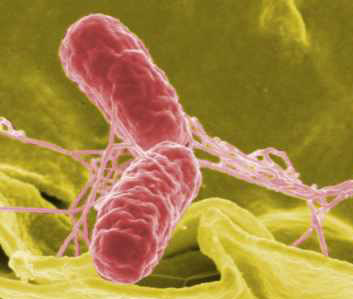 To find out, the team tested out nine genes known to be critical to survival in all known bacterium; the gene sequences were first "cloned" from bacteria that flourish in the Arctic and then inserted into the chromosomes of Salmonella and Francisella bacteria and also a Mycobacterial species related to TB, replacing the native gene.
The modified bugs grew unhindered at low temperatures, but grown at higher temperatures the bacteria suffered stunted growth. Injected into a cool spot on the bodies of experimental rodents, the modified bugs, which are usually fatal, instead provoked a robust immune response allowing the animals to fend off a lethal dose of unmodified bacteria which were administered a few weeks later.
This suggests that the technique could be used to produce a host of safe, temperature-sensitive live vaccines capable of protecting people against significant pathogens including Salmonella and TB.
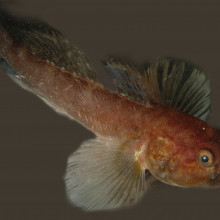
08:09 - Gobies fight against the 'Rise of Slime'
Gobies fight against the 'Rise of Slime'
Well it's been rare in recent times to find a positive story about life in the oceans, but this week, researchers from the University of Bern in Norway have shown that there is a species that is unexpectedly thriving.
The study, published in Science is about a fish called the bearded goby, Sufflogobius bibarbatus, and it seems to be an unexpected winner in an ecosystem that had been severely damaged - the Benguela upwelling system off the coast of Namibia. In the 1960s, aggressive overfishing, combined with environmental changes in the area, led to a collapse of the sardine population and a shift in the structure of the ecosystem. There was a massive rise in jellyfish numbers, and the sea bed was covered in an anoxic, sulphurous mud layer.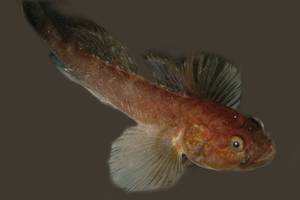
But the team led by Anne Utne-Palm found that the bearded gobies seemed to be thriving. They showed through a series of very elegant behavioural and physiological experiments that they were able to hide in the low oxygen mud on the sea floor from predators, and to feed on the bacteria in the mud. They turned down their metabolism to survive in the low oxygen sludge, ascending up into the more oxygen rich layers of the water under the safety of darkness to digest their food. They also munch away on the jellyfish, returning what were previously thought to be 'dead end' resources back to the food chain by then becoming prey themselves to larger fish.
The researchers see the goby population as a kind of stabilising factor, able to buffer the local fisheries against changes in environmental conditions in the future - if oxygen levels go down, goby predator numbers will go down, the goby population will increase, and will allow the larger fish populations to recover once conditions become more favourable.
It's really quite a promising finding, because it shows that it is possible for an apparently collapsed marine ecosystem to recover.
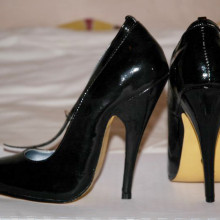
10:01 - Why high-heels are habit-forming
Why high-heels are habit-forming
High-heel tottering fashion slaves often complain that stepping down to normal footwear is extremely uncomfortable following the elevating effects of a six-inch height boost. Now scientists know why.
 In a paper in the Journal of Experimental Biology, Manchester Metropolitan University scientist Marco Narici explains how he used newspaper ads to recruit over 80 women with at least a 2 year, 5 cm high-heel history, 11 of whom reported discomfort when walking without their heels.
Ultrasound measurements of the calf muscle lengths amongst these women showed significant shortening - by 13% - of the muscle fibres compared with non-heel wearing controls.
At the same time, MRI scans showed that the Achilles tendons of the two groups were the same lengths, indicating that the tendons of the heel wearers had not lengthened to compensate for the shorter muscle length, although the heel wearers tendons were nonetheless thicker and stiffer than those of the controls.
Consequently, walking on flat-feet becomes uncomfortable for these people because the tendon cannot stretch sufficiently to compensate for the altered posture.
11:48 - The problems with Nuclear Waste
The problems with Nuclear Waste
with Dr Ian Farnan, Cambridge University
Ian - Well when we're talking about nuclear energy to generate electricity, what we're talking about is controlling the reaction of a neutron with a heavy element such as Uranium 235. What we do is we divide up the uranium into pellets and put those pellets into fuel rods, and those fuel rods are then clad in a zircaloy, an alloy cladding. What that allows us to do is to have, between those rods of fuel, water and control rods which are made of neutron absorbing materials. The way that the water and the control rods slow down the neutrons, is that it controls the rate at which that uranium atom splits. It's the fission of that uranium atom that we're trying to control with nuclear energy.
Meera - So essentially, you're bombarding Uranium atoms with neutrons and breaking the uranium apart to release energy?
Ian - That's right and the neutrons come from the uranium itself, so each fission of the uranium has on average about 2 ½ neutrons produced during that fission event and those neutrons go on to split further uranium atoms. And so what happens is that then you split the uranium atoms and you'll get different fragments produced of other elements. So you're transmuting the uranium into two roughly equally sized smaller elements.
Meera - But how much energy does that release say, in comparison to fossil fuels?
Ian - Well typically, you might expect a tonne of uranium produces as much energy as a million tonnes of coal, for example.
Meera - So that's quite a big difference.
Ian - Yes, that's a very important difference because when we're talking about waste products, for example carbon dioxide from the burning of coal, there's an enormous amount of carbon produced from that million tonnes of coal whereas the waste products from the nuclear energy is much, much smaller.
Meera - Well what are the waste products? So you split this uranium and then what's produced?
Ian - You get various products from the uranium fission. So typically, you might have barium and zirconium, then there is some distribution of different elements below those. The neutrons which are in the reactor also activate other elements, but it's within the fuel and within the steels which make up the reactor vessel. Those elements might be Cobalt 60 or Iron 55 for example.
Meera - Now I guess the important difference though, when it comes to nuclear energy, is the risk associated with these waste products. Which of these are a concern and are they different as well?
Ian - Well, when we take the fuel out of the reactor, it can be separated basically into three types of waste products. There's the fission products that I've already mentioned, there's neutron activation products, and then there are what's called the actinides; uranium which is still the vast majority of the nuclear fuel, there still uranium dioxide, then you have plutonium and some other heavier elements; americium, and curium. So you need to handle these materials in different ways and a standard way in this country has been to reprocess the nuclear fuel rods and put the fission products and the neutron activation products into a glass. This is a process called vitrification. You can dissolve up the nuclear fuel rod in acid and then separate the heavier elements like uranium or plutonium, leaving you with an acidic, highly radioactive liquid which is then dried and made into a boro-silicate glass.
Meera - And are these radioactive elements quite stable within this glass?
Ian - As far as we can tell, they seem to be pretty stable in the glass. The glass itself is not often tested because it's extremely radioactive and it's very hot. Typical centreline temperatures of a glass canister will be over 400 degrees centigrade. So the glass is immediately poured into this canister. It is molten glass at 1100 degrees C but the radiogenic heat keeps the temperature of the glass very high. So the glasses themselves are not really examined but they seem to be quite stable.
Meera - But when it comes to radioactive elements, the important thing to consider is their half-life. So 'how fast are they going to decay?' and I guess the faster something decays, the more risk it is immediately to you. So these fission products actually differ quite a lot in say, their half life and their radioactivity to the other heavier actinide elements, don't they?
Ian - That's right. One of the advantages of separating the fuel by the reprocessing process is to separate the fission products which have shorter half lives, typically 30 years for Strontium 90 or Caesium 137 after say, 300 years which will be 10 half lives, the radioactive load of those materials would be low enough that we wouldn't need to worry about it too much. That means that a lifetime or the guarantee that the repository has to provide for the safety of the materials is much shorter, typically a thousand years or so.
Meera - The big concern then or the main concern when it comes to the waste are then these heavier actinide elements because they've got quite a long half life. So they're a concern, long into the future as well.
Ian - That's exactly right. So the elements like uranium, plutonium, americium - actinide elements - are very heavy. They decay by what's called alpha process and their half lives are typically say, for plutonium, 24000 years, so you'd have to wait 10 half lives, so say, 240,000 years for that to decay to some sort of safe level. There, we run into problems. If we want to guarantee the integrity of the geological repository site over those sorts of timescales, we're less certain about how the geology of the site will change, we're less certain whether the metals of the canisters will last, then start to get concerned about how water will progress through the repository, interact with these packages of nuclear waste, and water is the only way really that that material can come back up to the surface and enter the biosphere where it would be dangerous to humans and animals.
But it's a very interesting question because we're looking at timescales now where Homo sapiens are only about a quarter of a million years old ourselves and now, we're looking that far into the future. So, what will the human race look like at that point in the future when we want to guarantee the lifetimes of these repositories? It's very, very difficult to provide that guarantee. We can probably make a pretty good shot at it, but people want guarantees and that's a very, very big challenge for scientists.
19:16 - Hybrid Nuclear Reactors
Hybrid Nuclear Reactors
with Dr Bill Stacey, Georgia Institute of Technology
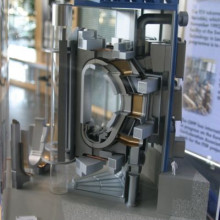
Chris - Radioactive waste produced by the nuclear industry is a very big problem. About 12,000 tonnes of it get produced around the world every single year and at the moment, it needs to be stored somewhere. But what if there was a way to take this waste and actually use it as a fuel instead? That might sound too good to be true, but scientists think that it might be possible by building a nuclear fusion reactor that's nestling inside a fission reactor. This hybrid reactor will then be able to produce large numbers of extra neutrons that can be used to burn off the waste inside the reactor, and therefore make much more efficient use of the nuclear fuel. Bill Stacey, is from the Georgia Institute of Technology. He's with us to explain how this could work. Hello Bill...
Bill - Hi.
Chris - What's the general idea about this? How does it work? What's the concept?
Bill - The basic idea is the actinides that Ian was just mentioning are all fissionable in certain types of reactors: instead of burying them, just put them back in reactors and burn them, which means to fission them. That's much easier said than done because it turns into competition for neutrons because as the fission products build up and the fission products are also competing for neutrons, it's hard to keep the reactor running. So, there's a need for a few extra neutrons. The idea of the fusion/fission hybrid is to have a fusion neutron source that provides these extra neutrons for the fission reactor that's burning up the actinides and spent nuclear fuel.
Chris - Basically, what you've got is in the core of the reactor and at the moment with a fission reactor, where those fuel rods are with the pellets of uranium in them, the waste products that build up as the reaction goes on prevent the reaction from happening very efficiently. In the end, you end up having to take the rods out even though only a tiny fraction of the fuel has been burned. So if we could find a way of getting more bang for the buck by burning off the waste products with extra neutrons, then we'd save a whole lot of money and save a whole lot of waste as well.
Bill - That's right. The waste products that we're talking about burning off are primarily the actinides that are left in the fuel so they are unburned fuel for all practical purposes. The waste products that are the fission products also are competing for the neutrons. The problem is to get a few more neutrons and that's where the fusion idea comes in because the fusion reactor, that would be in the centre, would be producing extra neutrons, and you can dial up a number of extra neutrons that you need. In this way, you can keep the fission reactor running a lot longer and enable it to burn off the actinides. Basically, the efficiency of doing this is that you can probably reduce by at least a factor of 10 the amount of material that would have to be stored in long term geological repositories. That means you would reduce by a factor of 10 the number of repositories that you had to build and that's substantial.
Chris - Talking practically though Bill, we can't even get a fusion reactor to work at the moment sustainably, how practical is it to try and get one that we could then have in the core of a nuclear power station that's a fission reactor. You're going to put one kind of reactor inside another reactor. It's huge, isn't it? 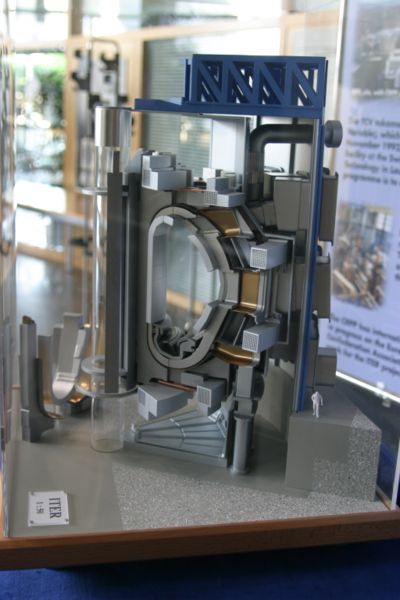
Bill - Yeah. This is an idea that's been around for a long time because of the arguments that I just made, but the thing that's different now is that it is feasible to talk about building a fusion reactor. The ITER project which is being built in Cadarache, in the South of France right now will have a fusion tokamak reactor that if we just took that technology and that physics, that would be sufficient for the neutron source for a fusion/fission hybrid. That device is being built now. It will start operating in about 10 years and 10 to 20 years from now we'll demonstrate the physics and the technology that's needed for the neutron source. So I think we would say that to be able to deploy something like this, starting in about 2030 or 2040 is a feasible thing.
Chris - What about the safety aspect? Because you'd have a very, very hot and very, very powerful fusion reaction going on in a core of a super critical fission reactor. Is there not quite a big element of danger there?
Bill - Well, not really because if anything happens to the fusion reactor - the [core of the] fusion reactor is a gas like the sun, and basically, the problem is to keep it from going out. If anything happened to it, you would just end up with a spoonful of liquid hydrogen in the bottom of the vessel. There are of course interaction problems that have to be taken into account in the technology to do this, but it's not as if you've got an uncontrolled sun in the middle of a fission reactor.
Chris - Just to look at the numbers to finish this off, apart from the waste issue, and you mentioned the 10-fold reduction in that at least, how much better would this be than what we can achieve at the moment with standard fission?
Bill - Well, that's the question that really needs to be evaluated. The benefit of going with fission/fusion, as opposed to going with just a standard fission reactor to do this job, is that you can leave the fuel and burn it for longer. That means there would be fewer re-processing steps and so fewer re-processing facilities. That means more efficiency in burning up the fuel, so fewer repositories. The other thing is that that since each of these fission/fusion hybrids can use reactors that are completely fuelled with spent fuel you wouldn't need so many of them as you would if you had just conventional reactors which could only be partially fuelled with spent fuel. In fact, we've done some calculations and we estimate that a nuclear fleet that were sort of 75% light water reactors (LWRs) and 25% fusion/fission hybrid reactors would do this job very well. Whereas if we were talking about a nuclear fleet made up LWRs and just plain fission burner reactors, it might be more like 75% the burner reactor and 25% LWRs. So it's a matter of efficiency.
26:51 - The Super X Divertor
The Super X Divertor
with Professor Swadesh Mahajan, University of Texas at Austin
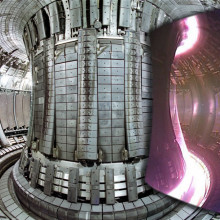
Chris - One of the obstacles of having a hybrid reactor is that you need a fusion reactor that's small enough to fit inside the fission reactor and yet at the same time, be sufficiently powerful to drive the nuclear chain reaction. In fact, to work in a hybrid reactor, you'd need a fusion reactor that's about five times more powerful than the ones we currently have. What limits the power of fusion reactors at the moment is how to make an exhaust system that can cope with the extreme super-heated gases that need to be vented from the reaction process. But researchers at the Institute for Fusion Studies at the University of Texas in Austin have come up with a new way of handling the exhaust. They're calling it the Super X Divertor and Swadesh Mahajan is here to explain how it works and partly also what the name means. Swadesh, hello.
Swadesh - Hi.
Chris - Tell us first of all, before we get into the Super X Divertor, what's the structure of a fusion reactor? How does it work and what's the problem that you're trying to solve?
Swadesh - Typically, what you have is superheated plasma, as you said, and when certain conditions are satisfied, it can have enough fusion reactions to produce the much-wanted neutrons. Now of course, you raised the question that when there is so much doubt about fusion being a reality, how could we really talk about the fusion reactors being stuck inside a fission reactor? Although producing direct energy from fusion may be in the very distant future, there is another aspect of fusion that is its ability to produce neutrons which could go and aid the fission reaction. That particular goal is well within our site, and in fact, we are going to simply depend on that. This Super X Divertor that one is talking about essentially became a necessity because we need to make a fusion reactor which produces a copious supply of neutrons and at the same time, it has to be sufficiently compact that we can load it in and take it out of the standard fission reactor. For that, you require enormous energy densities. It's not necessarily that the total power is more than ITER, but that power densities are about five times more than that of ITER.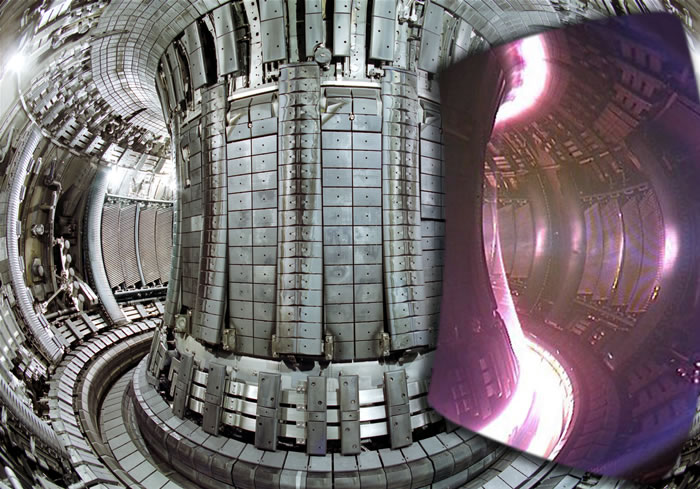
Chris - So it's going to be a material science isn't it: the demands you're placing on the reactor infrastructure are far and away beyond what the materials we have today are capable of delivering?
Swadesh - You said it absolutely correctly. What we are going to do is develop a scheme so that we do not depend on wonder materials. We're going to just learn to live with the materials that we have. The important thing, then, is that a better confined plasma has to have a better concentration of magnetic fields outside the plasma which is connected to the external world (and the external world means walls). The divertor has a special wall which is designed so that the hard plasma goes and finds a resting place there and if we use the standard divertor which for instance ITER uses then of course, it'll be far too inadequate in being able to handle the enormous heat and particle fluxes which a high power density compact machine will produce.
Chris - I get it. Just to translate a little bit: at the moment, a fusion reactor has got the fuel in the centre of the reaction vessel at very high temperature, 100 million degrees or more, and this is being held in situ by very powerful magnetic fields.
Swadesh - Correct.
Chris - It's going to produce exhaust gases which have got to be vented. At the moment, trying to vent those through existing materials, the demands are too high for those materials, so you've come up with this very clever way of taking the exhaust in a sort of circuitous route around the wall of the containment vessel so that it loses some of its heat into that wall, bringing it down to a temperature that the materials can handle.
Swadesh - Right. In the process of its transport from the main plasma to the wall, we do two things to it. We make it travel a very long distance along the magnetic lines so that it loses a fair amount of energy in this process. Furthermore, we do what's called flux expansion so that they expand in area so that the impact on a square metre of the wall material becomes considerably less in this case which is confirmed by state of the art [analysis] by a factor of five less. Therefore, we just cross that threshold so that the powerful fusion module which is replaceable, which can be taken in and out of a fission reactor, can actually be thought of as a near-term possibility.
Chris - So it's looking like it's genuinely real. Just to finally finish off Swadesh, what do you think is the ultimate benefit of moving into the fusion regime, rather than just doing nuclear fission like we do at the moment?
Swadesh - Actually, I would say that what we have right now is an intermediate regime where fusion and fission are cooperating. In order to make them cooperate, one has to work very hard because these two are extremely complicated technologies, and the progeny, to be beautiful, you have to work extremely hard to get it there. I believe that with the Super X Divertor, as I've called it, possibilities have come into existence. I believe that within the next 15 to 20 years, a real hybrid can be actually put together if there is a sufficient amount of funding and interest. Once you have that, I can imagine an era of nuclear energy which is quite green and quite abundant, and in fact, the fuel for this is produced in a reasonably proliferation-resistant manner - much more proliferation-resistant than, for instance, centrifugation.
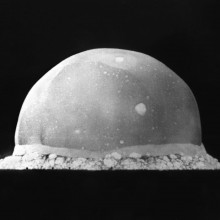
33:34 - Trinity - The site of the first Atomic Bomb Test
Trinity - The site of the first Atomic Bomb Test
with David Wolman
Sarah - Now, on the 16th of July 1945, the project code name Trinity was put into action. Trinity was the first test of an atomic bomb, the first nuclear weapon. The bomb, nicknamed the Gadget, was detonated in a remote area of New Mexico and the test heralded the birth of the atomic age with the "fat man" atomic bomb being detonated over Nagasaki in Japan, less than a month later. Sixty five years on, the test site is hard to access and rarely visited, but journalist and author David Wolman risked the radiation to find out more about this historic site. Hi, David.
David - Hi there, Sarah.
Sarah - Welcome to the Naked Scientists.
David - Thank you.
Sarah - Why don't you start off by setting the scene for us a bit. Where exactly is the Trinity site and what's it like?
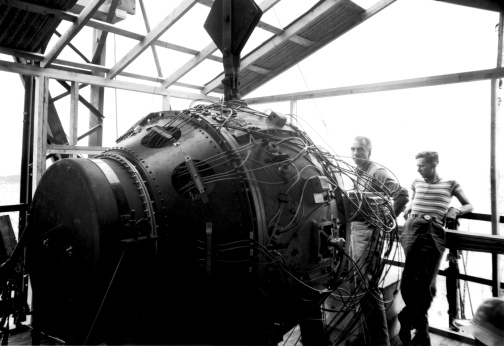 David - Sure. Well in the Southern part of the already rather desolate state of New Mexico, there is this giant swatch of land that the military owns. Today, it's called White Sands Missile Range and one spot within that area is a of sort desert basin and blaring sunshine, and creosote and sage brush, and mesquite. You have this black obelisk now standing to mark the spot at ground zero where the first atomic bomb was detonated. And at that time, almost everyone in America didn't know what was happening down there and it was chosen not surprisingly because it is so incredibly remote. There were some people around there who needed to be evacuated and no-one lives there now, but it is safe to visit, and for the past 30 or 40 years or so, twice a year, I think it's the first Saturday in October and in April, the public is allowed to visit the Trinity site.
Sarah - What's it like when people go to visit there? I mean, what sort of thing do people expect to see when they come?
David - Well, another journalist and I joined a caravan of cars leaving from the nearby town of Alamogordo. Because it's in a currently active missile range or military installation, you're not really allowed to colour outside the lines when you visit Trinity and so, you meet up with this caravan, have a brief security check, sort of like going to the airport and then we drove about an hour into the dessert. And when you finally get there, there's sort of a large gravel parking lot with a lot of people, a lot of SUVs it seems from Texas, and there are a couple of stands selling hotdogs and people selling books about atomic history, and then you walk down a corridor that's marked off by a chain link fence with some barbed wire on the top. And there are signs on it that say, 'Caution, radioactive active materials' beyond the fence, but the radar activity there is not a health hazard, I should say that right off the bat because I probably wouldn't have gone if it is!
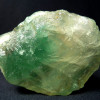
Anyway, you walk down this long corridor through the dessert. It's very dusty and sunny, so sunny. And then you finally get to a large enclosed area, still with the fencing, and that's where the obelisk sits and people are wandering around, sort of kicking their shoes in the dirt and in the dust because of course, there's a sign that says, please don't handle the Trinitite which is this glassy residue that is this light greenish colour rock that exists in the area that was created by the blast. And of course, there's a sign that says, "Trinitite is government property. Please don't pick it up and handle it." And so, that immediately makes everybody want to look for the stuff. And in fact, it's all over the place. I took a picture with some in my hand, but I figured as a journalist, I better not take any out of there, at least not right about it because that would be trouble.
Sarah - Well, it's this first thing people do, isn't it? You tell them not to do something and they go and do it.
David - Exactly.
Sarah - When you visit - when you look at it, would you know that it was the site of the test at that or is it actually, you know, surprisingly biodiverse or is it very obvious that some huge explosion happened there?
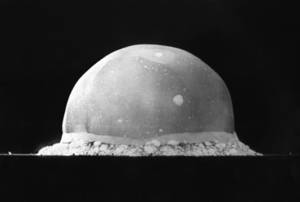
David - It's really not obvious. I think in the 60s, they bulldozed a lot of the residue and the glass that was created. And so now, you have a lot of this kind of sage brush desert landscape. It's a little more mountainous in the distance than I had imagined. Being from New England myself, I had always pictured it as flat as a pancake, as far as you can see, and in fact, it's sort of this basin area tucked between two mountain ranges. But you really wouldn't know from a distance and of course, there's this 8 or 10 foot tall stone obelisk there and a little monument, but you know, I was a little surprised not to see anything, for example, commemorating the war dead. This is certainly a science pilgrimage. It's not a war memorial. You know, the people there are wearing t-shirts with a periodic table on them, but still, it's a little strange that the tenor of the thing with the hotdog stands and nothing about dead people which is maybe an editorial for someone else to write, but a lot of people there are just snapping pictures, and are really excited to be in the centre of where this great scientific achievement happened regardless of your politics. And so that part is really interesting to me, but from a distance, you would never, ever know and in fact, you know, what brought me to Trinity and also to some other spots around the west this spring was this project I was working on called Accidental Wilderness because this area around Trinity, the White Sands Missile Range is still off limits to the public.
For the past 60 years, you have this flourishing ecosystem there because there are no people. There's no roads, there's no houses, there's very little public disturbance. And so, that is really an interesting irony and the same story can be told for a dozen places across the American west where the military has set out this great boundary and says nobody really can come inside here except maybe some wildlife biologists now and then. And the result is some of the most vibrant ecosystems and biodiversity rich areas left really on the continent.
Sarah - Well that's very exciting. So out of something quite violent can come a good story for biodiversity. Thanks so much, David. That was David Wolman and you can find more of his articles on his website at david-wolman.com.
How much does nuclear waste storage cost?
We put this question to Professor Swadesh Mahajan from the Institute for Fusion Studies at the University of Texas in Austin....
Swadesh: - Yes. The Yucca mountain site which was designed by the US folks - of course not with a tremendous amount of enthusiasm - was expected to cost about $90 billion to $100 billion and it would've stored waste of about 40 years of operation of 50 to 100 nuclear reactors. So if you really try to just divide it to all over, I think it adds just a few cents to the cost of electricity.
Chris: - And, of course, you've got to factor in the environmental impact which is that we're not releasing CO2 as Ian Farnan said. We're sparing, for every ton of uranium, the equivalent in CO2 terms, of a million tons of coal.
Swadesh: - Right. The very important thing of course is that it's very difficult for us to be able to engineer too many such repositories with 10,000 to 200,000 years of lifetime. So I think we should have a minimum number of them and if nuclear energy is going to have a renaissance, we really must destroy this before we store it. Destroy as much as we can, if we reduce it to 10% or to 1%, the better it gets. We are not going to be able to get a hundred Yucca mountains if the nuclear energy were to take off for instance, which is what will be needed if we try to store untreated waste. That's a political as well as a physical impossibility. So we must destroy this.
If nuclear waste is hot, can it be used as an energy source?
We put this question to Professor Swadesh Mahajan from the Institute for Fusion Studies at the University of Texas in Austin....
Swadesh - Yes, it can be, but when an actinide fissions inside a nuclear reactor, it produces about 200 MEV of energy. That means a large amount of energy in a single reaction. Anything that you might be able to get from the geothermal thing will be about a factor of 40 to 50 less. So it will be a tremendous wastage of the actinide energy, just to get it in the form of geothermal energy from the waste. Chris - And also, presumably taking into account the infrastructure you would have to plumb in in order to recover the heat from the storage materials. It just wouldn't be financially or from a safety perspective, viable, would it?
Swadesh - Too little energy for that much investment.
How do you control a nuclear reaction?
Chris - They use what are called control rods - these are dense materials which, when dropped down into the reactor, soak up some of the neutrons that are produced by the nuclear chain reaction. The consequence of that is that there are fewer neutrons left to bust open other uranium or fissionable nuclei, and as a result, the chain reaction is slowed down. By putting the fuel rods in, or drawing them out, you can speed up or slow down the chain reaction, and therefore, you can affect how much energy actually comes out of the reactor.

50:58 - Is there an evolutionary advantage to kissing?
Is there an evolutionary advantage to kissing?
We put this question to Gordon Gallup, Professor of Psychology from the State University of New York at Albany...
Gordon - We think that kissing is part of an evolved courtship strategy and that kissing conveys information at an unconscious level about health and a person's reproductive viability.
We've discovered that among the majority of undergraduates that we've surveyed, they report (both males and females) having been attracted to someone, only to discover on one or more occasions that after they kissed them for the first time they were no longer interested. So we think there are hardwired unconscious mechanisms that come into play at the moment of a kiss based on the exchange of information, based on posture, and odour, and taste, and smell that activate mechanisms that come into play to make a determination about whether continuation in this relationship would be in the person's long term reproductive best interest. We discovered that females place a lot more emphasis on kissing than males do. Females not only kiss for purposes of mate assessment, but once females are in committed relationships, they continue to rely on kissing as a means of monitoring and updating the status of their relationship. Males on the other hand tend to kiss for one or two reasons. Primarily as a means to an end. Namely for purposes of gaining sexual favours, or as a means of attempting to achieve reconciliation.
Diana - A kiss might tell us something of our partner's fertility and Gallup found that the majority of females used kissing to check on their relationship whilst males see it as a stage in getting to sex. Though this likely isn't true of everyone - Gallup also hypothesises that during a kiss between a male and female, some of the men's testosterone may be transferred to the female. Over a long period of time, this could affect her libido.







Comments
Add a comment